

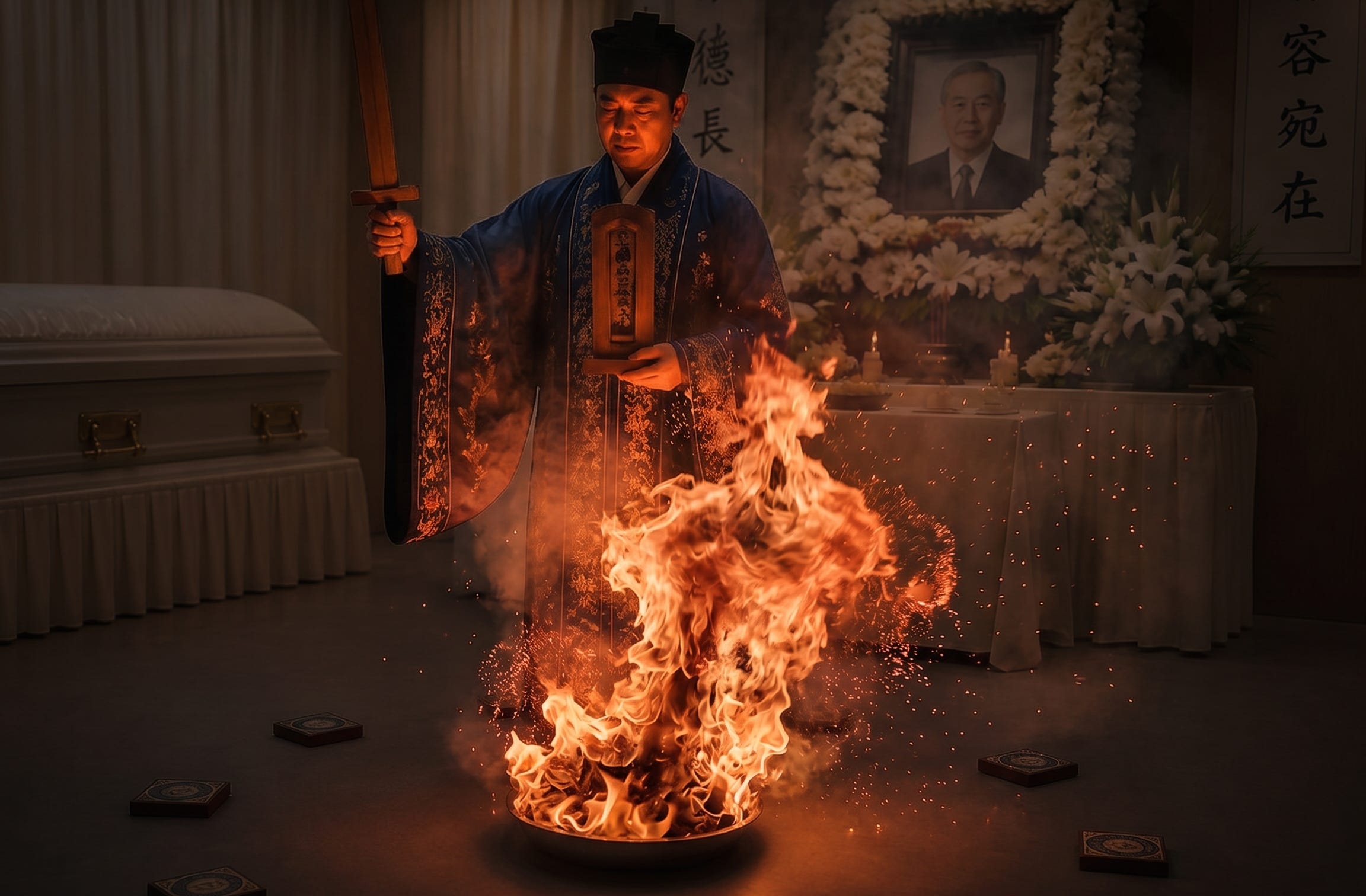
Recently, I watched The Last Dance, a Hong Kong film set in the world of funeral work, centred on Po Di Yu (破·地獄). The literal translation of Po Di Yu is “Breaking (the gates of) Hell.” I see it as a kind of “jail-break.”
I didn’t quite expect the movie to have such a strong impact on me.
I used to be dismissive of Chinese funeral rituals. I saw them as noisy, superstitious, and unnecessarily dramatic. This prejudice changed as I grew older, and watching this film now, I feel something stirred inside me. There is wisdom embedded in Po Di Yu, not just a commercial performance for the dead. It is a structured way for the living to mourn and deal with the shock of losing a loved one.
The movie follows Dominic, a wedding planner whose life was turned upside down during the pandemic and who ended up taking over a funeral parlour. He clashes with a traditional Daoist priest, Master Man, because Dominic approaches funerals like an event to be managed, while Man treats them as a sacred rite with strict rules. Over time, it becomes less about the business and more about what rituals do for the living: giving grief a form, and families a way to act when they feel helpless.
I’m not writing this as a movie review. I’m writing because it moved me, and poses the question: when someone dies, what can we, the living, do for them?
That’s where Po Di Yu comes in.
If you want to watch it, there’s an official trailer on YouTube. As for where to watch it: in Australia, it’s currently available on SBS On Demand and can also be rented or bought on Apple TV or YouTube.
Death comes to us all.
Death is traumatic as it is disruptive.
In the immediate hours, there is usually a lot that needs to be done. Practical stuff, like calls to make, relatives and friends to inform, arrangements that need to happen while you are still trying to digest what just happened.
The truth doesn’t sink in immediately. They’re gone. Forever. The person you have loved for so long is no longer here.
It feels like something from you has just been ripped out. Violently. Just a sudden…end. Like hitting a brick wall as you turn a corner.
Grief is often described as sadness, but in the first moments, it feels closer to helplessness. You want to do something, but you cannot.
This is where a Cantonese Daoist funeral rite offers something strangely practical: Po Di Yu (破地獄), or “Breaking the Gates of Hell.”
It’s a rite performed for the dead, a spiritual intervention meant to free the departed soul from the underworld, Di Yu (地獄), and help guide them toward reincarnation.
But it also gives the living a sense of agency at a time when they feel most helpless.
What happens when a person dies
In the Chinese worldview, death marks a transition, not an end, unfolding in stages.
Traditional beliefs hold that the spirit has three aspects after death. The earthy (po, 魄) soul remains with the body in the grave. The ethereal (hun, 魂) soul settles in the ancestral tablet for family veneration. A third aspect, sometimes referred to as the spirit (shen, 神), journeys through the Ten Courts of Hell (Di Yu) before reincarnation.
That underworld journey typically unfolds over forty-nine days, marked by weekly milestones.
The seventh day, Tou Qi (头七), carries special weight. The spirit is believed to return home. Families keep the lights on for them. They’re also told to stay in their rooms and not come out to meet the spirit because attachment can make it difficult for the departed to move on.
These beliefs offer a clear sequence to navigate the haze of “after”, transforming death from a sudden void and shock into a predictable process, one that even the living can participate in at every step. This is the classic function of mythology in Joseph Campbell’s traditions.
Di Yu, a bureaucracy of the afterlife
Di Yu isn’t framed as the eternal damnation in the Western sense of Hell.
It’s closer to a bureaucratic purgatory, a system where souls atone for the wrong they’ve done before they are allowed to re-enter the cycle of rebirth.
A common way Di Yu is described is the Ten Courts of Hell, a kind of underworld bureaucracy, each court presided over by a Yama King, a judge who listens, weighs, and decides.
The first court is a kind of pre-trial. A reckoning in which the life lived is exposed. The good and the evil, what was done out of kindness, what was done out of bad intentions, what was left undone. The soul arrives disoriented and vulnerable, and the journey begins with the unveiling of truth.
The middle courts are where consequence takes form. These courts are corrective and punitive, to extract a punishment for the wrongs one has committed while alive. In Buddhist tradition, one will be punished BY one’s sins, not FOR one’s sins, so that ultimately, you are also the judge of the life you live. Everything has to be accounted for, and debt has to be paid. And the spirit moves from chamber to chamber, through judgments and suffering that are meant to cleanse.
The Naihe Bridge marks the threshold, a slender crossing from the known world into the unknown. It captures the image of a loved one departing for a place where we cannot follow. It is the final letting go.
Then comes Meng Po’s soup of forgetfulness. A reset. For rebirth, the soul must release its hold on its past life; no grudges, no yearnings, no bonds can follow into the next life. The soup grants complete severance. A clean slate.
So, death and the journey through the underworld aren’t all horrible.
It’s a process of letting go and moving on. Not to pass away but to pass from one life into the next.
What the Daoist priest is doing in Po Di Yu
Po Di Yu is often treated as the main spiritual rite in a Cantonese Daoist funeral. On the surface, it’s about helping the deceased, guiding the soul out of Di Yu and toward reincarnation. At the same time, it gives the family some structure to hold onto when the shock of death makes everything feel unreal.
It is also a very physical ritual.
The space is set up to represent the underworld. A fire basin is lit at the centre, commonly described as the “Furnace of Hell.” Around it, usually 9 ceramic tiles are arranged, representing the gates of Hell.
When the Nam Mo master (喃呒师傅) enters, he is doing battle. He is there to jailbreak.
He carries a ritual sword and uses it throughout the rite, but the sword is not “his” power in the personal sense. In Daoist ritual logic, he acts under a borrowed authority (from the gods), granted through ordination, lineage transmission, and the celestial bureaucracy he is licensed to invoke.
A properly ordained priest receives registers (lu, 箓) that function like credentials. These registers link him to a named lineage and, in many traditions, list the divine officials, generals, and spirit soldiers he can lawfully petition or command during ritual. Without that ordination framework, the actions are unauthorised.
That is the background for why he “dares” to do what he does in Po Di Yu. When he swings his sword, he is not claiming personal dominance over the underworld. He is issuing orders as an agent of higher powers, backed by the gods and ancestors of his tradition, and by the ritual office he has inherited and maintained through training.
Scholarly descriptions of Daoist ritual practice are explicit about what the sword signifies in this context: it is a key implement used to convene spirits, mobilise divine agents, subdue harmful forces, and, in mortuary settings, to “break open the prisons of hell” and help liberate the dead.
So when the sword cuts the air, it is a visible sign to the family that the priest is acting with divine authority and, within the ritual’s protocol, opening the way for the deceased to move forward.
The first major action is the breaking.
The Nam Mo master moves in a circuit around the fire, chanting and working with his sword. Then he strikes the tiles one by one, breaking them. This is the “破” in Po Di Yu, a physical act that represents smashing through the gates of hell, so the deceased is no longer trapped.
After the tiles are broken, the rite shifts into the “guiding” phase.
The master takes up the deceased’s memorial tablet (荐位 or 牌位), holding it close as he leads the spirit through the threshold. At the pivotal moment, he whispers to the tablet, loud enough for the family to hear, “跟住我” (Follow me!), giving the deceased a clear instruction as he spits alcohol at the flames, then makes a dramatic leap across the flames to the other side.
“跟住我” (Follow me!)
In the common explanation, that jump is the “crossing over,” the embodied claim that the deceased is being led out of hellfire and away from bondage. The symbolism is clear and psychologically assuring: the passage has been opened, and the dead are being brought through it.
Why does it matter to the living
Po Di Yu assumes that the dead do not always move easily from one state to the next. A soul can get stuck, held back by the weight of karma, fear, confusion, or unfinished business. In that context, passages can be obstructed.
Without intervention, the spirit may remain trapped, unable to cross the Naihe Bridge and reach Meng Po’s soup of forgetfulness, and enter reincarnation. The 49-day underworld journey can last forever.
So the Daoist priest becomes an envoy. He isn’t a grieving family member. He acts as an agent, trained, authorised, and “registered” within the ritualistic system, someone who can enter the underworld to do a mission. He does for the dead what the family cannot do, no matter how much they love the deceased. He “breaks the gates”, clears obstacles, and pushes the journey forward.
But if you look closely, the emotional centre of Po Di Yu is family and loved ones witnessing the rescue.
Death also creates a kind of hell for the living. It takes away agency. It turns you into a helpless witness. You can only watch while someone you love becomes unreachable. There is nothing you can do to change the fact. That helplessness is often what people are really reacting to in the early days of grief. That helplessness is hell on its own.
Breaking the gates of hell also serves to free the living, to help them move on.
It gives structure to the tragedy that affects them. It provides a mythical sequence of actions to guide the psyche out of emotional turmoil. It creates the sense that love can still be expressed as a duty, and that duty can still be carried out even after the person is gone.
The bond that continues after death
A lot of modern advice circles around the idea of “closure,” as if the goal is to shut a door and move on. But many people don’t experience grief that way. A more accurate phrase from grief psychology is “continuing bonds”: the idea that the relationship doesn’t disappear but changes form. You don’t stop loving the dead. You learn how to live with them differently.
Chinese ancestral practices make that idea visible through rituals.
This is why many families maintain a small shrine or altar at home, why there is incense on certain days, food offerings on festivals, visits to the cemetery, and the careful keeping of a tablet. On one level, it’s devotion. On another level, it’s practical. It gives the relationship a place to live after death, so the dead are not sealed away as “the past,” and the living are not forced into “closure”, or pretending the bond has ended.
Po Di Yu fits into this same idea.
The rite frames the deceased not simply as “gone,” but as someone still on a journey that can be supported. That framing does real work. It turns grief from loss into responsibility and care. It gives love somewhere to go, in a form that feels legitimate.
In a Confucian frame, filial piety doesn’t stop at death. If anything, death makes duty more explicit, because you can no longer rely on everyday acts of care. Maintaining the shrine, remembering dates, performing rites, and offering incense are ways of staying accountable to the people who came before you, and by extension, to the standards they represent. You answer them.
This is why small actions matter so much in these settings. Lighting incense is a way of keeping a presence. Offering paper money is to provide, it is the same impulse as packing food for a parent or paying a bill when they no longer can. Standing close enough to witness the Nam Mo master “break the gates” is not passive observation; it’s a kind of participation. It’s saying: I am still here, and I am still doing what I can for you.
For many, when you love someone, your duty to them does not end at death. It continues in the form of these rituals.
Writer’s note
You don’t have to share the metaphysics of Di Yu or reincarnation to understand what this ritual is doing. I invite you to recognise the humanity underneath it: when someone dies, love continues. Po Di Yu is one traditional answer to that continuation.