

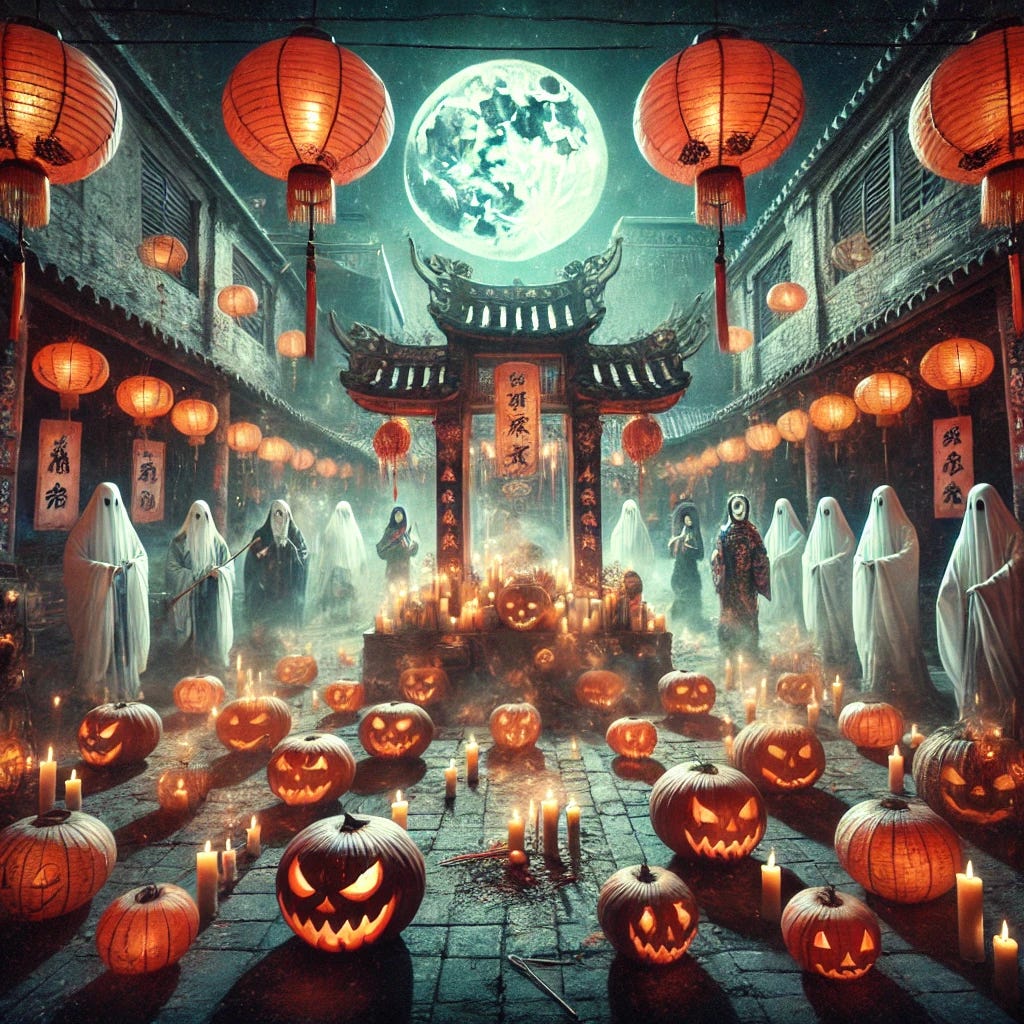
Today is Halloween.
Tonight, kids will dress up in costumes, tell ghost stories, and revel in the thrill of the spooky and supernatural. Homes everywhere are decorated with cobwebs, skeletons, jack-o’-lanterns, and ghouls, creating an eerie atmosphere that captures the excitement of the occasion. Many will join in the festivities, collecting heaps of candies and goodies while embracing playful frights and good fun.
We didn’t have Halloween when I was growing up in Singapore. We came across it occasionally in American movies, but otherwise; it made little an impression until we moved to Australia. It’s quite an important thing here.
But many of our Australian friends would not have heard of the Chinese version called the Hungry Ghost Festival, or 中元节 (Zhōngyuán Jié). This “Chinese Halloween,” if you like, takes on a very different character. It is, to me, scarier and more sombre.
My wife often tells our friends and her colleagues that it is not something we joke about.
The Hungry Ghost Festival

This is an important event celebrated by Chinese communities worldwide. Unlike Halloween, which is centred on spooky fun and trick-or-treating, the Hungry Ghost Festival is rooted in ancestor worship and helping the wandering souls of the underworld.
(Note: The underworld “Diyu” (地狱) is sometimes described as Hell, but I feel it is not quite correct. Hell is a Christian concept. It is eternal punishment for sins committed, and quite permanent. The Chinese underworld is more a purification process before reincarnating into the next life. Payment for one’s karmic debt, and quite temporary.)
During the seventh lunar month, the Chinese believed that the gates of the underworld open, allowing spirits to roam freely among the living. This month-long observance is marked by various rituals, offerings, and communal gatherings, all intended to honour the dead and appease the restless spirits. A kind of spiritual R&R.
The air is thick with the scent of burning incense, and you will find food offerings and joss sticks along the pavement in housing estates. There is also a feeling of caution and apprehension throughout, as if just around the corner, one might accidentally bump into a “Good Brother” (好兄弟, “hǎo xiōng dì”).
Chinese avoid saying the word “ghost,” which is unlucky. It reflects a sense of respect and acknowledgment, as we believe that speaking about ghosts openly might attract unwanted attention. By referring to spirits as “Good Brothers,” we hope to show a friendly attitude and maintain a harmonious relationship with the spirits during the festival.
Historical and Cultural Context
So where did this practice come from? The central myth associated with the Hungry Ghost Festival is originally Buddhist. The story is about Mulian (not Mulan), a devoted disciple of Buddha, who discovered that his mother had fallen into the realm of the hungry ghosts (a.k.a. Underworld) and how he wanted to help her.
The underworld is a place where spirits go to after death. Some may suffer from constant hunger and thirst because of their karma. In this realm, these spirits could not eat or drink anything they were offered, as everything would turn to ash and disappear just before it reaches their mouth.
In the story, Mulian was deeply distressed to learn of his mother’s suffering and sought help from the Buddha. The Buddha instructed Mulian to make offerings and perform prayers on the fifteenth day of the seventh lunar month. These efforts provided relief to his mother and helped her reincarnate sooner.
This story became the foundation for the Hungry Ghost Festival, emphasising filial piety and the importance of making offerings to relieve the suffering of our ancestors and the wandering spirits who may not have families to make offerings and pray for their relief.
My Experience Growing Up
Growing up as a Christian, I was told that these are the “works of the devil”. That I should avoid and never get involved. There is the usual condescending attitude towards pagan practices among Christians, without really understanding the cultural significance of these.
During the festival, everywhere there’s joss-sticks and “hell money” (冥币, míngbì) burning, and loud and colourful Getai, staged performance of Chinese opera and popular singers performing to an audience of empty chairs in front. It is both creepy and fascinating.
And although we were told not to believe in these superstitions, we were also warned about doing things that might upset the spirits. It was strangely confusing for a young catholic boy.
When I was working…
Where I used to work, the Hungry Ghost Festival was a big thing. For the salespeople especially. There is a huge fundraising committee who organises banquets and auctions for hundreds of people on the 15th day of the seventh lunar month, with food and almost unlimited alcohol that went on through the night.
The highlight of the event was the Auction of Lucky Charms. This is a unique aspect of the festival. These auctions, where items such as talismans, statues, or symbolic objects believed to bring good fortune, are auctioned off to the highest bidder. Sometimes, a piece of charcoal (black gold) can go for several thousands of dollars!
The proceeds from these auctions are usually donated to local temples or to fund next year’s festival. Taking part in these auctions is an act of merit, believed to bring blessings not only to the bidder but also to their family.
Winning a lucky charm is thought to offer protection and good luck throughout the year. The lucky salesperson will display his or her prize at the table or front of the showroom, often with supernatural confidence in the coming year.
You can tell how serious this event is. For a salesperson to bid $8,888 for a plastic talisman meant one has to really believe in it.
I always felt that these auctions were fun and exciting. People shouting out their bids at the top of their voice and drinking too much brandy can also be the formula for building community, doing charity, and pursuing personal prosperity. What a combination!
Lest we forget
Today, such festivals are more important than ever. Like the Mexican Day of the Dead, Japan’s Obon, and All Souls’ Day in Catholicism, these festivals remind us of all those who went before us. We light lanterns and sweep their graves. We honour them just like many other rituals that we now practice. Lest we forget.
For someone who has moved to Australia, traditions like the Hungry Ghost Festival provide a vital link to my past and my ancestry, and provide a foundation in the values and practices passed down. It is no accident that on days like today (Halloween); I feel nostalgic about the past.
The Hungry Ghost Festival also offers a sense of identity and belonging, reminding me of where I come from and the importance of maintaining that connection, especially in a still unfamiliar society.
While my children are completely unaware of these customs, I hope that one day, they will experience it, and understand their heritage a little better. I would like for them to sit through a Hungry Ghost Festival celebration, with the auction and all. I hope it can help foster in them a sense of respect for cultural diversity and the richness of the past.
For me, it also teaches values such as respect, compassion, and responsibility—qualities that are often overlooked in our pursuit of progress. Through these rituals, we are not just honouring the dead, but also reinforcing the importance of empathy and community in our lives.
My thoughts and memories…
There were many other practices that I was told to observe during this period:
Always knock before entering an empty room, or house to announce your presence.
Avoid walking about at night when “good brothers” are out and about.
Avoid going for a swim because those who drowned tragically might revisit these places.
If you need to take a leak in the bushes, announce your intention ahead: “Excuse me. Blind man peeing…”
Do not disturb offerings along the side of the road when you see them.
The Hungry Ghost Festival has given me an interesting perspective on life and the afterlife. While I am an atheist, I suspect that when the time comes, my consciousness may transcend into another realm. And based on the quality of my life, I might find myself in the underworld, yearning for spiritual relief.
Unlike Christianity, Buddhists believe we are punished by our sins, not for our sins. That’s why we all have to repay our karmic debt. No one, not even Buddha, can save us. We can only pray and make offerings to help those who suffer in the afterlife, but ultimately, we are all responsible for ourselves.
We have to work diligently towards our own salvation.
The Hungry Ghost Festival is something worth preserving and sharing. It is a reminder of the need for empathy and care for the community, even those in the afterlife. It is remembering of our ancestors, and honouring the wandering spirits who are really our “good brothers and sisters”. It is a calling for us to fulfil our duties as members of our community.
I hope you enjoyed this article. While "What Matters" is free, I do appreciate your support as a paid subscriber. If you don’t do subscriptions, you can also buy me a coffee. Either way, it means a lot.
Thank you for being here. Please remember to like, restack, and comment.
