

“The cave you fear to enter holds the treasure you seek.” — Joseph Campbell.
There is a scene near the end of Pirates of the Caribbean: Dead Man’s Chest that I will never forget.
The kraken has come for Captain Jack Sparrow. The Black Pearl is going down. His crew has rowed away in the longboat. Jack has finally worked himself free of the mast he was chained to, and for a moment it looks like he might escape.
Then comes the realisation that there’s no escaping this time.
He straightens his coat and puts on his pirate cap. He looks into the open jaws of the monster rising out of the sea. He draws his sword, says “Hello beastie,” and charges straight into its jaws.
I have thought about that scene often. It is not a heroic finale but more like an instruction for me when my time comes to face my kraken.
The hand that says do not fear
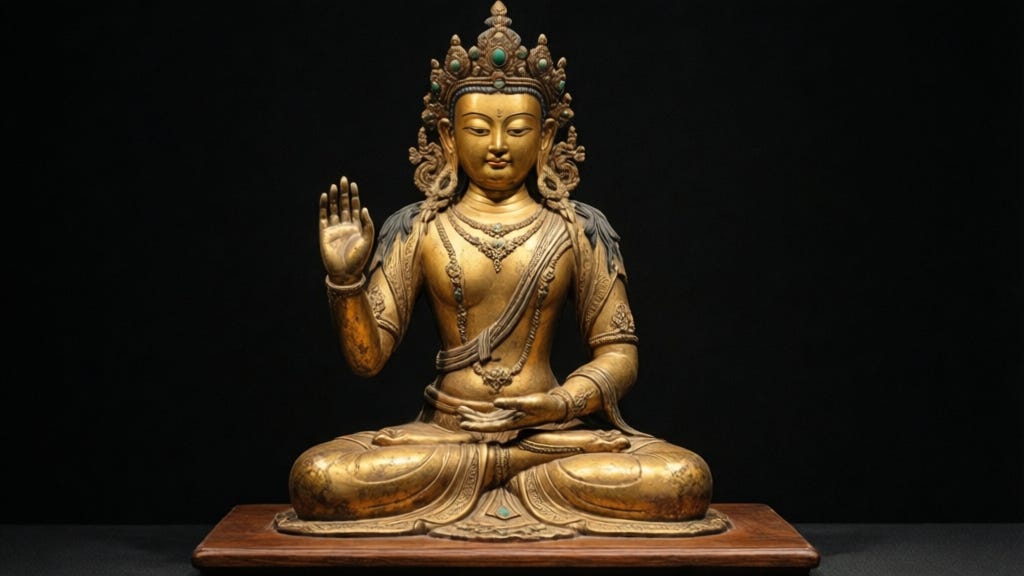
There is a hand gesture that appears across the world’s religions. Right hand raised, palm out, fingers up. In Sanskrit, it is the abhaya mudra. “A”, meaning not. “Bhaya”, meaning fear. It means “do not fear.”
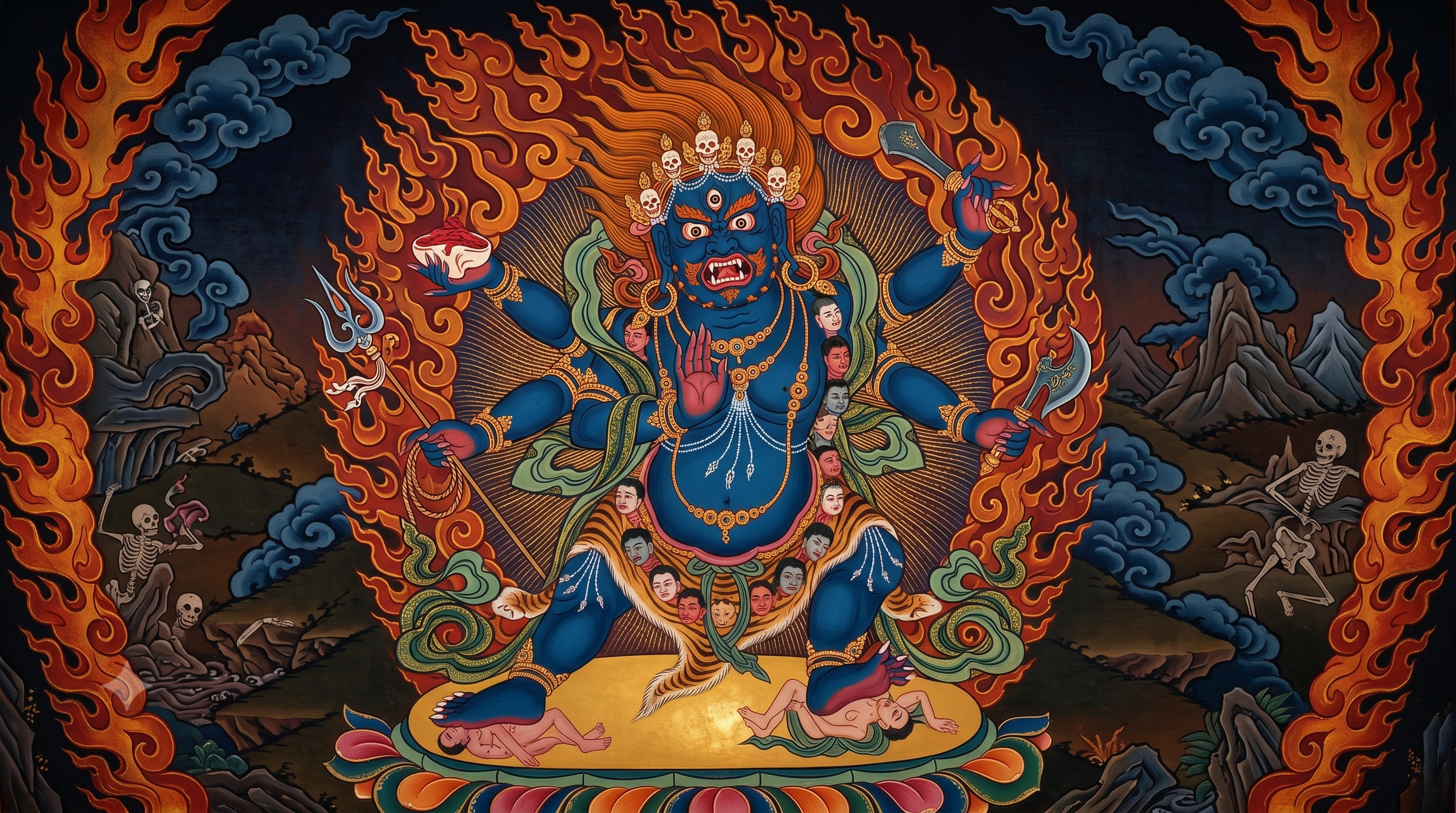
You find it in serene Buddha statues. The Bodhisattva. But you also find it on the wrathful deities of Tibet, figures wreathed in flame, hung with skulls, baring fangs; everything about them was built to terrify. And there, in the middle of all that horror, the same calm hand.
Do not fear.
Why would you visualise a god to look like your worst nightmare and then have it tell you not to be afraid? What did the people who made these understand?
What we are afraid of
If you have read Joseph Campbell’s The Hero with a Thousand Faces, you will see the same idea everywhere. The hero leaves home, crosses the threshold into the darkness, and, before he can return changed, something in him must die.
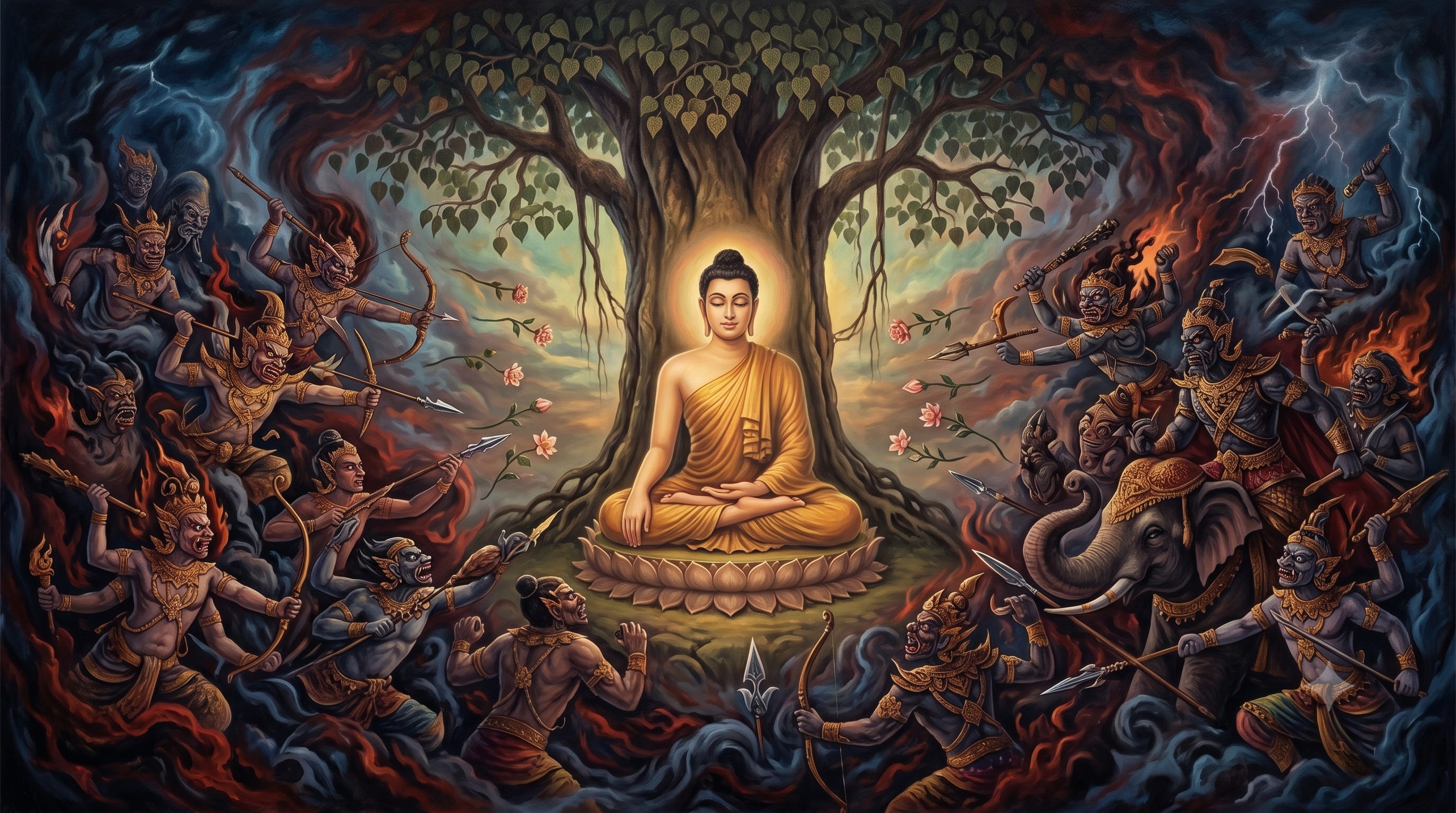
Hercules goes down into the underworld for his final labour. Odysseus sails to the land of the dead to consult the prophet Tiresias before he can find his way home. Jesus is crucified before he rises. Arjuna, on the battlefield in the Bhagavad Gita, watches his whole sense of who he is collapse, and Krishna has to walk him through to the other side. And the Buddha sits under the bodhi tree, set upon by Mara, the lord of death and desire, wearing every terrifying face of fear.
It is not the body that has to go. It is the self. The old “I,” with all its certainty about who it is, has to die. Campbell called it the hero’s death. Later writers called it “Ego death.”
That is the thing we are afraid of. Not the ending of the body, but the ending of the self. The name, the story, the accumulated sense of being someone. The identity. We say we fear death, but what we cannot bear is the idea of becoming nobody. Nothing. When there is no more “me” to notice that there is no more me.
Contemplate that thought and watch what happens. You will see the terror, the face of Mara, the jaws of the kraken. The mind will not entertain it for long. It reaches for a distraction, for a belief in the afterlife, for faith, God, anything.
That is the fear.
What do the old teachings do with it?
If I return to the image of the wrathful deity, the one made of fire and skulls, but with a single calm hand raised. I think I understand.
This gesture appears at the threshold. At the moment when we are faced with our own mortality. It is not a promise that nothing bad will happen, but that something is about to happen, right before your eyes. The raised hand does not describe the outcome. It is not a consolation. It is a posture. An instruction.
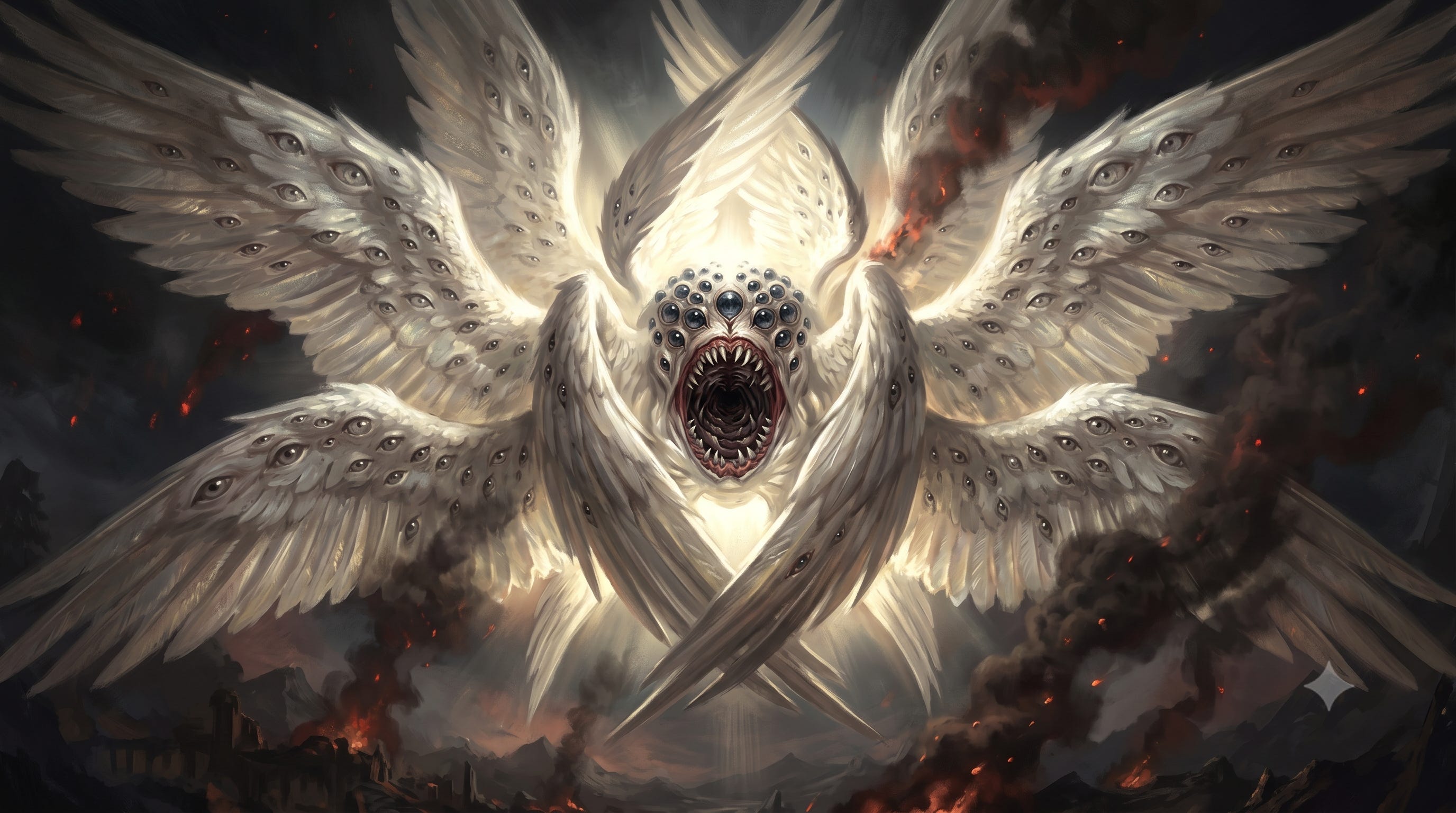
You find the same hand on Shiva, dancing inside a ring of cosmic fire. You find it in the angel at the empty tomb, the one whose face was like lightning, who dropped armed soldiers to the ground in terror, and whose first words to the women were “Do not be afraid.” The messengers of God in scripture were rarely the soft figures of Renaissance paintings. They were so frightening that the reassurance had to come first. Different gods, different centuries, the same instruction at the same moment.
The Tibetan Book of the Dead extensively discusses this. The book was meant to be read aloud to the dying, guiding them through everything they would see as the self came apart. Its instruction, repeated at every stage, was always the same. Do not be afraid. These terrifying things are your own mind. Run from them, and you are lost. Turn and look at them, and you are free.
In Dante’s Inferno, the only way out of hell is to climb down the body of Satan himself, frozen in the ice at the centre of the world. There is no door. No path around. You go over the thing you came all that way dreading. And at the exact centre, clinging to Lucifer’s spine, something changes. Down becomes up. The descent becomes the climb that carries you out, until you come through to the other side and see the stars again.
The way through is the way out.
That is why the god wears the frightening face. The thing you are most afraid of and the thing telling you not to fear are one and the same.
A Good Death
I am sixty now. The crossing that was always in the future is beginning to take concrete shape, and the threshold is closer with each passing day. I have since stopped treating these old teachings as mere superstitions.
Jack Sparrow appeals to me because I think that is what a good death should look like.
I do not want to be absent when it comes. I do not want to be so numbed, so sedated, so turned away that when the most important moment of my life happens, I am not there for it. If I can choose, I will meet the angel of death the way Jack meets the kraken. Awake. Eyes open. Sword drawn. Feeling all the fear and the pain and whatever suffering that comes with it, all the way down, right to the last moment before the self dissolves into nothing forever.
Alan Watts said that faith is not clinging but letting go. By holding his breath, a man loses it. By letting go, he finds it. I think that is right, and I think it is the hardest thing to do. To open the hand and let go.
This is not some technique or exercise that I can give, no breathing pattern, no 5-4-5 steps to acceptance. It is a tempering of the mind, slowly, over whatever years remain. You practise letting go of smaller things so that final letting go, when it comes, is not entirely foreign to you. You turn and look at the monster now, every day, so that you are not meeting it for the first time, on the last day.
A good death, for me, is not a painless, peaceful one. It is a conscious one. Present to the end.
“Hello, Beastie.”
In the final scene of Dead Man’s Chest, Jack does not defeat the kraken. He does not survive it. What he does is refuse to be taken from behind, refuse to spend his last moment looking the other way. He turns and meets it. With a grin.
That is the whole of it. The raised hand, in its gentle forms and terrible ones, was never promising us we would survive. That there is an afterlife. An everlasting life. To cling to that is to miss the point. It was showing us the only posture worth holding when we cross the threshold.
Do not fear.
Not because there is nothing to fear. But because the fear is the kraken, and the only way through it is to face it, sword drawn, and charge straight into its jaws.