

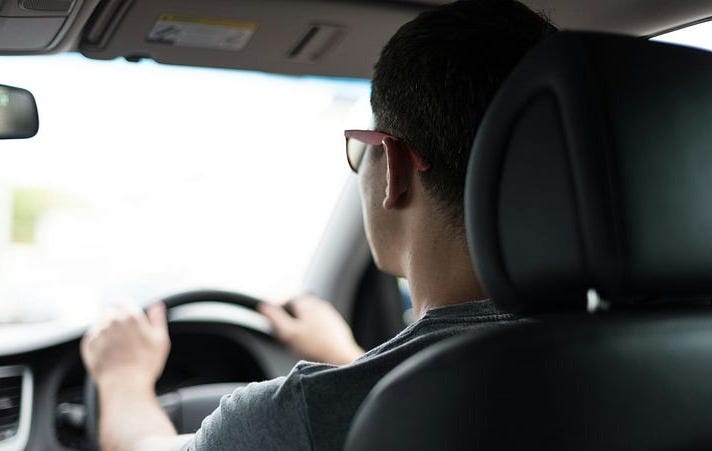
Last year, our two teenage boys started learning to drive. I thought if we’re going to do this, let’s do it at the same time. This has been one of the most stressful things for me since moving to Australia.
Although I am just an average driver, I have many years of driving experience. I am patient, sometimes to the pain of drivers behind me. I give way when I can, and wait until it’s clear before I enter a roundabout. I always check blind spots.
I am not very chatty while driving. I find it hard to do more than one thing at a time. I prefer driving with the radio off. And I dislike it when we have to change destinations on the go. I am glad some functions are now voice-activated. I look forward to the day when all cars are autonomous. No more human drivers.
So I wasn’t prepared when they took the steering wheels.
The process for getting a driver’s licence in Australia is simple: First, they have to be 15 years and 9 months old to get their Learner’s Permit (Your L’s). They have to complete an online assessment, study and pass a theory test, then apply for their learner’s permit, which is valid for 2 years.
This is where it differs from Singapore. Once they get their L’s, they can learn to drive with a qualified driver. That’s (average) me. We found a driving instructor to give them formal lessons, but I understand this is optional.
They each have to clock 75 hours of driving, including 15 hours of night driving.
That’s 150 hours on weekends, in the evenings, whenever. I had to find safe places for them to practise parking, do figure 8s, U-turns and 3-point turns, etc. All the things that I learned in 1984 came back quickly.
They can eventually get their Provisional Licence (P’s) through one of two methods:
Vehicle on Road Test (VORT) practical driving test with a VORT authorised examiner. That is like the driving test in Singapore, I think. Most people we know go with the next method.
Competency-Based Training and Assessment (CBT&A) course.
The second method is conducted by the driving instructor, who assesses their competence and approves the next step. It takes away the stress of the driving test that every Singaporean driver has to go through.
Once they have their provisional licence (P1), they can drive independently, but with conditions. And after 12 months, they can upgrade to a P2 licence for 24 months before qualifying for a full licence.
I like that it’s a long process. Experience is important for safe driving.

Every parent’s greatest fear
Two years ago, we had a friend whose teenage son died in a car accident. I understand it was after 10 p.m., and the road was dark and winding, with enormous trees on the side. I don’t know what happened, but it could have been anything. Speeding? Texting? A kangaroo?
His car wrapped around a tree trunk, and he died on the spot.
We knew him. We saw him grow up over the years. He was just a teenager, like ours. He had his whole life ahead. And he was a lovely, lovely young man.
This is every parent’s greatest fear. Sometimes, it may not be reckless driving. Sometimes it’s the driver, in the opposite direction, dozing off for 2 seconds. Sometimes it’s the slippery moss on the road around a bend. Sometimes it’s just bad luck.
You really can’t know.
You are NOT above average
Although mathematically impossible, most drivers consider their driving skills to be above average. The study conducted by Ola Svenson (1981), “Are you less risky and more skilful than our fellow drivers?”, found that 88% of US drivers rated themselves as above average in driving skills.
Another study found that 80% of drivers believed they were in the top 30% for safety.
Source: McCormick, Walkey, and Green (1986) “Comparative perceptions of driver ability — A confirmation and expansion. Accident Analysis & Prevention.”
This is called illusory superiority, or the “above-average” effect. It is a psychological bias where individuals overestimate their abilities when compared to others. Overconfidence.
From my experience, it is most dangerous when you are not yet competent but think that you are. I can see it happening.
When they first started driving, they were alert and cautious. They would go through a mental checklist that their instructor gave them before driving off. They know they are not yet competent.
After they have completed the Competency-Based Training and Assessment (which they passed), I noticed signs of “illusory superiority”.
They swear at other drivers. “What the…” as they gesture at the driver in front.

They drive with one hand, elbow locked, gripping the top of the steering wheel. This is despite my constant reminder to maintain “10 and 2”. Sometimes it’s just the index finger on the bottom of the steering wheel.
They forget to signal before turning or changing lanes.
They drive more aggressively, especially when exiting a bend or when the lights turn green.
They overtake more frequently while doing №1.
I understand because I was like that. I guess we all were, at some point.
How can I ensure they drive safely until they become competent?
I want to share a few tips. I will implement these when they get their P’s. Although it is important to give them time to build confidence and competence, I want to give them the best chance to get there safely.
Go on long (and boring) drives. I let them drive in traffic jams (peak hours) and bad weather. Run errands with me. I also insist they practise driving to the airport so that eventually, they can drop us off when we travel.
Increase frequency. My younger son drives to and from school when possible. Or to his friend’s house for birthday parties, even if it’s a short drive. Nothing replaces experience, so I encourage them to get as many hours as possible under their belt.
Take a Defensive Driving Course. I did this years ago when I was working with Subaru and found it very useful. How to use ABS effectively. How to recover when your car loses control on a slippery bend. How to avoid an obstacle at 100 km/h.
Learn to think ahead. The thing I talk about most when I drive is “the car’s body language.” You can sometimes tell when a driver is indecisive. Or when he is about to suddenly change lanes. Where is he looking when he’s driving? Down on his phone? The rear-view mirror?
Set rules. No texting while driving. No using the phone, no matter who calls. If you drink, I will pick you up whenever, wherever. Even if you are tired. Whenever, wherever. You will lose your driving privileges if you break these rules.
Learn to use the car’s technology. Cars today come with voice-activated control, so you don’t need to fiddle with knobs and switches while driving. Use cruise control to maintain speed and a safe distance. If you set it properly, you can just say “Call Dad”, and the car will do the rest. Most phones can also do the same.
Think “What if…”. What if you are driving between two large trucks, and the one behind can’t stop in time? What if you are in a school zone, and kids suddenly cross the road without looking? What if the left tyre blows while you are on the expressway? What if your brakes fail?
Then learn the proper countermeasures for №7.
Avoid criticising when driving with them. I may suggest or remind, but do it in a non-reactive way. I realised that my presence can also become a source of stress for them, and they are trying their best. I want to build good habits, not create fear.
Make driving enjoyable. We do long drives to new destinations and have a pleasant lunch when we get there. Just remember not to order beer with it.
I realise that the best way to learn is to drive often. Practice will give them the experience of becoming truly competent drivers. I know that eventually, they will learn to drive in their own ways, in their own time.
I just want my sons to be safe, especially now that they are about to get their P’s. I want them to observe the rules, to be patient. Give way. Slow down. Check twice, then check again. I want them to assume that the other driver may not always do the right thing. Be paranoid. Be prepared.
I just want my sons to be safe.