

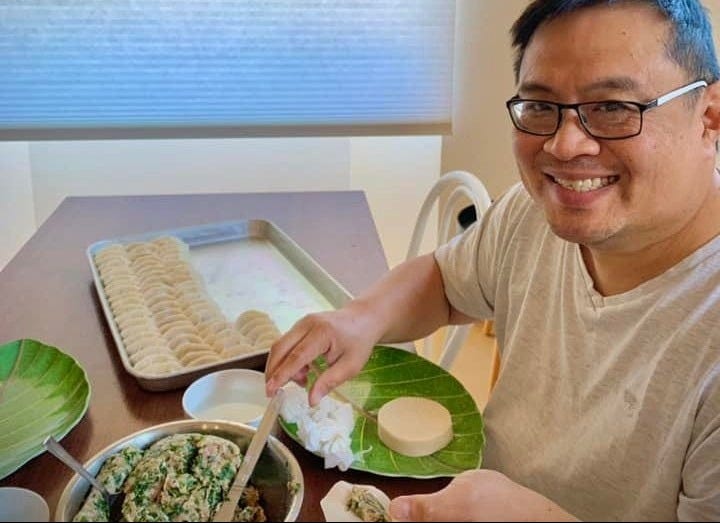
“I have to make 3,400 dumplings for the fridge.”
“The table, about 7,000 dumplings.”
We used to measure the setup costs of our restaurant in terms of dumplings. So when someone asked how much we invested to build the shop, my wife would inevitably say…
“…he has to make 618,000 dumplings to pay it off.”
Customers loved the analogy.
Here’s the math. We initially sold dumplings at $10 for a plate of 12. It takes me about 3 hours to make 300 dumplings a day. At 618,000 dumplings, you can tell how much we borrowed from the bank to build the restaurant.
These dumplings often sell out before we open. Regulars would order ahead via Messenger, and those who missed out would ask, “Why don’t you make more?”
“He’s a one-person show. That’s all he can make a day,” she would say.
Eventually, we increased the price, but it was time-consuming. The “scalable” dishes, like Laksa and Chicken Rice, paid the bills.
Making dumplings is hard work. We know of a Chinese lady near our home who sells dumplings to support her three young children. She only sold them on Saturdays at the local farmers’ market. After her husband left her and the children, she found a way to support her family.
She did other work, like cleaning and washing, but selling dumplings was what she enjoyed most. And they were delicious! There was always a crowd at her pop-up stall, and you had to wait. Sometimes for close to an hour. She made them fresh as the orders came.
One-woman show. It’s all she can make in a day.
She has since stopped. Her kids have grown up, and she can now take it easy. It was hard work.
My first dumpling was in Kaohsiung.
In 1998, I was in Taiwan, China, for reservist military training. An officer had bought the platoon two packets of pork-and-cabbage dumplings. I had just one dumpling before it was gone.
It was so delicious. More cabbage than pork? 50/50 maybe?
Dumplings, or Jiaozi (饺子), were hardly available in Singapore in the 1990s. They weren’t mainstream. Jiaozi is a Northern Chinese dish in which wheat is the staple. We were more familiar with soup-based wontons (云吞) and the Cantonese Siu Mai (烧卖).
In 1989, a stall selling Shanghai cuisine was near where I worked. They had pan-fried dumplings and hand-pulled noodles. It was exotic and spectacular to watch, but too expensive for a poor bookshop assistant.
Now, of course, you can find dumpling restaurants all over Singapore and dumpling bars all over the world.
In Australia, dumplings are among the most popular dishes, especially the pan-fried variety. We call them “Pot Stickers” (锅贴) or “Jian Jiao” (煎饺).
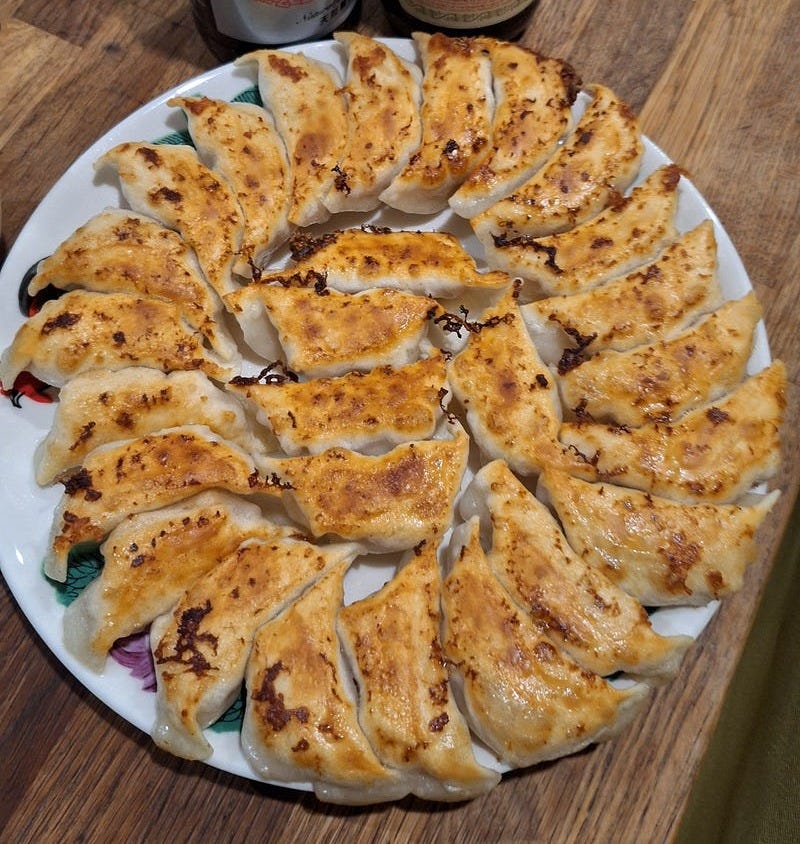
You know it is popular when you google “dumpling recipe” and it appears on Gourmet Traveller and the New York Times. When every MasterChef winner has a dumpling recipe on their website, and hatted restaurants serve fancy “dumpling-type dumplings” on $130 tasting menus, using lowercase letters to describe the dish:
king fish dumpling with sweet shoyu and warm wasabi oil
duck and chestnut dumpling with kimchi reduction and charred porcini
mixed mushroom and tofu dumpling with semi-fermented chilli oil
and burned garlic and a sprinkle of pixie dust
The descriptions get longer as you get fewer dumplings on ever bigger plates.
Don’t get me wrong, we enjoy these too. Most are delicious and very creative. Some are a bit too creative and not quite “authentic”. But you don’t go to hatted restaurants for “street food” authenticity.
My dumpling recipe
I started making dumplings for shared meals when we moved into the eco village years ago. I wanted to impress my neighbours. Most people love them, and I tell them it’s easy to make. Just look it up on YouTube.
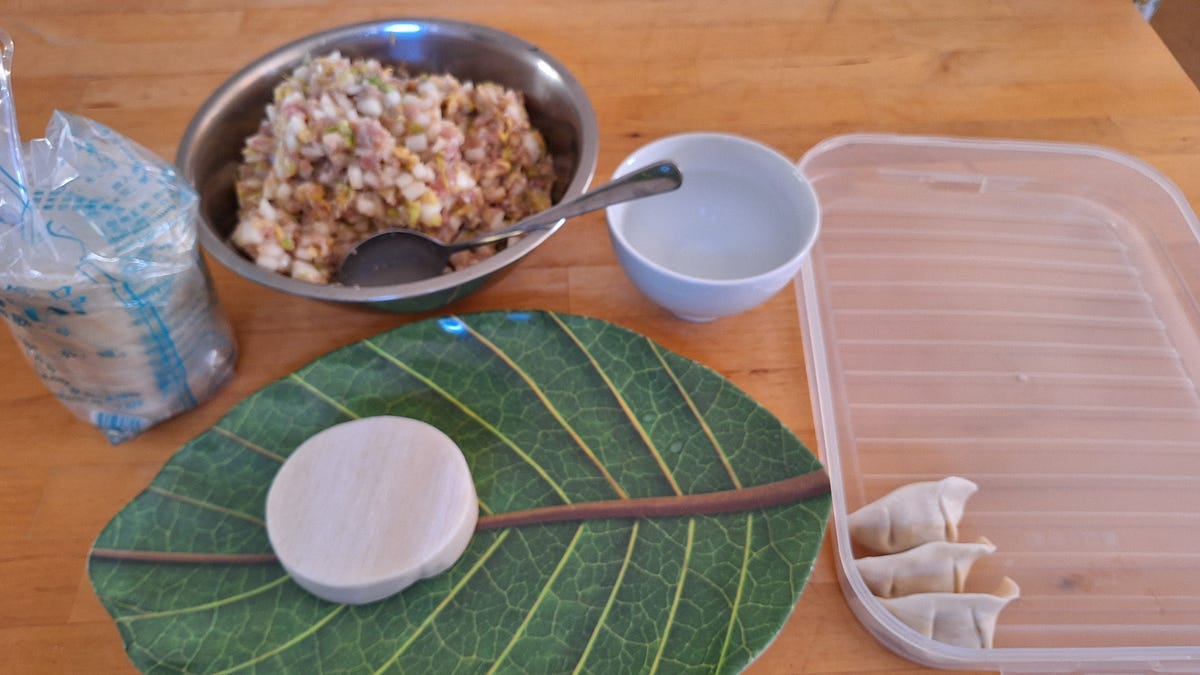
Preparing the dough
Although I often use commercially made wrappers (or dumpling skin 饺子皮), I have occasionally made these from scratch.
The recipe for the dough is simple:
2 parts plain flour (400g)
1 part room temperature water (200 ml)
A pinch of salt
That’s all. No oil, no yeast.
Put the flour into a mixing bowl. As you add the water (slowly), mix it with a pair of chopsticks until it becomes a sticky mess.
Then, knead the dough into a ball. It will be hard and lumpy initially, but that’s ok.
Cover and let it rest for 20 minutes. This allows gluten to develop, making the dough elastic. A pinch of salt neutralises the electrically charged parts of the gluten and improves the taste.
Knead the dough again for about a minute. It should now be a little softer, smoother, and no longer stick to your hand.
Then, let it rest for an hour while you prepare the fillings.
The fillings
If you visit the northwestern parts of China, where some of the most delicious dumplings are from the Muslim community, lamb is the key ingredient. In Southeast Asia, pork is more common. You can use tofu or mushrooms as the main filling if you are a vegetarian or vegan.
I prefer minced chicken thigh with skin on. It should have a high “fat to lean” ratio, or it will become dry when cooked. I ask the butcher to prepare it with 40–50% fat. It is much tastier.
In a large bowl, add:
500g of minced chicken/pork/lamb/beef/minced tofu (or a combination of)
A tablespoon of minced ginger
A tablespoon of minced garlic
A generous dash of soy sauce
Some white pepper
2 tablespoons of oyster sauce
A dash of sesame oil
A tablespoon of sugar
Slowly add soup (carton soup is fine) or water to the filling as you mix. Mix in one direction. You should notice that the mixture will become gluey. This improves the texture and moisture content.
Add the vegetables
Dice about 500g of vegetables. These can be Chinese cabbage, garlic chives, or even kimchi. Mix them in just before you make the dumplings, or the salt will draw out moisture, and the filling will become too wet.
There’s a process that many recipes call for. Heat some oil (about 50 ml) to a boiling point and add it to the filling. Cooked oil gives a smoky taste. You can even flavour the oil with spices like star anise and Sichuan peppercorn. I usually just add sesame oil.
I will put a teaspoon of filling in a saucer and microwave it for 20 seconds. Taste and adjust (调味) accordingly.
Making the “dumpling skin” (饺子皮)
As mentioned, I usually use commercially made dumpling wrappers. If you are keen, here’s a video showing how to make them yourself. I have tried, and it’s not too hard. Practice will get you there. I even practise in my head as I move my hands and fingers.
The magic dipping sauce
My younger son makes an excellent dipping sauce. This is HIS recipe:
100ml of Light Soy Sauce
100ml of Chinkiang Vinegar (Chinese Black Vinegar)
1 teaspoon of Sugar
1 large tablespoon of Lao Gan Ma chilli oil (You should be able to get it anywhere in the world)
200 ml of hot water or unsalted chicken stock to dilute the sauce.
To make a bigger batch, increase the amount proportionately. There should be enough in a small bowl for each person to dunk a whole dumpling.
Cooking the dumplings
There are quite a few ways to cook them. The traditional way is to boil them. Drop a tray of dumplings into a large pot of boiling water and let it come to a boil.
Add half a cup of cold water to the pot when it boils to bring the temperature down. Do this three times. The dough will cook before the filling (especially frozen dumplings), so slowing down will ensure that the dumplings cook properly. Otherwise, the skin may break if overcooked.
You can also pan-fry them.
Add oil and water, about 50:50, to a non-stick pan. This should cover about ⅓ of the dumplings.
Then, arrange the dumplings in the pan until it is complete.
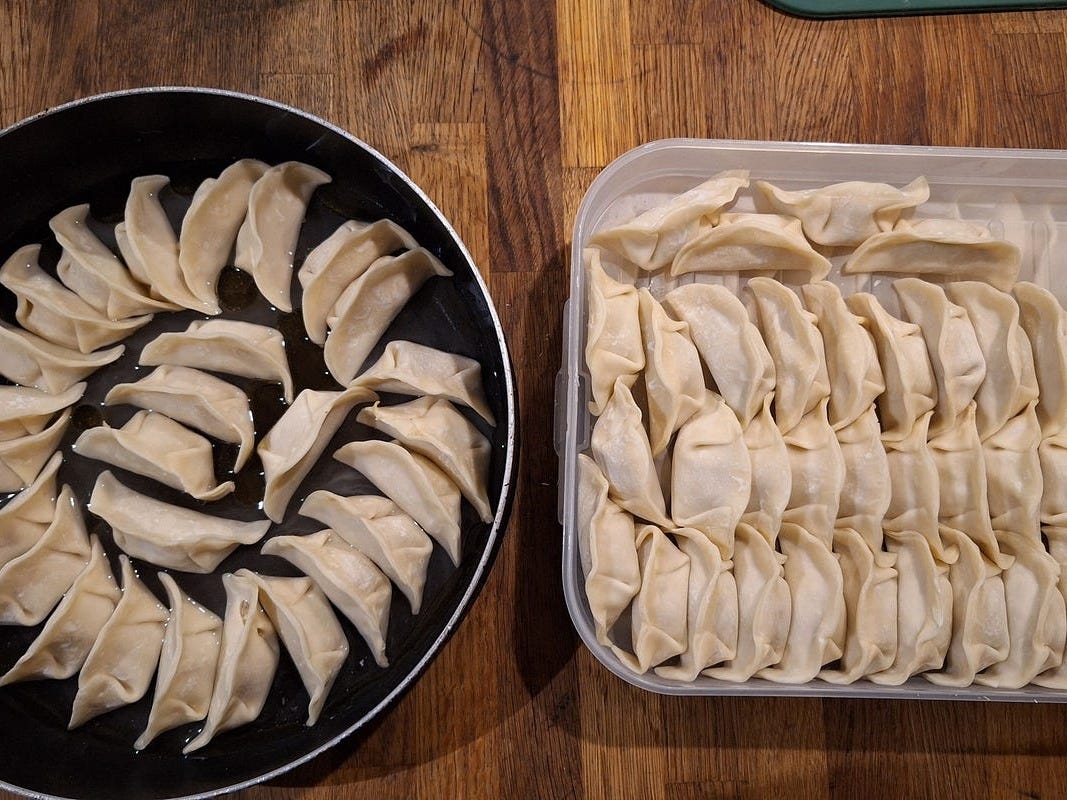
Cover the pan and put it on the stove. Let it steam for a few minutes.
The water will evaporate slowly as it cooks. Once most of the water has evaporated, remove the lid and let the fish fry in the remaining oil. I check frequently with a pair of chopsticks to make sure they don’t burn.
When the bottoms of the dumplings turn light brown, I put a plate over them (like a lid) and pour out the excess oil. Do it slowly, and don’t burn yourself. Then I flip the whole thing over and serve.
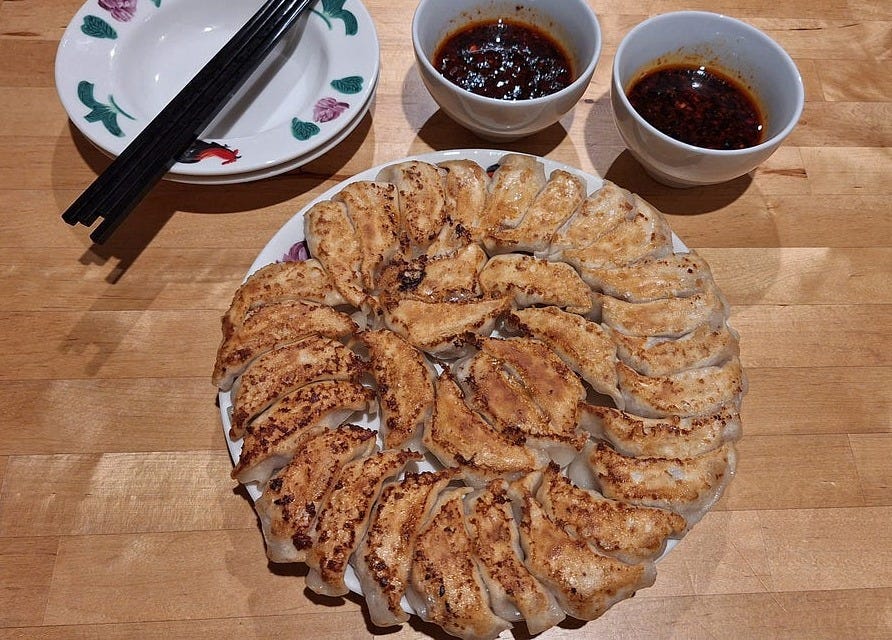
You can also steam them in a basket steamer or deep fry them.
I didn’t make 618,000 dumplings, so I am still paying off the loan. I hope this newsletter can help pay off a little more. But I also love eating dumplings, and I still make them often.
I am grateful for this little dish that helped me put food on the table after I quit the corporate world.
I am grateful to my wife and kids, who helped make hundreds of dumplings over the years when more orders poured in than I could handle.
I am grateful to all the customers who came, ate, and shared sweet memories in our little restaurant.
Thank you all! Thank you.