

When we first moved into the village, an old couple invited us for dinner at their home. The lady of the house was French and quite an excellent cook, as we discovered. Although I couldn’t remember what she served, it was impressive and delicious.
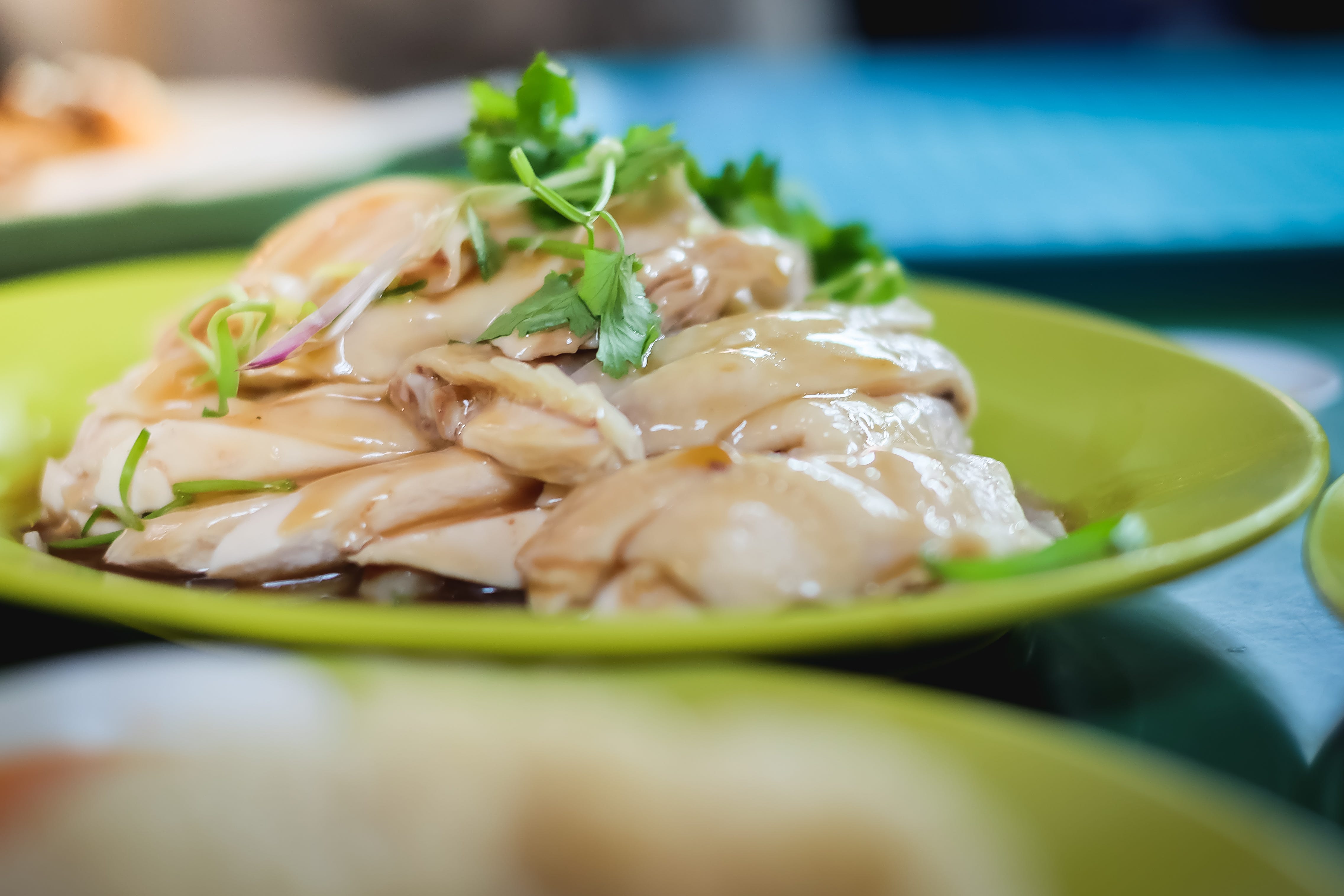
So, to return the hospitality, we invited them over a few weeks later for dinner. For Hainanese Chicken Rice. I will always remember her reaction when I served the platter of chicken.
“Oh. The chicken is cold,” she said.
It was dull. Almost boring and incomplete when I presented Singapore’s culinary pride. I assured her that it would taste better than it looked.
She was polite, and we sat down for dinner.
By the end of dinner, she was raving about how delicious it was and insisted that I give her the recipe for Hainanese Chicken Rice. (Which I included at the end of this article).
It’s not Hainanese Chicken Rice in Hainan
Hainanese Chicken Rice is as simple as it gets. It is “boiled” chicken. In Chinese tradition, it is often offered to the gods on auspicious days and during important events.
Traditionally called Wenchang chicken, named after the Wenchang county of Hainan Island in the Southern tip of Mainland China (文昌市). During festivals, family gatherings, and other significant occasions, Wenchang chicken is prepared and presented as an offering to ancestors and deities.
The chicken is offered whole, with “head and tail” (有头有尾), symbolising completeness. And having sat on the altar for hours, it is also served at room temperature or cold.
Growing up, I had it only as a dish when my mother prepared it. Chicken in the 60s and early 70s was a luxury, and we only had it on festive occasions like Chinese New Year.
It wasn’t until the mid 80s that I remember seeing it as a popular dish at hawker centres. Restaurants like Boon Tong Kee and Tien Tien Chicken Rice specialise in the dish, and made it to the Michelin Bib Gourmand Guide after the late Anthony Bourdain featured it in one of his episodes.
Army Days
Chicken Rice (we hardly called it Hainanese Chicken Rice in Singapore) was a staple when I was doing National Service. On weekend guard duty, someone would offer to buy lunch for everyone, and the 2 dishes we could order were Chicken Rice and Roti Prata. These were easy to pack and would make the volunteer’s job easier.
No variations. Just a packet of chicken rice or plain Prata.
If you ordered chicken rice, it would come wrapped in a brown paper packet. Inside, you will have a serving of cold rice with a few slices of cold chicken breast and cucumber. If you are lucky, you will have a small packet of chilli sauce.
All for $2.50 a pack.
It was ok. At least, it was something different from what they were serving at the cookhouse.
National Dish of Singapore
In his 1992 National Rally Speech, then Prime Minister Goh Chok Tong praised Hainanese Chicken Rice as an iconic representation of Singaporean culture, elevating it to the status of a national dish. I vaguely remember his call for Singaporeans to make this dish popular globally.
“If you want to find a national dish for Singapore,
it should be Hainanese Chicken Rice.”
Goh Chok Tong - Former PM of Singapore
Since then, the humble Hainanese Chicken Rice has reached culinary fame on the world stage.
When we first arrived in Adelaide, there was no Hainanese Chicken Rice. So, like many of the dishes I shared, I had to learn how to cook it. It wasn’t until Adam Liaw, who won MasterChef Australia in 2010, cooked it in one episode that it started becoming popular in Adelaide.
Today, fine-dining restaurants and celebrity chefs each have their own version of the 1authentic Hainanese Chicken Rice. And there are at least several chicken rice stalls in Adelaide CBD serving just this dish.
How to prepare Chicken Rice (the Recipe)
I wish chefs and restaurants were a little more confident in the recipes they present. If you were to ask any chicken rice hawker in Singapore about their dish, they would never need to claim that it is “authentic” or “original”.
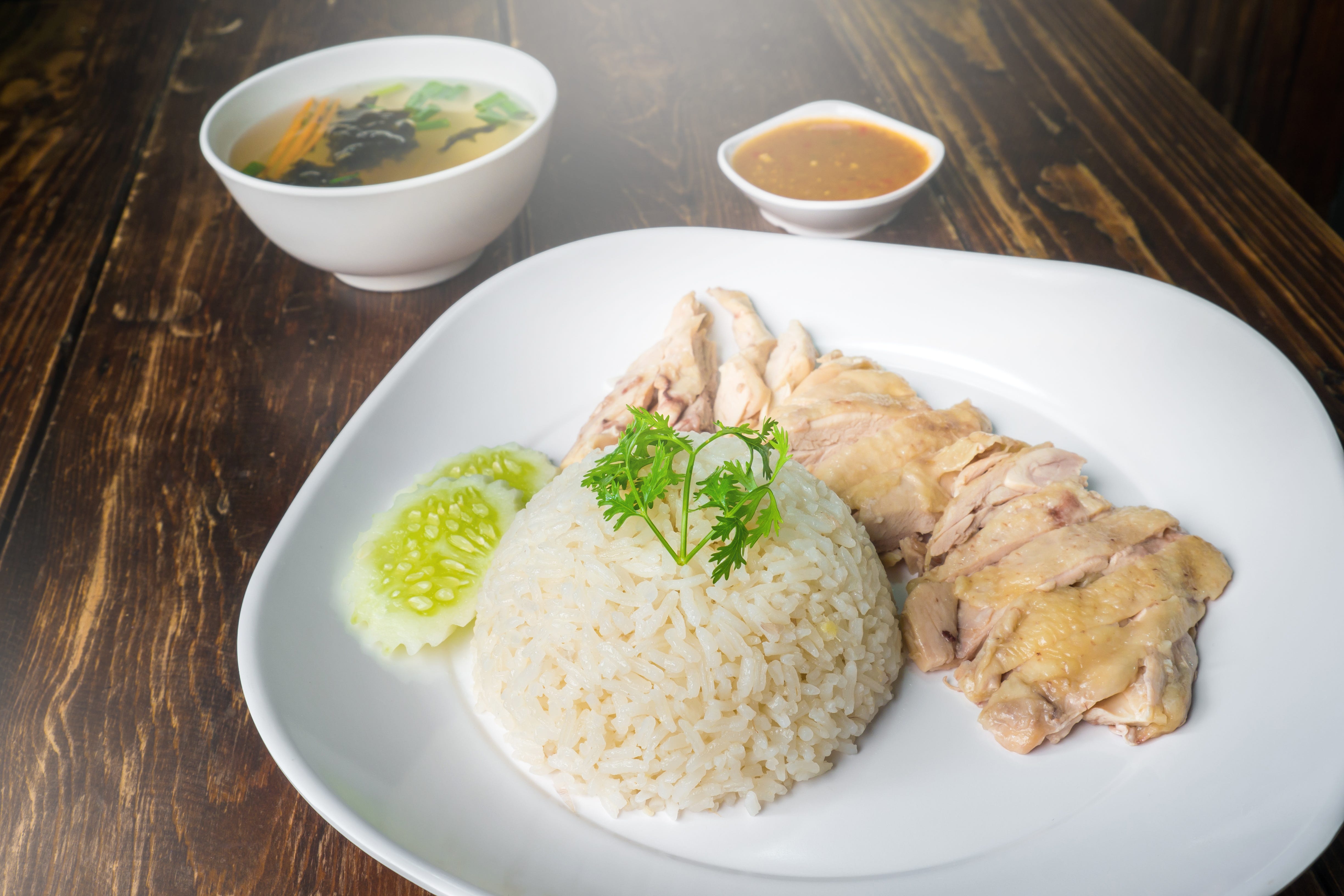
Chicken rice is just chicken rice. It is a humble dish prepared by those who want to make a living and send their children to university. Claiming authenticity and originality suggests that it isn’t.
Anyway, this is how I do it. It has passed the test of my Singapore friends and customers, including a French foodie who still craves it after 10 years. It tastes like the chicken rice I used to eat when I lived in Singapore. I think it is good enough.
Ingredients
1 or 2 chicken. I prefer those that are about 1.5 to 2 kg each,
Salt
Some ginger
Some garlic
Some spring onions
Some coriander
Some sliced cucumbers and tomatoes for garnish
Panda Leaves (difficult to find in Adelaide). We only get the frozen ones that have little fragrance, so you can skip it if you like.
Preparation
I use free-range chicken because I feel good about it. I suspect there isn’t much difference, but if the chicken you are about to cook had a comfortable life, it is worth the extra few dollars.
Wash the chicken and use a generous amount of salt to give it a good massage. A massage helps loosen the muscles and clean the skin’s surface. Rub a generous amount of salt inside and outside the chicken. Rinse and put aside.
Allow the chicken to come to room temperature. Otherwise, it takes more time and may not cook evenly. But this applies to most cooking.
When I ran our restaurant, I would use about 4-5 kg of chicken frames and some wings/drumsticks (whichever was cheaper), along with salt, ginger, and spring onions, to make the base stock. I would also add some rock sugar or chicken powder to taste.
Put everything in and bring it up to a boil. Let it simmer for 2-3 hours. Strain the stock into a pot large enough to submerge the chicken completely.
Unlike chicken rice restaurants in Singapore, which poach hundreds or thousands of chickens a day, using just water will not give the depth of flavour needed to cook the rice. I find this step quite necessary for flavouring both the chicken and the rice.
Poaching the chicken
Pour some boiling water over the chicken just before it goes into the pot of stock. This tightens the skin, improves its texture, and enhances its presentation when cut.
When the stock is boiling, slowly submerge the chicken into the stock, turning it to release air bubbles in the cavity. Ensure the chicken is fully submerged. Let the stock return to a slow boil for about 10-15 minutes, then turn off the fire and put a lid on. Leave the chicken in the pot for about 45-60 minutes.
Here is where I got it wrong so many times. It depends, really. On the pot’s volume, the chicken’s size, and how quickly the temperature drops.
The chicken is to be sous vide at about 77° to 82° C for 60 minutes. At 71°C, the collagen in chicken starts to unwind, and at 77 °- 82°C, it dissolves into gelatin. This makes the chicken tender and juicy.
Overcooking occurs when the chicken is cooked at a temperature above 82°C for extended periods. This causes the protein fibres to contract, squeezing out moisture and making it dry and tough. So it’s important to keep the temperatures at the correct range, and for long enough.
Use a meat thermometer to ensure the internal temperature reaches 74°C. At 82°C, the chicken’s internal temperature will exceed the minimum safe temperature, ensuring the meat is safe to eat.
Ice Bath
When the chicken is ready, lift it out gently and place it in an ice bath. This will stop the cooking process immediately and lock in the gelatin between the skin and the meat. This is the magic process that makes Hainanese Chicken Rice unique. Let it soak in the ice bath for about 20 minutes, then lift it out and let it rest on a rack. In Singapore, you would see them hanging on the windows of the stalls or restaurants.
Serve on a plate
Cut the chicken into bite-sized pieces and serve it on a plate of sliced cucumbers and tomatoes. If you dare, debone it. Your guests will be so impressed. Garnish with spring onions and coriander.
Chicken-flavoured Soy Sauce
This is the diluted soy sauce that is drizzled over the rice and chicken to flavour the dish. It is a key component of the dish that ensures both the chicken and rice are not too dry.
A small bunch of coriander stems and roots
A small bunch of spring onion stems and roots
2 tbsp of sesame oil
2 tbsp of light soy sauce
2 tbsp of fish sauce
1 tbsp of oyster sauce
1 tbsp of sugar
1 cup of chicken stock (poaching liquid)
In a saucepan, heat the sesame oil and fry the coriander and spring onion roots until fragrant. Add everything else into the pan and bring to a simmer. Strain and drizzle over the chicken and rice.
Chili Sauce
10 pieces of red chillies
2-inch piece of ginger
8-10 cloves of garlic
2 tbsp of sugar
½ tsp salt
½ cup of chicken stock from poaching the chicken
2 tbsp lime juice (we use calamansi in Singapore, but almost impossible to find here in Adelaide)
I use a Nutribullet to blend everything into a paste. Taste and adjust accordingly.
Ginger Sauce
2-inch piece of ginger
5-6 cloves of garlic
½ tsp of salt
2 stalks of spring onions
½ cup of cooking oil (not olive oil)
I use a Nutribullet to blend ginger and garlic, except the oil, into a paste. Top with sliced spring onions. Transfer to a heatproof bowl. Then heat the oil in a saucepan until it smokes, then pour it into the ginger-garlic paste. Taste and adjust accordingly.
Chicken Rice
I recommend a rice cooker. It’s easy to use and almost impossible to go wrong.
4 cups of jasmine rice
4 cups of chicken stock
Chicken fat from the cavity of the chicken
2-inch ginger
5-6 cloves of garlic
In the pot where you will cook the rice, render the chicken fat. You can add more oil if there isn’t enough. You should have about ¼ cup of oil, eventually.
Blend ginger and garlic, or mince it up with a cleaver. Sauté in oil until fragrant. Then add rice into the pot and stir-fry it a little. When the rice is well coated, add the chicken stock in a 1:1 ratio.
Cook the rice in the rice cooker or on the stove. If you use a rice cooker, then just relax and let it do its work.
If over a stove, bring to a boil, then turn the heat to low and simmer. Cover and when the stock is absorbed into the rice and the rice is cooked, turn off the heat, cover and let it rest for 10-15 minutes.
Serve. Enjoy.
Have you had chicken rice before?
If you have never tried Hainanese chicken rice before, you should. It appears to be a simple dish, but it is clean and complex at the same time. There isn’t another dish that I can think of that is remotely close to this.
The combination of cold, juicy poached chicken on hot, steaming, savoury rice, with a bit of chilli and ginger sauce, is simply incredible.
It is indeed a dish fit for the gods.
I always thought that if you have to claim authenticity, it is likely not authentic.