

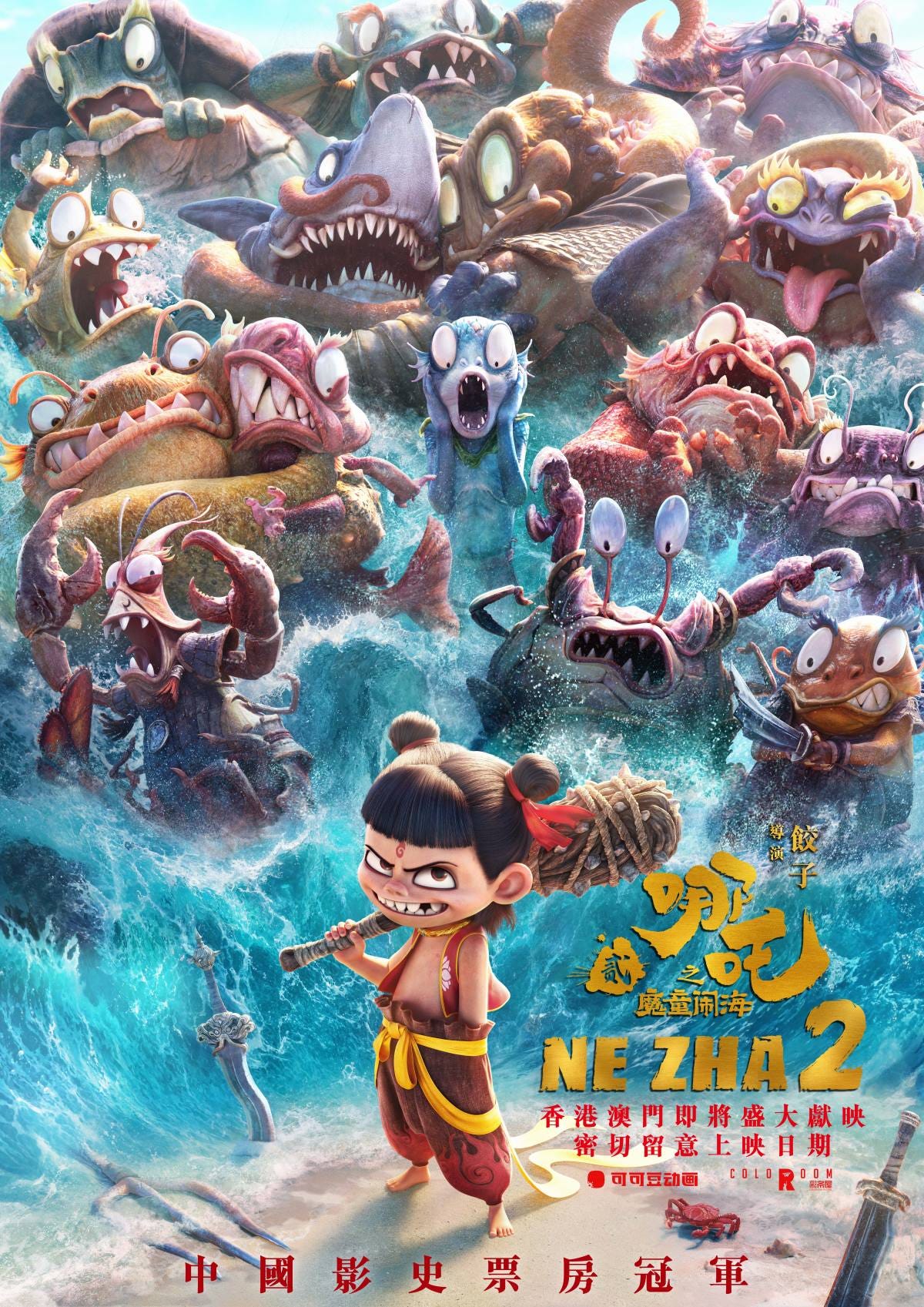
I recently watched Ne Zha 2 in a small cinema in Adelaide (Nova Palace Eastend), one of the 2 or 3 places screening it. I missed the first Ne Zha (2019) because I assumed it would eventually appear on Netflix, but it never did. This time, I wasn’t taking any chances. I’m so glad I did.
As of 4 March 2025, Ne Zha 2 has crossed the US$2 billion milestone at the global box office. This makes it one of the most successful films in cinema history. The movie has achieved many records in its short theatrical run. As the highest-grossing animated film of all time, it also shows the influence of Chinese cinema in the global industry.
Ne Zha 2 is expected to conclude its theatrical run with total receipts of $2.09 billion. This means it would rank the fifth-highest-grossing movie in history, surpassing Star Wars: The Force Awakens ($2.07 billion) while trailing Titanic ($2.26 billion). With the film continuing to perform and officials aiming to keep it in cinemas throughout March, Ne Zha 2 could exceed even these projections.
I watched it twice—and might even watch it a third time. There’s something about the story, the characters, and the themes that speaks to my heart. It’s a deep reflection of life, identity, and the struggle to define oneself against all odds.
Who is Ne Zha?
In Chinese mythology, Ne Zha (哪吒) is the third son of General Li Jing, a revered military commander, and is considered a child deity born with supernatural powers. His story is derived from the Ming Dynasty novel Fengshen Yanyi (Investiture of the Gods), which blends folklore, Daoist cosmology, and historical fiction.
According to the myth, Ne Zha gestated for three years and six months before being born as a ball of flesh. This unusual birth terrified his father, General Li Jing, who interpreted it as an evil omen. He attempts to destroy the mysterious object by cutting it open with a sword. Upon doing so, Ne Zha emerges as a fully formed 3-year-old boy with superhuman abilities.
Ne Zha’s story is one of rebellion, redemption, and transformation. As a headstrong and impulsive youth, he causes widespread chaos wherever he goes. Disaster struck when he killed Ao Bing (敖丙), the third son of Ao Guang (敖光), the Dragon King of the East Sea. In the myth, Ao Bing is often portrayed as arrogant and oppressive, but Ne Zha’s killing him escalates the incident into a larger conflict with the Dragon Clan, threatening his family and the celestial order.
To protect his family from divine retribution, Ne Zha makes the ultimate sacrifice: he commits suicide by dismembering himself to absolve his parents of any liability (Ne Zha was 3 years old, after all).
Ne Zha resurrected through the intervention of his mentor, Taiyi Zhenren (太乙真人), a Daoist immortal. Taiyi reconstructs Ne Zha’s body using lotus roots, lotus flowers, and other sacred elements, granting him a new, immortal form. This resurrection symbolises purification, rebirth, and transcendence, allowing Ne Zha to continue serving as a protector of humanity and a warrior in the celestial hierarchy.
But the director of Ne Zha 2, Jiao Zi, whose real name is Yang Yu, takes this myth and reimagines it in a refreshing, moving way. While the movie keeps the core elements of Ne Zha’s character, the interpretation adds layers of complexity and humanity that make Ne Zha relatable and very lovable.
A New Take on an Old Legend
In the movie, Ne Zha and Ao Bing become friends. Ne Zha’s parents, Li Jing, and Lady Yin, are devoted towards Ne Zha, willing to do anything to protect their son. Even the village that fears and ostracises him becomes a place he fights to protect.
The movie deepens the story’s conflict by introducing a profound critique of the celestial realm’s hypocrisy and its exploitation of the mortal world. The celestial order, portrayed as an upper class maintaining rigid hierarchies, perpetuates inequality under the guise of justice and compassion. Mortals are deceived into believing their suffering will be removed if they surrender to divine will, only to become “spiritual food” for the gods, who consume their energy for personal gains.
This makes the movie more compelling. It’s not just about a boy with supernatural powers; it’s about identity, love, the struggle to define oneself in a world that tries to dictate who you should be, and the hypocrisy of those who claim moral superiority over others.
Themes in the movie that moved me
Defying Destiny
“我命由我不由天” (My Destiny Is Up to Me, Not Heaven). This iconic mantra from the first film takes on a new weight in Ne Zha 2. It’s the battle cry throughout the sequel, and becomes a manifesto for Ne Zha’s defiance against heavenly mandates.
Ne Zha is born with a curse, destined to bring destruction and chaos to the world. But he refuses to accept this fate. Instead, he takes control of his life and decides who he is and aspires to be.
Unconditional Parental Love
In a striking departure from tradition, Ne Zha’s parents are transformed into embodiments of unconditional love. They are unwavering in their devotion to him. Despite the curse and the danger he poses, they never give up on him. Their love gives Ne Zha the will to change his fate. Similarly, Ao Guang’s love for Ao Bing is another testament to the bond between parent and child. No matter who you are or what you’ve done, your parents will always love you.
Towards the end of the movie, there is also an acknowledgement that, despite all our good intentions, our children must walk their own paths. The experience and knowledge that we, as parents, have gained and occasionally try to impart may be irrelevant to them. They must embark on their personal journey.
This idea deviates from traditional Chinese norms. It inspires parents, like me, to consider that our love should not be conditioned on our children doing and being what we want them to be. Our job is to love and let them be.
Shen Gongbao: The Complex Villain-Hero
For me, the most intriguing character in the movie is Shen Gongbao (申公豹). He’s introduced as a villain, but as the story unfolds, we see his complexity. He is disillusioned with the system he once believed in. A system that promised rewards for hard work but only exploited him. This was so artfully expressed in his dialogue with his younger brother.
His love for his father and younger brother humanises him, and his ultimate sacrifice to save Ne Zha’s parents from Wuliang reveals his innate heroism. Shen Gongbao is a reminder that people are never just good or evil. They’re often shaped by their circumstances and choices, and try their best to make it in a hypocritical society.
The Real Villain: Hypocrisy and Exploitation
Then there are the “good guys” who pretend to be compassionate but are ultimately selfish and manipulative.
The primary antagonist is Wuliang, who is the leader of the Chan Sect. Wuliang represents the hypocrisy and exploitation that exist in our society. They use those beneath them for their own gain, all while maintaining a facade of benevolence and social justice. True evil often hides behind a mask of virtue.
Rebirth Through the Fires of Samadhi
This is the part when everyone cries. Lady Yin’s sacrifice and Ne Zha’s subsequent transformation under the Fires of Samadhi. The Fires of Samadhi (三昧真火) are a powerful, primordial flame that is invisible, boundless and inextinguishable.
After her passing, Ne Zha undergoes a harrowing and (visually) painful rebirth, tearing his body apart before he is consumed by the Fires of Samadhi. He eventually emerges as the complete version of himself. This sequence is both horrifying and beautiful, a metaphor for rebirth and the achievement of one’s potential after extreme suffering.
The symbolism is profound: To become who he truly is, he must break free of everything (the blades) that holds him back. Watching him endure unimaginable pain while emerging stronger and complete is nothing short of breathtaking.
The visual imagery amplifies the impact: flames engulfing his form, energy coursing through his veins, and finally, the triumphant emergence in a new form. Like a phoenix rising from the ashes.
A Cultural Awakening
Ne Zha 2 is a cultural awakening for the Chinese. It explains its global popularity. For Chinese audiences, Ne Zha’s story mirrors the historical experiences of being bullied, marginalised, and oppressed. Ne Zha’s journey of self-reconstruction with the Fires of Samadhi is a powerful metaphor for cultural rejuvenation. It speaks to the collective consciousness of a people who have endured more than a hundred years of suffering and humiliation.
But the movie’s appeal isn’t limited to Chinese audiences. Its themes of defiance, love, and self-discovery are universal. Whether or not you’re familiar with Chinese mythology, Ne Zha 2 has the power to inspire and move you. It’s a reminder that no matter how dark the path is, there’s always a way to rise above it.
My Thoughts
Watching Ne Zha 2 was a journey of reflection and inspiration. The movie’s numerous themes left me with a sense of hope and empowerment. We are not defined by our circumstances or the expectations of others, even gods. We have the power to shape our own destinies, to rise above adversity, and to become who we want to be.
In a world that often feels chaotic and hopeless, Ne Zha 2 is a catalyst for spiritual awakening. Beneath the story of disobedience, love, and the unyielding spirit of humanity, it is also a call to break free from the confines that society imposes on us. It encourages the audience to question the inherited paths we took, and to accept the ones that our children will take.