

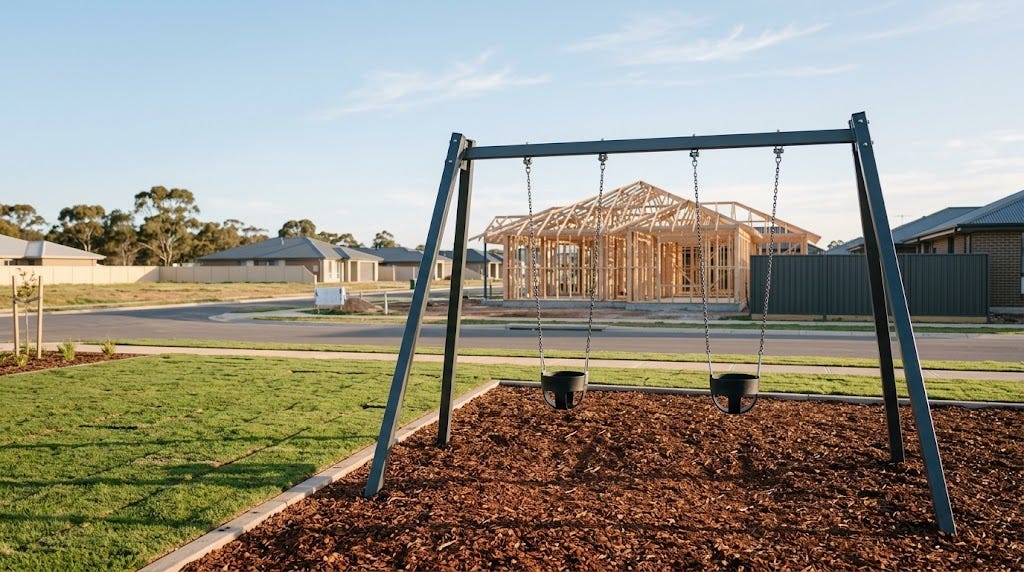
“I cannot solve the problem, and I have given up.” - Lee Kuan Yew.
Lee Kuan Yew wrote that in 2013, a month before his 90th birthday, in One Man’s View of the World. The problem was babies. Singapore’s fertility rate that year was 1.2 children per woman. In 2025, it was 0.87. The man who built a first-world country from a swamp, who planned everything from water to language to chewing gum, said the one thing he could not do was persuade Singaporeans to have children. Cash bonuses had not worked. Nothing had worked. He handed the job to the next generation.
I thought about that last night, watching the ABC lay out Australia’s migration debate. Everyone had strong positions, but nobody seemed to have a plan.
One Nation announced on 14 September that it wants net overseas migration below zero: more people leaving than arriving, with 750,000 fewer temporary visa holders over three years. Three weeks earlier, its own leader had put the target at 130,000. The Coalition says it will tie migration to housing completions but will not name a number until closer to the 2028 election, while its home affairs spokesman concedes that without the right skills coming in, “we all are worse off.” The Labor government is sticking to 225,000 a year from 2027; its minister for immigration delayed a speech meant to explain the policy, and another minister told reporters it is “a very complex area” and they need to get it right rather than fast.
This is where we are.
What Singapore did
I grew up inside the Singapore version of this argument, so let me describe what happened 2 decades earlier.
Singapore did not start from migration. It started with growth, because growth paid for everything else. Growth required foreign capital, so the Economic Development Board was established in 1961 to attract multinationals. Capital needed infrastructure, an educated workforce, political stability, and enough people to fill the jobs it created. Land, housing, and transport were planned against a population figure in the Concept Plan, which was revised roughly every ten years. Migration sat at the end of that chain. Its job was to serve the other links, and when the birth rate fell, it was the tool that the Government used to keep the chain intact.
Lee said it plainly to students in 2003: four million people in Singapore, one million of them foreigners, and if you got rid of that million, many Singaporeans would not find jobs. He was equally plain about who he wanted. Talent. Educated people who would lift the place. He knew they would change the character of the country, and he said so. His answer was that Singaporeans were not having enough children, so what else could you do?
Singapore did this with a level of state control Australia will never have, and it still blew up. The 2011 election was the PAP’s worst result in decades, largely due to overcrowding, housing, and the presence of foreigners. In 2013, a white paper projected 6.9 million people by 2030 and produced the largest protest at Speakers’ Corner since it opened.
The government backed down, tightened the inflow and promised to keep a “Singaporean core.”
Migration did not fix the underlying problem. Singapore’s fertility rate is now at its lowest level, and its citizen population is projected to begin shrinking in the early 2040s regardless. Migration bought time. It did not buy a solution.
Australia’s fertility rate was 1.48 in 2024, also a record low, and the Centre for Population expects it to be 1.42 this financial year. We are twenty years behind Singapore on the same path.
The housing crisis argument
Here is what the evidence shows. Migration adds demand for housing. Monash University research published in 2020 found that Australian house prices would have risen about 1.1 per cent a year less between 2006 and 2016 had there been no immigration. The ABC set that against annual price growth of about 5.95 per cent over the same decade. So migration is real, but it is a small part of the problem.
The problem is that we stopped building years ago. AMP’s Shane Oliver puts the accumulated shortfall at 200,000 to 300,000 dwellings. The National Housing Accord needs roughly 240,000 completions a year to hit its target, but the country is delivering around 160,000 to 170,000. Approvals are running about 19 per cent below the Accord's requirement. And an approval is not a house until it is built.
Then look at this year. The Reserve Bank has raised rates three times since February. Capital city prices have been falling since March, and ANZ now expects a fall of more than 10 per cent from peak to trough. Net overseas migration over that same period has averaged about 300,000. If migrants drove house prices, prices would not be falling while migration stays high. Interest rates, construction costs, an energy shock and investor nerves are causing that. But migrants are the easiest to blame.
The irony is that the workforce that has to build the missing houses is heavily composed of migrants. Cut the intake to zero, and you cut the tradies with it.
Growing people
NOM is arrivals minus departures: students finishing, backpackers leaving, Australians coming home. The government sets visa caps at the front and hopes the number that falls out the back works. What industries do we want the capital to flow into? What is the education system meant to produce? What will we do about a fertility rate heading for 1.4, other than call it a lifestyle choice?
No one knows.
The Guanzi, written more than two thousand years ago, puts it in one line:
一年之计,莫如树谷;十年之计,莫如树木;终身之计,莫如树人。
(《管子·权修》, Guanzi, “Quan Xiu”)
If you plan for a year, plant grain. For ten years, plant trees. For a lifetime, plant people.
You do not plant people by tweaking the migration cap. You decide what kind of country you are building, then work backwards to how many hands it needs and where they will live.