

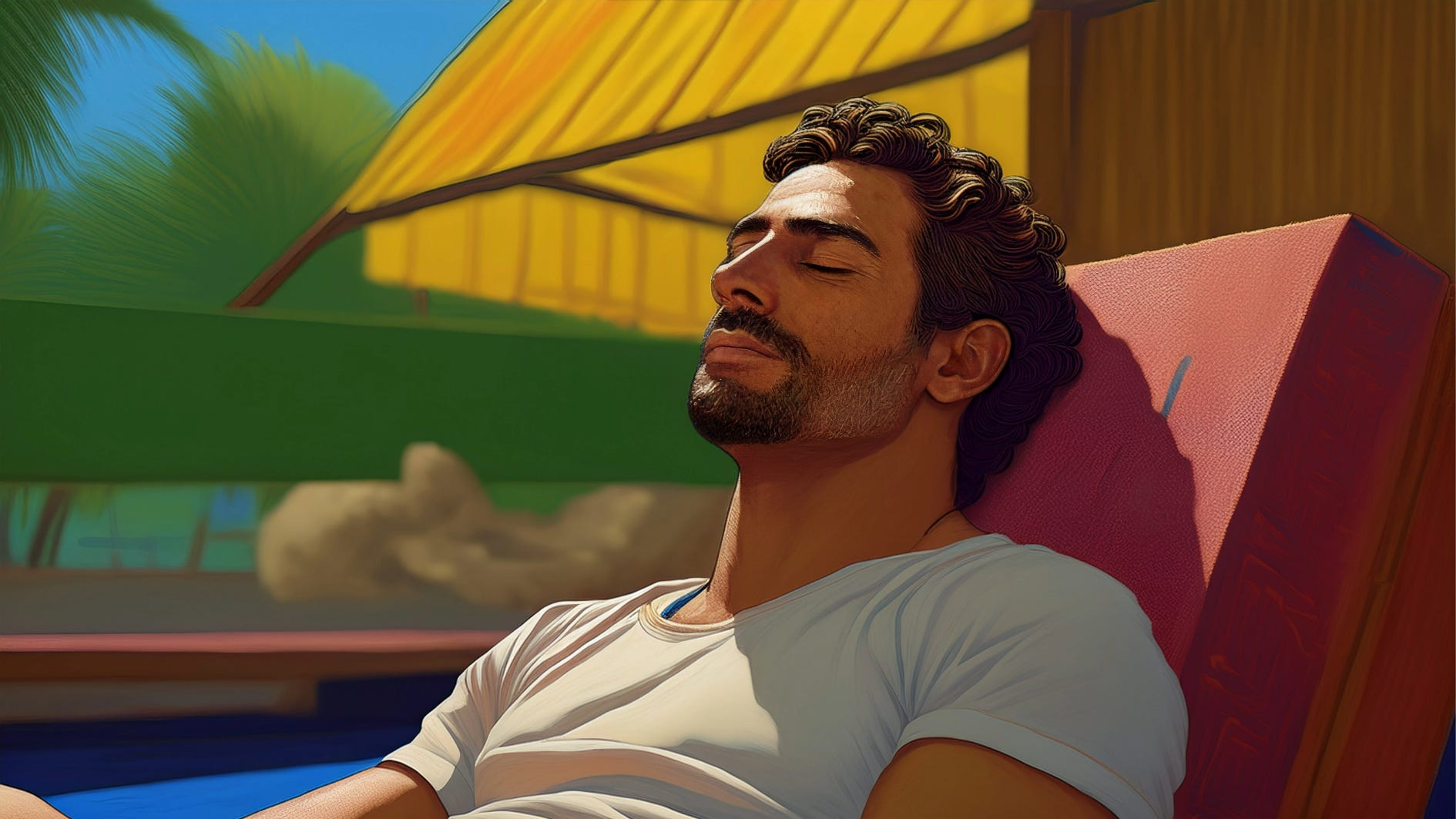
I have always loved rest. I cannot remember a time when I thought of resting as a waste of time. Of course, I was often busy, with school, with work, with family, but I never felt that taking a break was wrong.
Yet in the world I grew up in, the idea of rest was not always viewed kindly. During my National Service in the Singapore Army, we had a term for it: idling. If you are caught doing nothing, then you are labelled an “idle king.” It was an insult, a warning that you weren’t pulling your weight. Worthless. Or worse, being called “chao keng,” a phrase that has no neat English translation, but roughly means someone so lazy that they invent every excuse to avoid work.
Every morning in Africa, when an antelope wakes up, it knows it must run faster than the fastest lion or it will be eaten.
When a lion wakes up in the morning, it knows it must run faster than the slowest antelope or it will not eat.
Whatever it is, when you wake up in Africa, you’d better start running.
Von Bergen, C., & Bressler, M. (2015). Active Waiting As Business Strategy: Learning From The Serengeti Plains. Journal of Business Strategies, 32(1), 21-40.
Those words betray a culture that frowns on those who rest. They coloured how we saw one another, and how we saw ourselves. Resting was seen as suspicious. Weak, worthless to the team. Unless you had just completed an inhuman amount of hard labour, rest was a sign of weakness, as was falling sick. So most Singaporean men, at least, grew up familiar with the relentless drive to be “on the ball.” This culture has permeated entire generations, from the mid-1960s to the present.
I still see this all the time: the inability and unwillingness to take a real break, to do nothing, to idle. Even when there are valid reasons, like recovering from illness or exhaustion. There is always a restless glancing over one’s shoulder, as if to see if anyone was watching. We rest, but we are never restful. Guilt keeps a constant watch.
Why Rest Feels So Hard
Why is it so difficult to rest without guilt? Why do we feel the need to explain ourselves when we are not doing something productive? Something like work?
Part of the answer lies in the story our societies tell us about worth. From an early age, many of us were taught, sometimes with words, often with judgmental glances, that value comes from effort. You’ve got to be busy. To be busy is to be important. I remember being told by a mentor in the company I used to work for that “Not only must you work hard, you must be seen working hard.”
This suspicion of rest runs deep. It is woven into the language we use: don’t be idle, don’t just sit there, take action, stay on top. In many cultures, pausing is seen as a risk, as it can lead to being overtaken by others who continue to move forward in the rat race.
In Singapore, this drive had its roots in necessity. In the early 1960s, the nation was emerging from extreme poverty. Survival was at stake. Families pushed themselves because they had to. The ethic of relentless effort was not just about ambition; it was about putting food on the table, about staying afloat in a precarious world. That urgency, combined with the real experience of hunger, etched itself into the psyche of an entire generation.
The result is a strange paradox. Even when our bodies cry out for rest, our minds resist. We have absorbed the belief that rest must be earned, and only after sufficient toil. Anything less is indulgence.
So we fill our weekends with errands, our holidays with itineraries, our evenings with screens that keep our minds buzzing. We lie down, but we do not rest. We sit still, but inside we are restless. We are always justifying, always defending, constantly checking if anyone notices that we have stopped.
Rest feels so hard because it is not only a physical act — it is a cultural and emotional struggle. To rest freely is to resist the pressure to prove our worth.
The Cost of Never Stopping
There is a price to never stopping, and it shows itself in every part of life.
Physically, the body begins to fray. Headaches become routine. Muscles tighten. Sleep grows shallow, never quite refreshing. The immune system weakens, leaving us vulnerable to every passing flu. Some carry stress in their backs, others in their stomachs, others in migraines that strike without warning. The body keeps the score, and it never lies.
Emotionally, restlessness corrodes our capacity for joy. We become irritable over small things. We rush through conversations without listening. We sit with loved ones, and our minds are still occupied with unfinished tasks. Even when pleasure is within reach, such as a good meal, a child’s laughter, or a quiet evening walking along the beach, all these will slip past us unnoticed.
Spiritually, the cost is even greater. When we never stop, we forget what it means simply to be. We confuse our identity with our output, our worth with our usefulness. Life becomes a treadmill, not a gift to be enjoyed. Ultimately, we risk becoming strangers to ourselves.
I experienced this after we closed the restaurant in 2023. At first, I thought I was failing when I spent long hours doing “nothing,” watching YouTube, pottering about the house, or simply sitting. But I realised that my body and mind were trying to heal from years of overextension. “Wasted” time was not wasted at all. It was the slow uncoiling of tension, the gradual surfacing of hidden exhaustion, the first steps of recovery.
The cost of never stopping is not only burnout. It is the quiet erosion of our soul.
The Wisdom of Rest
If the cost of never stopping is erosion, then the gift of rest is renewal. Rest is not the absence of life or purpose; it is the condition that allows life to flourish.
Even God rested on the seventh day. Across cultures and traditions, wisdom has always made space for rest. The Jewish Sabbath, the Christian Sunday, the Buddhist retreat, and the Mediterranean siesta all carry the same truth: to stop is to regain your strength.
Rest has always been seen as sacred because it is more than recovery. It brings us back to the deeper rhythms that are easy to lose in the noise of daily life.
When we rest, we allow what is hidden to emerge. Artists and scientists alike will tell you that breakthroughs often come not in the midst of effort, but in moments of pause — in the bath, on a walk, in the silence before sleep. In the soil, it is the fallow season that restores fertility. In us, it is rest that renews imagination, clarity, and joy.
Rest is wisdom because it restores us to ourselves. It teaches us that we are more than what we produce, that life is more than what we achieve.
Learning to Rest
Rest does not always require grand gestures. It can be woven into the fabric of ordinary days, if only we allow it to be.
It might look like a quiet walk with no destination, simply moving at the pace of your own breath. It might be turning off the phone for an evening, reclaiming a few hours of undisturbed presence. It might be sitting on your favourite chair at the end of the day and simply idling.
Sometimes, we need longer pauses. Retreats in the mountains, a few days by the sea, or a stay at the local monastery. A longer moment to give us space to step outside the familiar noise and reflect. It is a returning, a listening more deeply to the life we often rush past.
Learning to rest is about giving yourself permission to do so. Permission to stop without guilt. Permission to trust that the world will carry on without you. Permission to believe that rest is part of being human.
When we give ourselves that permission, rest ceases to be an interruption. It becomes rhythm. And in finding the rhythm, life regains its balance. Rest is written into the very fabric of our lives; to pause is to honour the rhythm that sustains us.
Take a break - a good, long break.
When we learn to rest without guilt, we discover that rest is not opposed to work. It gives work meaning. It is the soil where strength, creativity, and joy are renewed.
Rest is where we ready ourselves for what lies ahead.