
Stupid.
Why Is Trump Imposing Punishing Tariffs on Everyone Now?

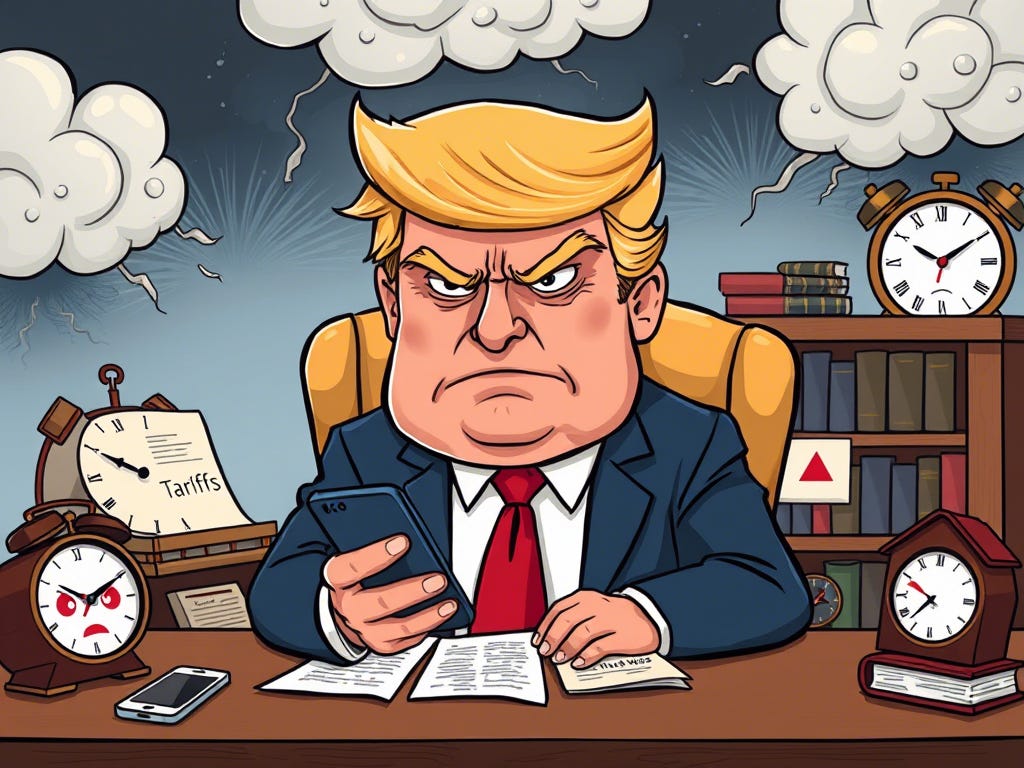
“When I was a boy I was told that anybody could become President.
I’m beginning to believe it.” — Clarence Darrow
This week, my phone was flooded with headlines and commentaries about Trump’s trade war, which is targeting not just China and Europe but even allies like Australia and Canada. Instead of a coherent economic strategy, it feels more like a middle school playground standoff, where the bully is very, very angry.
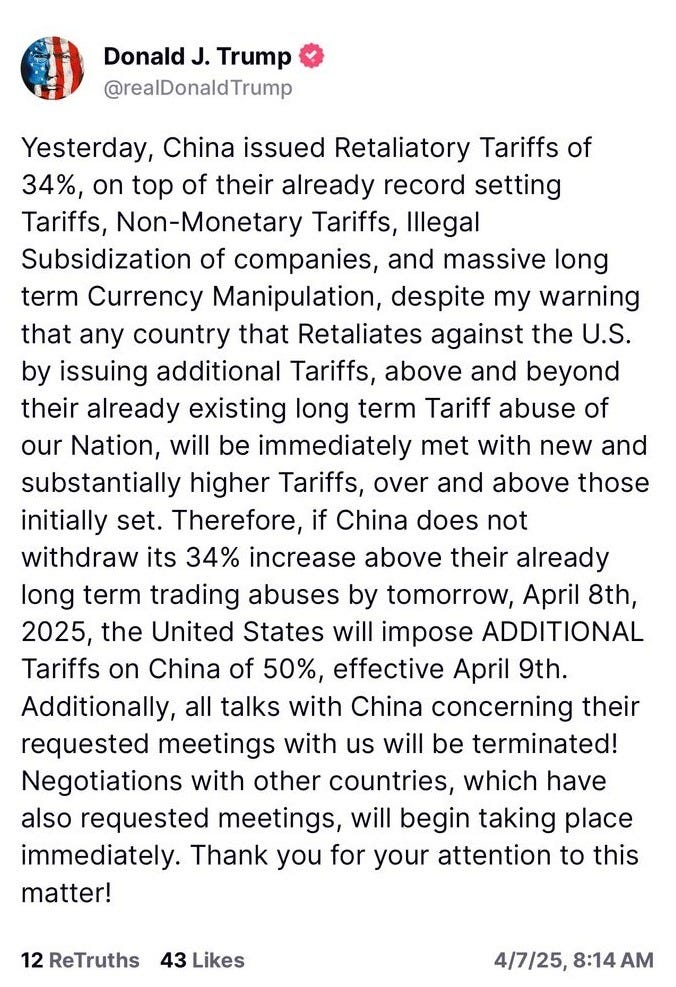
I can almost hear him scream as he tweeted.
As the world braces for impact, financial markets are crashing, and investors are fleeing to gold. But the meltdown is just the beginning. In the days and weeks ahead, an increasing series of retaliations, currency devaluations, and disrupted supply chains could follow.
Trump cannot fully anticipate the ripple effects his actions will unleash. And in the coming weeks, the world may face consequences far beyond what anyone envisioned when the first tariffs were fired.
Stupid.
Why Is Trump Imposing Punishing Tariffs on Everyone?
Last year, I wrote an overly optimistic piece about what could go right with the second Trump presidency.

If his administration de-escalated tensions in Ukraine and Gaza, stopped the wars (or did not start new ones), and improved relations with China, maybe we might see some light at the end of the tunnel.
Well, that light at the end of the tunnel is an oncoming train.
Trump Wants to MAGA
“It’s America’s turn to ‘do the ripping…’” Donald Trump
Donald Trump wants to “Make America Great Again” by revitalizing U.S. manufacturing, reducing trade deficits, and strengthening national security. He aims to make foreign goods so expensive that Americans will buy domestically produced products instead, thereby reducing trade deficits, which he views as evidence of other countries “ripping off” the U.S.
He also seeks to restore manufacturing jobs, appealing to voters in industrial states nostalgic for the good ‘ol days of factory floors and assembly lines. He hopes that tariffs will force companies to relocate production to the U.S. and reverse decades of offshoring.
However, Trump overlooked the structural realities of the U.S. economy and its role in the global system. The U.S. economy is not a manufacturing base but a financial powerhouse, underpinned by the dollar’s status as the world’s reserve currency.
This has provided the U.S. with enormous benefits, from lower borrowing costs to the ability to run persistent trade deficits without consequences.
But to understand why Trump’s tariffs will fail, let’s examine how the dollar became the world’s reserve currency and the unparalleled advantages this has conferred on the United States.
How Did the Dollar Become Great?
The U.S. dollar’s dominance as the world’s reserve currency was due to two key events. In 1971, President Richard Nixon ended the Bretton Woods system by severing the dollar’s tie to gold and allowing the U.S. to adopt a fiat currency system based on trust alone.
Then, the U.S. established the petrodollar system by agreeing with major oil-producing nations, notably Saudi Arabia, to price oil exclusively in U.S. dollars. This created persistent global demand for the U.S. dollar since every country must have dollars to buy oil.
Together, they cemented the dollar’s supremacy, granting the U.S. unprecedented privileges, including the ability to “print money” out of thin air.
These privileges hinge on global trust and continued demand for the dollar in international trade and finance.
The Upside of the Dollar
The high global demand for U.S. dollars, driven by the widespread holding of Treasury bonds, enables the U.S. to borrow at exceptionally low interest rates and finance persistent trade deficits without facing immediate consequences.
Additionally, the dollar’s dominance grants the U.S. significant geopolitical leverage, enabling it to impose sanctions and enforce compliance on the global stage. In extreme cases, this power has been used to freeze or confiscate the foreign reserves of adversarial nations, as seen with Russia in 2022.
Finally, the Federal Reserve enjoys unmatched monetary flexibility, allowing it to pursue policies like quantitative easing (commonly known as “printing money”) without triggering an immediate loss of confidence. This is due to the dollar’s widespread trust and enduring global demand.
These advantages have transformed the U.S. economy from a manufacturing-focused system to a system centered on services, finance, and consumption. This shift enables the U.S. to sustain a high-consumption lifestyle while retaining significant economic adaptability.
The Downside
Despite its advantages, the U.S. dollar’s dominance is threatened by internal weakness and external pressures, made worse by years of overindulgence and abusive behaviour. These have strained global trust and prompted collective efforts to reduce reliance on the dollar.
Rising Debt and Deficits
As of 6 March 2025, the total U.S. federal government debt is approximately $36.56 trillion, raising concerns about its sustainability.
During Obama’s Presidency, the 2008 financial crisis led to increased deficit spending, causing the national debt to nearly double from about $10.6 trillion to $19.6 trillion.
In 2017, during his time in office, Trump implemented massive tax cuts and increased military spending, adding $7.8 trillion to the national debt. His tariffs and trade wars also disrupted global supply chains, increasing costs for American consumers and businesses.
Both the Trump and Biden presidencies increased pandemic-related spending to combat the economic fallout from the COVID-19 pandemic. Both enacted fiscal stimulus measures, including direct payments to households and expanded unemployment benefits, adding $5.6 trillion to the debt.
All these led to massive inflation, which prompted the Federal Reserve to raise interest rates by 525 basis points between March 2022 and August 2023 to stabilise prices. This increased the cost of servicing U.S. debt, creating enormous pressure on the federal budget. The projected interest payment for the U.S. government is $952 billion in 2025.
Erosion of Trust
The erosion of trust in the U.S. financial system has emerged as a critical factor undermining the dollar’s dominance. For decades, the world relied on the dollar as a symbol of stability and a cornerstone of global trade. However, geopolitical overreach, the weaponisation of sanctions, and growing concerns about fiscal irresponsibility have begun to chip away at this trust. As countries grapple with the risks of holding dollars in an increasingly uncertain world, the dollar’s privileged position is no longer untouchable.
America First
Trump’s “America First” philosophy embodies a self-centered approach that prioritizes U.S. interests at the expense of global cooperation, where American gains must come at others’ expense. This perspective reflects entitlement and short-sightedness, driven by emotion rather than strategic foresight.
The sweeping tariff wars against all countries highlight this mindset. By imposing tariffs indiscriminately, Trump sought immediate advantages for the U.S., disregarding the broader harm inflicted on allies and trading partners and throwing out the international rules-based order.
Weaponisation of the Dollar
By weaponizing the dollar through sanctions, the U.S. demonstrated its ability to “bully” other nations, using the global financial system to isolate adversaries. Actions like confiscating $300 billion of Russia’s reserves in 2022 were seen as an overreach, eroding trust in the dollar’s neutrality.
This move highlighted how holding dollars exposes countries to geopolitical risks, especially if they oppose U.S. policies. In response, nations like China, India, and others in the Global South have accelerated efforts to reduce reliance on the dollar, exploring alternatives like local currencies, gold, or new financial systems.
A New World Order
“Novus ordo seclorum"
This Latin phrase, written on the back of the U.S. one-dollar bill,
translates to “A New Order of the Ages"
The global order is transitioning from U.S. hegemony to a multipolar world shaped by rising powers like China and India. Initiatives such as yuan-based trade and BRICS-led financial systems are accelerating efforts to bypass the dollar, reducing U.S. influence. As new players redefine global rules, the decline of U.S. dominance marks the birth of a new world order, one defined by shared power and fairer economic systems.
Why Trump Will Fail
A fundamental mismatch undermines Trump’s tariff policies: the U.S. cannot simultaneously sustain the dollar’s role as the world’s reserve currency and become a global manufacturing superpower.
The dollar’s dominance relies on exporting currency through trade deficits, as global trade requires dollars for transactions and reserves. Achieving manufacturing supremacy would demand trade surpluses, exporting more goods than importing, a goal at odds with running deficits. These two are mutually exclusive.
In addition, the dollar’s strength depends on global trust in the U.S. financial system. Protectionist policies like tariffs erode this trust, signaling a retreat from free trade and globalisation. They raise costs for everyone, potentially stifling growth and innovation.
Trump’s tariffs ignore the structural realities of the dollar-based economy. Attempting to reconcile reserve currency status with manufacturing dominance is impractical and will destabilise the very system that made America great in the past.
A Perfect Storm
The U.S. cannot simultaneously enjoy the privileges of reserve currency status (running trade deficits and financing its lifestyle with “magic money”) while pursuing isolationist policies aimed at reshoring manufacturing.
A combination of factors accelerates the decline of U.S. hegemony and the erosion of the dollar as the world’s reserve currency. Trump’s aggressive tariffs and unpredictable policies have strained alliances and alienated key partners while soaring U.S. debt and rising interest rates have fueled doubts about the currency’s stability.
The contradiction at the heart of Trump’s vision makes this even more self-defeating. “America First” promotes an isolationist, zero-sum mindset that prioritizes narrow, immediate gains at the expense of global cooperation, alienating allies and eroding trust in American leadership. Yet “Make America Great Again” hinges on restoring U.S. global dominance, which requires strong alliances, open markets, and a stable international order. These two goals are fundamentally incompatible: pursuing one undermines the other.
Attempting to square this circle is just stupid. The result will not be greatness but chaos. And chaos will not make America great again.
“What Matters” is free to read. I also appreciate your support as a paid subscriber. But if that’s not your thing, you can also leave a tip. Either way, I am just as glad that you are here.
Please remember to like, restack, and leave a comment.
Interesting analysis of the market forces and the incroguity of Trumps messaging and actions