

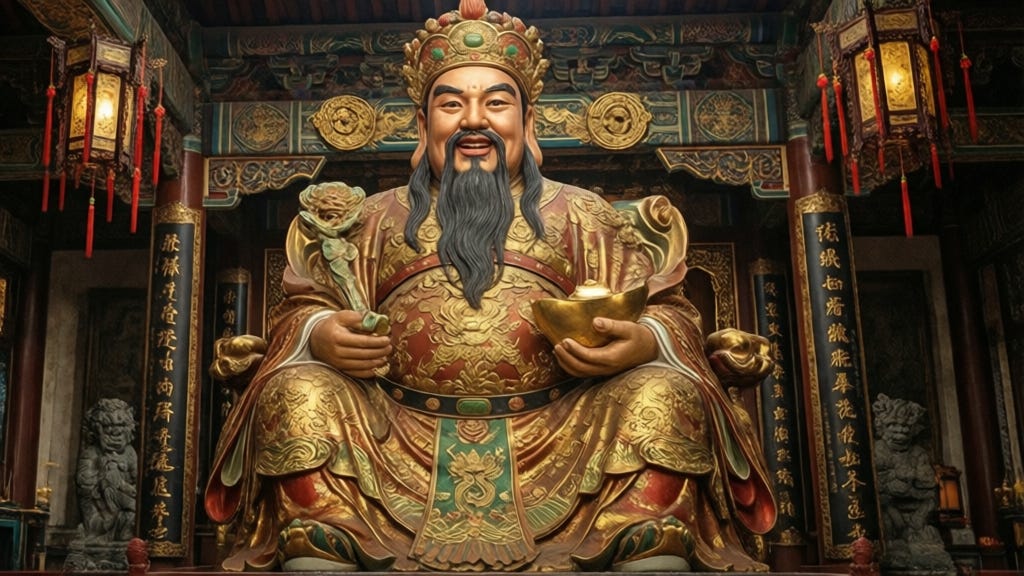
Wealth is an essential aspect of Chinese culture. As an idea, personal wealth did not appear in Chinese societies until the rise of the merchant class. With the beginning of commerce, the philosophy of wealth was built on the foundation of business, specifically in “win-win” relationships. And how exchanging goods and services can help improve the lives of all engaged in business.
In this article, we will explore the idea of wealth from a Chinese perspective and the role of the God of Wealth in Chinese culture. Wealth is more than mere superstition; it is a philosophy of treating others as you build your personal fortune.
First, I will provide a brief history of personal wealth and its origins in Chinese society.
History of Wealth
During the dynastic periods of the Xia-Shang-Zhou dynasties (2070 BCE to 1046 BCE), wealth was mainly in the hands of the ruling elites, in the form of land ownership and the control of labour in an agrarian society.
It wasn’t until the rise of the merchant class during the Spring and Autumn period (770-476 BCE) and the Warring States period (475-221 BCE) that the idea of personal wealth took root in Chinese societies.
These developments were driven by increased trade and commerce between the states and the introduction of coinage as a medium of exchange and a store of value. It made wealth accumulation practical and measurable.
When Qin Shih Huang unified China in 221 BCE, he standardised currency, among other things, and by the time of the Han Dynasty (206 BCE to 220 CE), the Silk Road was well established, and the thriving merchant class traded with South East Asia, India, Persia and as far as Rome and the Mediterranean basin.
It became inevitable that trade and commerce influenced the beliefs and practices of the Chinese people and led to the emergence of the God of Wealth in mainstream society.
We have a God of Wealth?
My most distinctive memory of the God of Wealth was a loud knock on the door in the mornings on the fifth day of every Chinese New Year. “才神到!” someone shouted. It means “The God of Wealth is here!”
This was in the 1960s and early 1970s in Singapore. They were mostly opportunists who asked for money during the Chinese New Year. Most people would give them a dollar or two in a red packet before sending them off. It is bad luck not to open the door for the God of Wealth during the Chinese New Year. It is worse if you chase him away.
During these celebration periods, inviting people into your home is also customary. Wealth is a guest, and one has to be ready and worthy to receive the God of Wealth when he arrives. Wealth enters your home or business freely.
Who is the God of Wealth?
Usually referred to as Cai Shen Ye (财神爷), the God of Wealth is one of the most celebrated deities in the Chinese pantheon.
Although there are many manifestations, the most common were Zhao Gongming (赵公明) and Bi Gan (比干). They were officials revered for their virtues and benevolence while alive. They took their places in temples and shrines as models for devotees and showed them how to conduct themselves ethically in their daily affairs.
Today, businesses and Chinese communities worldwide have statues or images of these deities. It’s a common practice to pray to these figures for good fortune and success during major business decisions or at the start of the Chinese New Year.
It also serves as a constant reminder that one should conduct one’s business ethically, worthy of the favours of the God of Wealth.
Wealth as a religion
The worship of the God of Wealth is integral to Chinese culture. It dates back to the earliest appearance of the idea of wealth in Chinese societies.
But wealth is not just material riches. It includes abundance, prosperity, and good fortune.
This concern with wealth permeates every aspect of daily life. If you have lived in a predominantly Chinese society, statues of the God of Wealth, auspicious words and signs, and greetings centred around wealth are abundant. “Gong Xi Fa Cai” (恭喜發財) reflects the centrality of wealth in social interactions.
Principles of Creating Wealth
To understand why the Chinese hold such reverence for the God of Wealth, and particularly the value of accumulating wealth, we have to examine the historical, cultural, and socioeconomic context that governs Chinese societies.
Cultural Emphasis on social stability and group welfare
Wealth is not just personal success but also about ensuring social stability and continuity.
It is based on Confucian ideals of harmony and group welfare, a philosophy that prioritises the interests of the group above those of the individual.
This sense of striving for the greater good is the foundation for creating wealth—the same principles espoused by the Gods of Wealth when they were mortals.
Practice of Fair Trade and Commerce
Fair trade, as a principle of wealth creation, means that for one to become wealthy, others must also benefit.
The importance of relationships (关系, guanxi) in Chinese business culture promotes not just networking and social capital but, more importantly, ethical considerations.
Confucian, Daoist, and even Legalist traditions warned against the dangers of nepotism or corruption and promoted the importance of mutual respect and trust.
Striving for collective benefit is an important aspect of common prosperity. We can build the trust needed to grow wealth only when we consider win-win propositions.
Symbolic Significance of Optimism
Invoking divine favour also creates a sense of optimism that encourages the risk-taking needed for business ventures.
By constantly striving to improve their lives, the Chinese also understand the need to sacrifice and take risks to become wealthy. Do your best and hope it is good enough to find favour with the God of Wealth.
Ethical Wealth Acquisition
Confucius said, “While it is understandable for a gentleman to desire wealth, he must gain it ethically.”
君子爱财,取之有道
This Emphasis on ethical business dealings is a constant reminder to those who want to enrich themselves. For example, Bi Gan is remembered not for his wealth but for his integrity and righteousness.
Thus, reverence for the God of Wealth encompasses respect for ethical practices and the belief that good deeds lead to divine favour and blessings.
From a practical perspective, this is especially true of businesses that strive to be good corporate citizens. Wealth, in the Chinese context, should always result from best practices and delivering good value.
Social Aspiration
Wealth means social mobility and status in many parts of Chinese society worldwide. Each generation aspires to do better than the previous. This drive to build a better life motivates people living in difficult circumstances to escape poverty.
The God of Wealth becomes a focal point of personal and collective aspirations, embodying the hopes for economic advancement and improved social standing.
This reverence is prominent among the middle and lower economic classes, for whom the God of Wealth represents the possibility of better lives and the acquisition of riches.
This provides many people with a strong hope and aspiration for a better life, especially for future generations.
Festivals and Celebrations
Rituals are an essential factor in cultivating the mindset necessary to become wealthy. These acts provide structure and continuity in daily life.
They also help strengthen community bonds through shared practices and beliefs, aiming at collective prosperity.
The Chinese Art of Creating Wealth
Worshipping the God of Wealth is mostly a symbolic ritual. Understanding the key principles of acquiring wealth is essential.
Consider the interests of the group. This means considering others’ needs and putting them ahead of your own. In Chinese philosophy, wealth is created when we focus on society’s needs and social harmony.
Practice Fair Trade. Wealth is a win-win proposition. When we conduct our business with this aim, we want the other party to benefit from doing business with us. This builds trust and ensures continuity. It will also inevitably lead to mutual prosperity.
Be optimistic. While worshipping the God of Wealth may be superstitious today, optimism isn’t. Optimism is having enough faith that a sound proposition can lead to success. If the foundations are strong and relationships are built on trust and mutual benefit, the chance of creating wealth is good.
Be ethical. Do not cheat or steal, and deliver value. Good practices and honesty are the foundation of excellent businesses. They build a reputation and help customers trust you.
Have aspirations. For many Chinese, the aspiration for a better life is an ongoing, multi-generational affair. We hope that tomorrow will be better than today and that our children will live better lives than ours. It gives us hope.
Rituals to remind you. Whether it is the status of the God of Wealth or a Post-it note with your life goals written on it, it is important to remind yourself of what you want to achieve. Create reminders for yourself. If you follow these principles and live a good life of diligence and hard work, wealth will eventually enter your life. Be optimistic.
In Chinese culture, the God of Wealth is mixed with history, ethics, and values. The art of creating wealth is a practical approach to improving the lives of those around us.
Wealth includes aspects of moral conduct, aspirations, and communal harmony, and it offers insight into the role of beliefs in prosperity.