
The Fire Horse Returns
A Historical Perspective of the Bing Wu Year

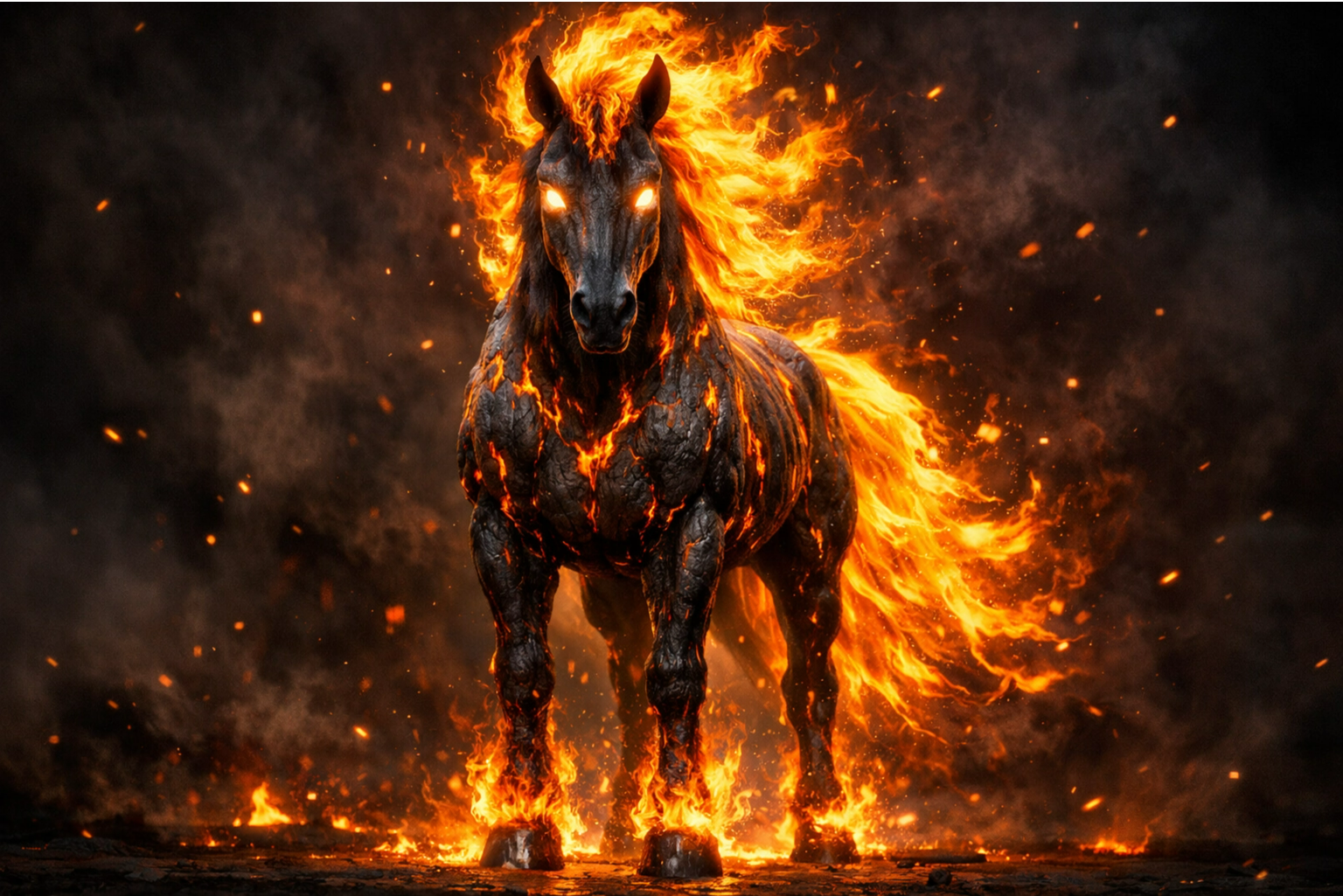
I was born in 1966, a Bing Wu (丙午) year, the Year of the Fire Horse.
As a Catholic, then, regarding myself as a “Fire Horse” was considered superstitious. It was just something “heathens” believed in. As I’ve gotten older, I’ve noticed that this ancient Chinese wisdom points to a deeply profound collective experience that should not be ignored.
This year, 2026, is one of those years. Not just because the world already feels so unstable. For people born in 1966, it’s also a return point in the traditional 60-year cycle. The sign returns, offering a perspective of warning and opportunity.
The 60-year cycle
The Chinese see time as cyclical. The sexagenary cycle (干支) combines ten heavenly stems and twelve earthly branches into sixty pairs, so that a full cycle is 60 years.
(If you’re wondering why not a 120-Year cycle, there’s an explanation at the end of this article.)
In the traditional system, Bing (丙) is Yang/Fire, often compared to the sun: direct, visible, forceful. Wu (午) is the Horse branch (also fire by nature) tied to noon and midsummer. Together, you get what the Chinese call “double fire,” intensity on intensity.
A Warning for those in power
One of the most cited “volatility” frames is the “Red Horse and Red Goat calamity” aka 赤马红羊之厄. It refers to the two-year span of Bing Wu (丙午) followed by Ding Wei (丁未). In our context, this is 2026 and 2027.
Bing and Ding are both fire stems, linked to “red.” Horse and Goat are adjacent branches. This does not mean that calamity is inevitable, but that when the heat is high, weak governance and fragile social structures get tested to the extreme.
Chinese history is filled with such examples and lessons from the red “Horse and Goat” periods.
1126–1127, Northern Song: Jingkang Incident 靖康之变
The Jingkang Incident was not a single “bad day.” It was a rapid sequence that exposed just how unprepared the Northern Song Dynasty was for a steppe war from the invaders of the North.
The trigger was the rise of the Jurchen-led Jin dynasty, founded in 1115, which turned on the Northern Song after the Song had allied with the Jurchen against the Liao. From 1125, the Jin launched a full-scale war against the Song, and by December 1126, they besieged the Song capital, Kaifeng (then called Bianjing).
Facing an inevitable invasion, Emperor Huizong abdicated, and his son, Emperor Qinzong, inherited a collapsing empire. The city’s defences included early experiments with gunpowder weapons (not decisive in the modern sense, but notable as an early recorded battlefield use), yet no effective relief force arrived. Kaifeng fell in mid-January 1127.
What followed was remembered as humiliation as much as defeat: looting and destruction, mass atrocities, and the seizure of the imperial house. Emperor Qinzong and his father, Huizong, were taken prisoners, along with large numbers of court officials and members of the imperial clan. Qinzong remained captive until his death.
The political consequence was immediate and permanent. With the capital lost and both emperors captured, the Northern Song effectively ended, and Qinzong’s half-brother, Zhao Gou, escaped south and reestablished the dynasty in 1127 as the first emperor of the Southern Song (Gaozong). The dynasty survived, but with vastly reduced territory, while the north remained under Jin control.
The human consequence was just as profound: 靖康 also helped trigger one of China’s great north-to-south population shifts, often compared to the earlier 4th-century flight south after the Yongjia-era upheavals, as officials, elites, and families moved into the Yangtze basin and the southeast, accelerating the long-term drift of China’s demographic and economic centre toward the south.
That is why the Jingkang Incident endures in Chinese memory: it’s not just a military loss. It’s a moment when a state’s strategic misjudgments, fiscal and military weaknesses, and inability to mobilise effective defence were exposed under extreme pressure, and the cost was a dynastic fracture that reshaped China for generations.
1846–1847, late Qing: pre-Taiping unrest
The 1840s were a turning point for the Qing Dynasty. In 1840, the First Opium War broke out, opening a new era of foreign pressure and internal crisis for China. By the mid-1840s, the dynasty was already under tremendous structural stress: rural hardship, local security problems, and a growing gap between central authority and what counties could actually control. Guangxi in particular was a combustible region facing sharp resource pressure and social conflict, where poor farmers, miners, charcoal workers, and migrant communities were vulnerable to banditry and clan violence.
This is the backdrop for why 1846–1847 matters.
The Taiping story begins with Hong Xiuquan, a failed civil service exam candidate who developed a syncretic Christian-inspired doctrine and a mission to purge “evil” from society. His schoolmate Feng Yunshan was the organiser. In 1844, Hong and Feng preached in Guangxi; Hong returned home, but Feng stayed behind to build what became the God Worshippers’ Society (拜上帝会) among impoverished communities in Guangxi.
In 1847, Hong rejoined Feng in Guangxi and was accepted as the society’s leader. This was the moment the movement became organised and formidable, with a shared doctrine and a growing base.
From there, things escalated quickly. When Qing troops attacked the God Worshippers in July 1850, open rebellion broke out. Within months, Hong proclaimed a new dynasty, the Taiping Tianguo (太平天国, Heavenly Kingdom of Great Peace), and assumed the title Tianwang (Heavenly King).
The war that followed (1850 to 1864) was one of the deadliest conflicts in human history. Britannica estimates about 20 million deaths, and other modern historians estimate up to 30 million deaths, reflecting uncertainty and the huge proportion of deaths from famine and disease tied to the war.
So 1846–1847 earns its place in history because it captures the moment when the fuse is lit: hardship is rising, local governance is weakening, and a movement with both a spiritual claim and a social program acquires leadership, structure, and a mass base, setting the stage for an explosion a few years later.
1906–1907, late Qing: reform scramble and social shocks (leading to the fall of the Qing)
In these years of the Fire Horse, the turmoil in China was institutional in nature. After the shocks of the late 19th century, the Qing court tried to modernise rapidly enough to survive, but the effort satisfied no one. Conservatives saw reform as surrender. Reformers saw it as too slow. The result was a growing legitimacy crisis, playing out in public view: a dynasty still wearing imperial robes but increasingly forced to speak the language of constitutionalism.
This matters because 1906–1907 also marks the end of the empire’s final break. By 1911, a chain of political and financial missteps, including the railway nationalisation crisis and resulting unrest, helped trigger the tipping point. On 10 October 1911, the Wuchang Uprising broke out, an event widely treated as the formal start of the Xinhai Revolution.
Provinces declared separation from Qing rule, power fractured, and negotiations reshaped the state. On 12 February, 1912, the child emperor Puyi abdicated, ending China’s last imperial dynasty and opening the Republican era.
1966–1967, modern China: the Cultural Revolution as rupture, and the long runway to reform
The Cultural Revolution did not begin as a vague mood shift. It began as a political decision, with a date you can put on the timeline.
Many historians treat 16 May, 1966 as the moment the movement was declared, when a key Party document warned of “bourgeois” infiltrators inside the system. Mao then formally launched the Cultural Revolution at the Eleventh Plenum of the Eighth Central Committee in August 1966, and the country moved rapidly into mass mobilisation and institutional breakdown.
Mao pursued his goals through the Red Guards, mobilising urban youth to attack “bourgeois” elements and the “Four Olds.” Schools were shut, public struggle sessions spread, and violence escalated with little oversight. Key leaders were purged early, most notably Liu Shaoqi and Deng Xiaoping, who were removed from power during the initial phase.
By January 1967, the movement shifted from symbolic denunciation toward the overthrow of provincial Party committees and attempts to build replacement power structures. Through 1967, factional conflict worsened, including armed clashes between rival Red Guard groups, and Mao called on the PLA to intervene, which did not stabilise the situation but deepened the chaos.
The Cultural Revolution ran on until 1976 (and was officially declared over later), leaving the economy disrupted and the political system traumatised.
After Mao’s death in September 1976 and the fall of the Gang of Four in October 1976, the internal conditions changed. In the years that followed, Deng Xiaoping emerged as the central figure who restored domestic stability and pushed China toward economic growth. Scholars frame Deng’s legacy specifically as restoring stability and growth “after the disastrous excesses of the Cultural Revolution.”
In other words, the Cultural Revolution is not “the beginning of reform,” but it is part of the reason reform became politically and economically necessary. It burned through the old system, and the post 1976 leadership had to rebuild a workable model for the country.
Bing Wu can also mark golden years
Chinese history also remembers the Fire Horse years as periods of extraordinary competence and cultural bloom. A golden age when those in power got their act together.
646, Tang Taizong: Zhenguan Good Governance
This Bing Wu year sits near the mature end of Tang Taizong’s reign, inside the period later praised as the Zhenguan era of good government. What makes it more than a nostalgic label is that we can point to specific state capacities: tax relief for disaster-stricken regions, relief granaries to buffer famine, and a countryside described as enjoying low prices and general prosperity.
But “flourishing” in the late 640s was not only about domestic administration. It was also visible in how the Tang Dynasty projected confidence outward. In 646, Tang forces defeated the Xueyantuo, turning them into Tang vassals, part of a wider expansion of Tang influence across the north and into the Tarim Basin. This mattered because it stabilised corridors that promoted trade, diplomacy, and the sharing of knowledge.
This was expressed in the Capital Chang’an (Perpetual Peace) as a key eastern terminus of the Silk Roads and, under the Tang Dynasty, a major trade hub with a “surprisingly diverse” population, including many from Sogdiana, the Central Asian merchant culture whose networks connected Eurasian routes into China.
UNESCO notes that one of the few surviving Tang structures that reflects these Silk Road exchanges is the Big (Giant) Wild Goose Pagoda, built to house the scriptures brought back by the monk-scholar Xuanzang. The pagoda’s construction, dated to 652, is a sign of the prosperity and stability of the Zhenguan era, which created the stable, wealthy capital where large scholarly projects like Xuanzang’s translation work could be protected and scaled.
1726, Yong Zheng: the reform furnace
This Bing Wu year sits inside Yong Zheng’s reign (1722–1735), which historians consistently describe as a period of hard, technocratic consolidation. Yongzheng is remembered less for glamour than for a governing style that tightened control, attacked corruption, and rebuilt state revenue. He checked corruption, enforced laws, and reorganised finances, thereby increasing state revenue.
Rebuilding fiscal legitimacy by changing how taxes were assessed
One of Yong Zheng’s hallmark reforms was expanding the policy commonly known as tanding rumu (摊丁入亩), folding the head (poll) tax into the land tax. Yongzheng extended and rolled this out nationally beginning in the mid-1720s, shifting taxation away from counting people and toward taxing land, easing burdens on landless peasants while improving state control over revenue and reducing tax evasion.
Reducing “informal extraction” by making local finance more rules-based
Another major Yongzheng era move was to rationalise the messy world of local surcharges and hidden fees that encouraged corruption and instability. A recent quantitative study of Ming-Qing fiscal revenue describes Yong Zheng’s attempt to legitimise extra-legal conversion surcharges (huohao) into official revenue, including the well-known yanglian silver (养廉银), often treated by scholars as a hallmark of rational fiscal reform because it aimed to fund local administration more transparently and reduce the incentive for predatory fee-taking.
Therefore, in 1726, the “fire” horse was not chaotic. It was the concentrated heat that purified governance, pushed reforms that hardened the state: tightening discipline, rationalising fiscal flows, and rebuilding trust in the administration’s ability to function competently.
Bing Wu can become an accelerator that amplifies both weakness as well as strength.
“Great changes unseen in a hundred years”
Chinese President Xi Jinping’s phrase “great changes unseen in a hundred years” (百年未有之大变局) resonates well in the Year of the Fire Horse in 2026 because it captures something that’s almost impossible to miss: the world’s old structure is failing, and everything is shifting. One key reason is that, over the past several decades, China has shown it can plan ahead, marshal resources, and deliver results at scale.
As of 2025, China has about 50,000 kilometres of high-speed rail, the largest such network on Earth. In energy, China’s clean-power capacity recently surpassed its fossil-fuel capacity, and the International Energy Agency now calls China the main global driver of renewables.
On the human side, the World Bank estimates that nearly 800 million people in China were lifted out of extreme poverty in 2020, accounting for the largest share of global poverty reduction. This was no small feat for a country of 1.4 billion people. As of 2021, China is focused on consolidating its gains and preventing a return to poverty.
In technology, China’s space program has hit major milestones, like bringing back the first samples from the far side of the Moon with Chang’e-6 in 2024, a mission that demonstrates serious depth in engineering and project discipline.
None of this means China is perfect or without problems. But it’s clear that when China sets its mind to something, it can make things happen, and fast. That’s part of why this Bing Wu feels like an accelerator: the familiar routes are gone, new ones are opening up. Change is here.
What the Fire Horse means for us
The Fire Horse year is best understood as a stress test.
Fire doesn’t only destroy. It reveals. It shows what is solid and what is fragile, what is real and what is fake. There’s a Chinese saying: 真金不怕红炉火, real gold does not fear the furnace. Extreme heat reveals our true nature.
That’s a useful way to welcome the Year of the Fire Horse. It accelerates. Weak structures will collapse. Empty slogans will fail. But competence will compound. Good systems will earn trust. People with real skill and steady values gain an edge because they will pass the test.
The question isn’t whether the year is “good” or “bad.” It’s whether we will survive the heat. Focus on building what can pass the furnace test: skills that endure, relationships that hold, institutions that are legitimate, and projects that will leave a useful legacy behind.
Bing Wu will turn up the temperature. And when the temperature rises, the strong become recognisable, in the world, and in ourselves.
Note: Why 60 and not 120?
The reason the sexagenary cycle consists of 60 unique combinations instead of 120 is due to the mathematical concept of the Least Common Multiple (LCM) and a structural restriction known as the “parity rule”.
Why only a 60-year cycle?
The ten Heavenly Stems and twelve Earthly Branches are paired sequentially. Because 10 and 12 share a common factor of 2, the two cycles do not produce every possible mathematical permutation. Instead, the sequence restarts as soon as it reaches the Least Common Multiple of the two numbers:
LCM(10, 12) = 60
After 60 pairings, the sequence returns to its starting point (Jia-Zi), leaving half of the theoretical 120 combinations unused.
The Parity Rule (Yin and Yang)
Metaphysically, the cycle is governed by the law that Yang and Yin elements cannot pair with one another. Every stem and branch is categorised as either Yang or Yin based on its position in the sequence:
Yang (Odd-numbered): Stems 1, 3, 5, 7, 9 and Branches 1, 3, 5, 7, 9, 11.
Yin (Even-numbered): Stems 2, 4, 6, 8, 10 and Branches 2, 4, 6, 8, 10, 12.
A Yang Stem will only ever pair with a Yang Branch, and a Yin Stem will only ever pair with a Yin Branch. This restricts the total number of valid pairings to:
(5 Yang Stems X 6 Yang Branches) + (5 Yin Stems X 6 Yin Branches) = 60
Consequently, combinations such as a Yang Stem with a Yin Branch (for example, Jia-Chou) never occur in the traditional calendar. This completed 60-year cycle is often referred to as a Jiazi, figuratively meaning a full human lifespan.