

My encounter with the Heart Sutra began rather unexpectedly—it was on YouTube. It was through the haunting voice of a Japanese Zen monk and rock singer, Kanho Yakushiji. I have shared the link here:
I remember feeling a certain stirring when I first heard it. The visual was interesting because it featured a Zen monk who is a rock star. What a combination!
I shared the video with my wife, and we watched it repeatedly. We found the song on Spotify and added it to our playlist. I listened while I was doing my prep in the kitchen, and I felt a sense of peace and calm I hadn’t felt in a long time.
I am curious. I had to know more.
What’s the Heart Sutra?
The Heart Sutra, known as the Prajnaparamita Hridaya, is one of the most revered texts in Mahayana Buddhism. Its concise yet profound teachings on emptiness and wisdom have made it a central focus of Buddhist practice and philosophy.
Prajnaparamita means “Perfect Wisdom”, and Hridaya means “heart”, so that the Heart Sutra literally means the “perfect wisdom of the heart.”
In the Chinese version translated by Xuanzang, it’s only 262 characters, encapsulating the essence of Buddhism. It is so concise that nothing from the thousands of lines of scripture is left out.
In this article, I want to share my thoughts and feelings about the Heart Sutra.
For those not familiar with the text, here’s my translation for my readers’ benefit. I wanted to write it as close to normal language as possible, which is quite challenging, so please bear with me. It is not a “translation” per se, since these are awkward considering it was originally in Sanskrit.
The Heart Sutra - 心经
This is the sutra as I understand it.
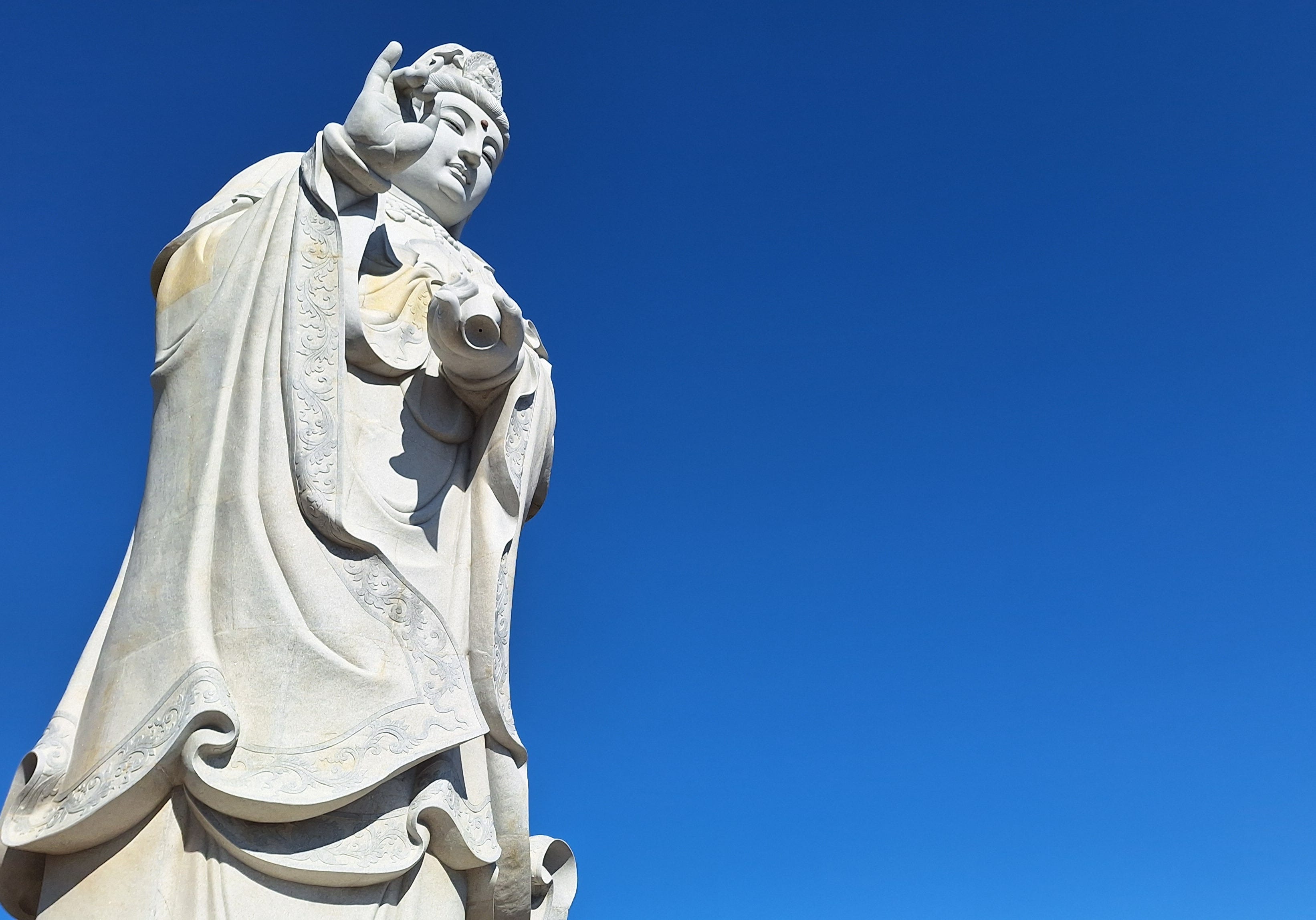
Avalokiteshvara Bodhisattva, also known as “the Lord who looks down with compassion”, realised that all five 1Skandhas are empty, and with this realisation, he overcame all suffering.
Shariputra, my disciple, form does not differ from emptiness,
and emptiness does not differ from form.
Form is emptiness, and emptiness is form.
The same goes for feelings, perceptions, thoughts, and consciousness.”
Shariputra, everything is emptiness;
It is not born, nor can it be destroyed.
It cannot be defiled, nor can it be made purer,
It cannot be added to, nor can it be taken away from.
Therefore, in Emptiness, there are no forms, no feelings, no perceptions, no thoughts, and no consciousness.
There is no eye, no ear, no nose, no tongue, no body, no mind;
There is no sight, no sound, no smell, no taste, no touch, no thoughts;
There is no realm in which you can see,
There is no realm in which you can be conscious.
There is no ignorance or the end of ignorance,
There is no death or the end of death;
There is no suffering, or the cause of suffering, or the end of suffering,
There is no wisdom to attain, and even attainment itself is emptiness!
Since there is nothing to attain, the bodhisattva simply dwells in Perfect Wisdom, so that the mind is free from illusion and fear.
And therein realise enlightenment.
All Buddhas of past, present, and future rely on Perfect Wisdom to arrive at this unsurpassed, complete, and perfect enlightenment.
So understand that Perfect Wisdom lies in this great mantra, this supreme mantra, this mantra beyond compare, which can remove all suffering.
Now repeat after me!
Go! Go! Go beyond! Go completely beyond! And awaken!
History of the Heart Sutra
The Heart Sutra originated around the 1st century CE. This original body of texts was developed about 400 years after the death of Shakyamuni Buddha (aka Siddhartha Gautama) and includes various versions ranging from 8,000 to 100,000 lines.
The popular version of the Heart Sutra today is therefore a condensed version that captures the essence of these teachings, making it accessible for common practitioners.
One of the most significant figures in the history of the Heart Sutra is Xuanzang, a monk from the Tang Dynasty in China. Xuanzang embarked on an epic journey to India in the 7th century, driven by his quest to obtain authentic Buddhist scriptures. This was later fictionalised in the Chinese Classic Journey to the West.
Xuanzang travelled thousands of miles across treacherous terrains, deserts, and mountains to reach India, where he studied with renowned Buddhist scholars at Nalanda, and collected many texts, including the Heart Sutra.
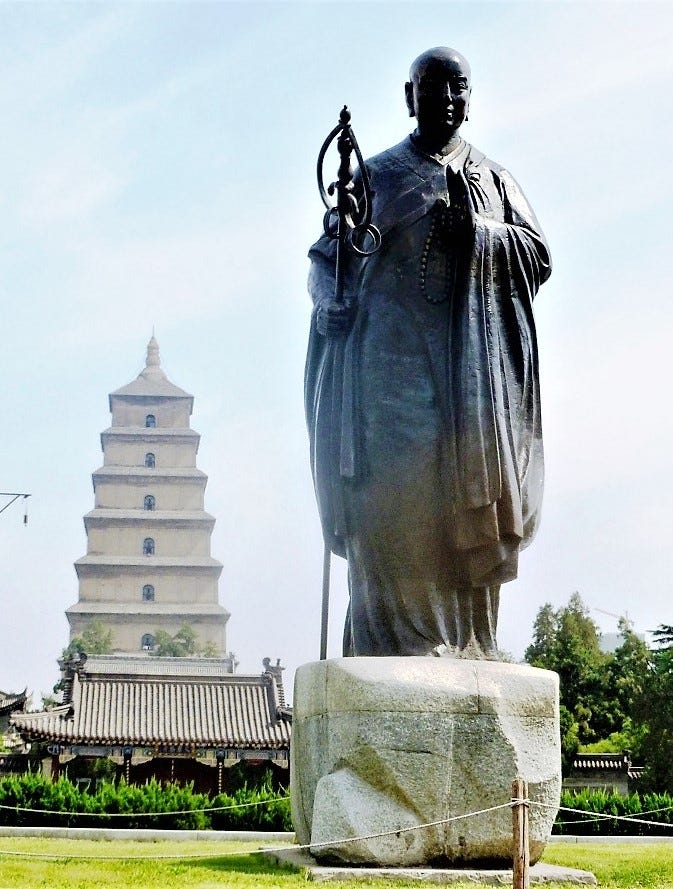
Upon returning to China, Xuanzang translated these scriptures into Chinese, including the Heart Sutra. His translation played a crucial role in popularising the text in China and throughout East Asia, contributing to the spread of Buddhism.
Xuanzang’s translation is one of the most widely used versions today, and helped establish the Heart Sutra as a central text in Mahayana Buddhism. His efforts not only preserved the teachings but also made them accessible to millions, allowing the wisdom of the Heart Sutra to flourish across cultures.
The Essence of the Heart Sutra
The essence of the Heart Sutra centres on the concepts of emptiness (śūnyatā) and the interdependence of all things. These are some of the core themes that define the Heart Sutra and its significance for practitioners seeking a deeper understanding of reality.
Emptiness
The Heart Sutra teaches that all things, including physical forms and mental experiences, are empty of inherent existence. This means that nothing exists independently or permanently; everything is interconnected and arises because of various causes and conditions.
This is often mistaken for nihilism in the West. But “Emptiness” is not “nothingness”. While nihilism holds that life is meaningless and denies the existence of intrinsic value or purpose, emptiness holds that everything lacks inherent existence. It does not mean that things do not exist; rather, they are interconnected and impermanent.
Incidentally, Taoism has a simpler explanation of emptiness. A cup is useful because of the emptiness (non-cup, or space) in the cup. A cup with no space is not a cup. Therefore, form (cup) is emptiness (non-cup), and emptiness is form. The two cannot be separated.
Interdependence
The Heart Sutra emphasises that because everything depends on one another, they lack a fixed essence. This interconnectedness is key to understanding reality. When we see everything is interdependent, we also recognise the futility of clinging to any single aspect of existence. This is further explained in the article You are a lump of clay.
This insight encourages compassion, giving us a sense of connection with all beings, and reminding us that our lives are inextricably linked to those around us.
We are each of us and all of us.
The Nature of Reality
This immortal line: “Form is emptiness, emptiness is form” is the centre of the Heart Sutra. It illustrates that everything we perceive as real (form) is, at its core, empty.
Emptiness cannot be separated from form, since it manifests as the very forms we see and experience.
This paradox challenges how we usually perceive the world and encourages us to see beyond appearances. And to understand that form and emptiness are inseparable aspects of the same reality, like two sides of a coin.
Liberation from Suffering
By realising the emptiness of all phenomena, one can overcome attachment and aversion, which are the root causes of suffering (Saṃsāra).
Saṃsāra is a Sanskrit term referring to the continuous cycle of birth, death, and rebirth across various realms of existence. Saṃsāra is caused by ignorance (avidya), particularly ignorance about reality, impermanence (anicca), and the concept of non-self (anatta). This ignorance leads to attachment and craving, which bind individuals to the cycle.
A bit like William Blake’s “Mind-forg’d Manacles” in his poem London.
Understanding emptiness allows us to let go of the delusions that bind us to the cycle of suffering. This insight leads to mental balance and even-mindedness, freeing us from fear, anger, and desire.
Ultimately, the realisation of emptiness is the path to enlightenment, enabling each of us to experience liberation.
Compassion
The Heart Sutra also highlights the importance of compassion, especially through Avalokiteśvara, who embodies compassion itself. Realising emptiness should be accompanied by compassion towards all sentient beings.
True wisdom is inseparable from compassion, since understanding the emptiness and interdependence of all things naturally gives rise to empathy and a desire to ease others’ suffering.
I would like to recall my favourite story, attributed to Hui Neng, the Sixth Patriarch of Chan (Zen) Buddhism in China, about compassion.
A monk asked Hui Neng, “What must I do to enter Nirvana?”
Hui Neng said. “You must be free of all passions.”
The monk asked, “Oh, was the Buddha free of all passions?” cheekily.
Hui Neng said: “No. The Buddha had one great passion, and it was to save all sentient beings.”
“So what happened to the Buddha after he died?” the monk asked.
“He went straight to hell,” said Hui Neng.
The monk was shocked. “How can that be?”
Hui Neng said, “Because only in hell can he continue to save sentient beings.”
Lessons from the Heart Sutra
I remember when I first became interested in learning about the Heart Sutra; I used to listen to it while doing my prep in the kitchen, mostly wrapping dumplings. I would listen to it repeatedly, and it would bring peace to my heart.
Realising Emptiness
There were moments of calm and clarity that vanished when I tried to cling to it. Perhaps that’s the nature of form and emptiness.
It is difficult to always know that everything is interconnected. It is harder to reduce attachment and fosters compassion towards others. How do you look upon the suffering of others, the evil that men do, and not feel the anger and frustration? And suffer?
But I think the point is not to be indifferent but to cultivate empathy and compassion. Then let go. Do not cling to it. Good or bad. Letting go is inevitable when you realise everything is essentially empty.
Meanwhile, we do all we can to help others ease their suffering.
Overcoming Duality
Duality is a funny thing. I know what it is, but it is extremely difficult to pin down.
That’s because we are all taught to think dualistically. This is right, that is wrong. This is an apple, and that is not an apple. I am me; you are you. I have previously written about it in:

The rejection of dualistic thinking is the foundation of Zen Buddhism. Not this, not that. It encourages us to move beyond simplistic notions of right and wrong, or of self and others, and helps us understand reality. There are many stories and instances of Zen masters helping the clumsy student realise the true nature of things. Usually through a koan (riddle).
Form is emptiness, and emptiness is form.
Direct experience
True wisdom arises from direct experience rather than intellectual understanding. But what is direct experience?
Eating an ice-cream cone on a hot day.
That’s a direct experience.
Thinking about how you might put on weight and the calories you have to lose, and maybe you should have gone with sorbet instead of chocolate and caramel, and why is that person staring at me? Is there something on my chin? And these damn flies…oops, did one just land on my ice-cream? Can I eat it? Oh, I shouldn’t have walked this way…I hate summer…and I hate Paul. What a bloody crook! How could he do that! I should have…
That’s not a direct experience.
Conclusion
There is much to be said about embracing the concepts of emptiness, interdependence, and non-duality, so that one can move beyond the illusions that create suffering. That ultimately, the Heart Sutra can lead us toward enlightenment and liberation beyond the further shore.
I hope I did some justice to the Heart Sutra. It is a personal take on something close to my heart. Something I want to share over dinner with friends and family. And I hope, like Zen masters, we do not take all of this too seriously.
I think realising Nirvana could be like trying to move your ears. I always wondered how I could do it. I have seen my uncle move his ears, so I know it is possible. But how?
Without wanting or really trying, it happened one day. I discovered my auricular muscles, and I can move my ears. It was there all the time.
I had a big belly laugh and said to my younger brother, “Hey, Meng! Watch this…”
“Go! Go! Go beyond! Go completely beyond! And Watch This!”
The five Skandhas are: Forms - everything you can touch, see, smell, taste, etc. Feelings - love, hate, joy, fear, etc. Perceptions - our interpretation of sensory information, like “This is a flower. That is a snail, etc. Cognition - Thoughts, emotions, habits. Everything that goes on in your mind. Consciousness - Your awareness of everything around you, including self-awareness.
Hey Buddy! Yes, we are well thanks! And you? Have a great weekend ahead!
Hi Francis, you've written sth very close to my heart. For many years I've chanted this sutra without the understanding that I now have... After reading what Zen Master Thich Nhat Hanh wrote it makes much more sense to me now, and I'm so grateful for that understanding. He explained that because everything is interconnected (he calls this interbeing), there is no such thing as 'self'....since everything is made up of something else, except itself. Like how the bicycle is made up of its various parts, without which the bicycle will not exist. Conditions arise for the parts to come together thus the bicycle is there. And when conditions arise for the parts to be disassembled, it ceases to be. Thus, form is emptiness and emptiness is form.
That's my understanding. Thanks for letting me share;)