

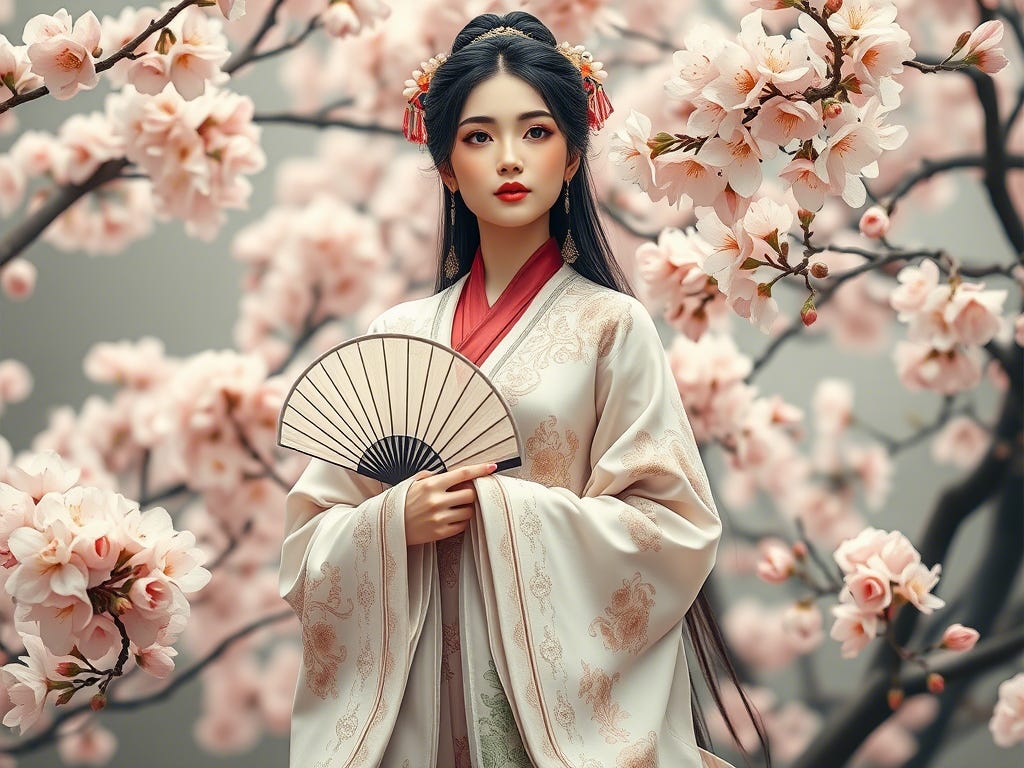
I was recently talking with an Australian friend about one of my sons. When he was born, the fortune teller told us he would have “Peach Blossom” luck or 桃花运 (táohuā yùn) until he turned 29. Therefore, it was advised that he should avoid getting married or settling down too early.
In Chinese culture, “Peach Blossom” refers to luck in love, romance, and relationships, particularly magnetic attraction that seems to come from nowhere. It suggests a period where romantic opportunities appear effortlessly: Someone catches your eye, a chance meeting leads to a romantic encounter, or an admirer suddenly enters your life.
Many (younger) people consider this a good thing. After all, who doesn’t want to be seen as sexy and attractive, especially if there is an opportunity for romantic encounters?
But as with all luck, the Peach Blossom is double-edged. While it can bring genuine connections, chemistry, and even a soulmate into your life, it can also bring about entanglements or unnecessary distractions. At the wrong time, it will lead to broken families and failed marriages.
My Australian friend was surprised that I saw the Peach Blossom not necessarily as a good thing, but our conversation led me to think about the dualistic nature of luck. It can either overwhelm us with abundance or overburden us with hardship, often in the blink of an eye.
The Old Man Who Lost His Horse
Many of my friends would have heard me tell this story from the famous Daoist Philosopher, Zhuangzi (369 BCE). It is based on a famous Chinese idiom:
塞翁失马,焉知非福
Translates to, “The old man lost his horse; how can one know this is not a blessing?"
The story goes like this:
One day, an old man’s horse runs away. The neighbours feel sorry for him. “How unlucky!” they say.
He replies, “Maybe.”
The next day, the horse returns, bringing three more wild horses. The neighbours say, “How lucky!”
Again, he says, “Maybe.”
Then, his son tries to tame one of the wild horses. He fell and broke his leg. Again, the villagers sigh, “How unlucky!”
The old man repeats, “Maybe.”
Several days later, war broke out, and young men everywhere were conscripted. The old man’s son was spared because of his broken leg.
Fortune and misfortune are often intertwined and unpredictable. Perhaps that is why we often describe some events as “a blessing in disguise."
Was it good luck for the old man eventually? Maybe.
What Is Luck?

In Western mythology, Luck is personified as the Roman goddess Fortuna, associated with prosperity, fertility, and abundance. Her nature was deeply dualistic. She could bestow blessings of good fortune (Fortuna Bona) or unleash a series of misfortunes (Fortuna Mala). Her ever-turning wheel of fortune embodied life’s unpredictability, reminding us how quickly things can change.
In Chinese culture, luck (运, yùn ) is a multifaceted and deeply rooted concept with much in common with Fortuna: fleeting, unpredictable, and ultimately unreliable. The Chinese attitude toward luck reflects a fascinating blend of enthusiasm and pragmatism. On one hand, we actively seek to invite good fortune and ward off misfortune through time-honoured traditions and superstitions. We wear red for prosperity and display characters like 福 “upside down” to symbolise the arrival of blessings. We avoid sweeping the floor on the first day of the Chinese New Year to avoid “sweeping away” good luck, and we consult almanacs or feng shui masters to align our actions with auspicious timing.
Many of our friends who attended our “groundbreaking” ceremony for our restaurant on the first day of the Chinese New Year in 2018 would have witnessed the lengths we went to ensure future good luck and prosperity.
On the other hand, we see luck not as mere random chance (like picking up a fifty-dollar bill at the car park) but as part of a broader cosmological order, in which an intricate balance of forces shapes events. This duality shapes a worldview that embraces rituals while remaining grounded in the understanding that, although luck cannot be fully controlled, it moves in cycles. It may come and go as it pleases, but it will come and go, eventually.
Good Can Be Bad, and Bad Can Be Good
“This too shall pass” – Attar of Nishapur
Good luck can sometimes lead to unforeseeable trouble, and bad luck may open unexpected doors to new opportunities. Understanding this helps balance life’s uncertainties by staying optimistic in bad times and avoiding arrogance in good.
“Peach blossom luck” might feel like a romantic opportunity for some, but it can also destroy relationships if it comes at the wrong time or too often. Similarly, financial windfalls often carry the risks of jealousy, betrayal, poor financial decisions, and shattered relationships if not managed properly.
On the other hand, tragedy and misfortune can sometimes bring opportunities and favourable outcomes, as in the case of the old man losing his horse. Good and bad luck are intertwined, flowing into each other like day into night. This perspective reflects a pragmatic view many Chinese take of luck: it brings temporary blessings or challenges; it is unwise to rely on it because we can’t control it.
Instead, focus on controlling what we CAN control. Personal effort, preparation, and fortitude to protect ourselves against uncertainty.
We Can Only Depend On Ourselves
谋事在人,成事在天
Translated as “Man proposes, heaven disposes”.
This captures a profound truth about life: we can only do our best and leave the rest to fate. This is not a call to self-help heroics or pulling ourselves up by our bootstraps, but rather an invitation to embrace a quiet, deliberate path of persistence and faith.
君子求诸己,小人求诸人。
“The superior person seeks within himself; the petty person seeks from others.”
Analects of Confucius – Book 15, Chapter 21
In moments of hardship, looking outward for answers, to others, to fate, or even to divine intervention can be tempting. Yet true transformation begins when we turn inward, recognising that the only things we truly control are our own effort, attitude, and integrity. By focusing within, we align ourselves with the deeper rhythms of life, trusting that the outcomes will unfold as they are meant to, in their own time.
The Only True Foundation
Chinese philosophers have warned that fortune is unpredictable. Zhuangzi mocked those who prayed to heaven for good luck while neglecting personal cultivation; Confucius taught that true nobility comes from self-discipline, not fate. Like bamboo that deepens its roots unseen during drought, the wise know that luck may come and go, but the strength you build within becomes unshakable.
The Unshakable Core

“Keep calm and carry on”
British government motivational poster produced in 1939 by the
Ministry of Information in preparation for World War II
At the heart of most Eastern philosophy lies a profound emphasis on cultivating an unshakable core, a symbolic centre within ourselves that remains steady as the world around us spins out of control. This idea is captured in Confucius’s practice of 修身 (xiū shēn ), or self-cultivation. While we cannot control the chaos outside of us, we can master our response. Strength comes not from trying to bend the world to our will but from developing an inner foundation so deep that nothing can uproot it.
Why is this core so crucial? Because the world is messy, filled with noise, demands, and distractions. When everything around us seems to be falling apart, it’s easy to feel lost or powerless. Yet, if we have nurtured an unshakable centre, we gain clarity amidst confusion and stability amidst chaos. Challenges are not insurmountable barriers but opportunities for growth.
Ultimately, the core anchors us in a world of constant change. We build an inner sanctuary by committing ourselves to becoming the best version of ourselves. No matter how bad life becomes, we are always grounded. From this place of inner strength, we discover the freedom to face whatever comes with confidence and grace.
The Wisdom of Indifference
破财消灾 (pò cái xiāo zāi).
“Lose money to eliminate disaster"
For the most part, luck comes and goes as it pleases, caring little for our hopes and fears. The better approach is to cultivate an attitude of calm indifference, neither becoming overly elated by good fortune nor consumed by despair when misfortune strikes. Instead, focus on doing your best, fulfilling your duties to your family and society, and building resilience and good character. This is the foundation upon which you can face life’s uncertainties with strength and grace.
When good luck arrives, seize the opportunity and make the most of it. And when bad luck inevitably appears, adapt, persevere, and wear it out. This is not a fatalistic resignation but a proactive adaptability. As we say, “In every crisis lies an opportunity.”
By focusing on yourself, you take charge of what you can control while remaining flexible in the face of what you cannot. Your ability to respond ensures that you remain in control of your own steps.
Be prepared for fortune and misfortune, stay grounded in your values, and trust your ability to adapt. That is the best we can do, in love, in life, and in everything.