

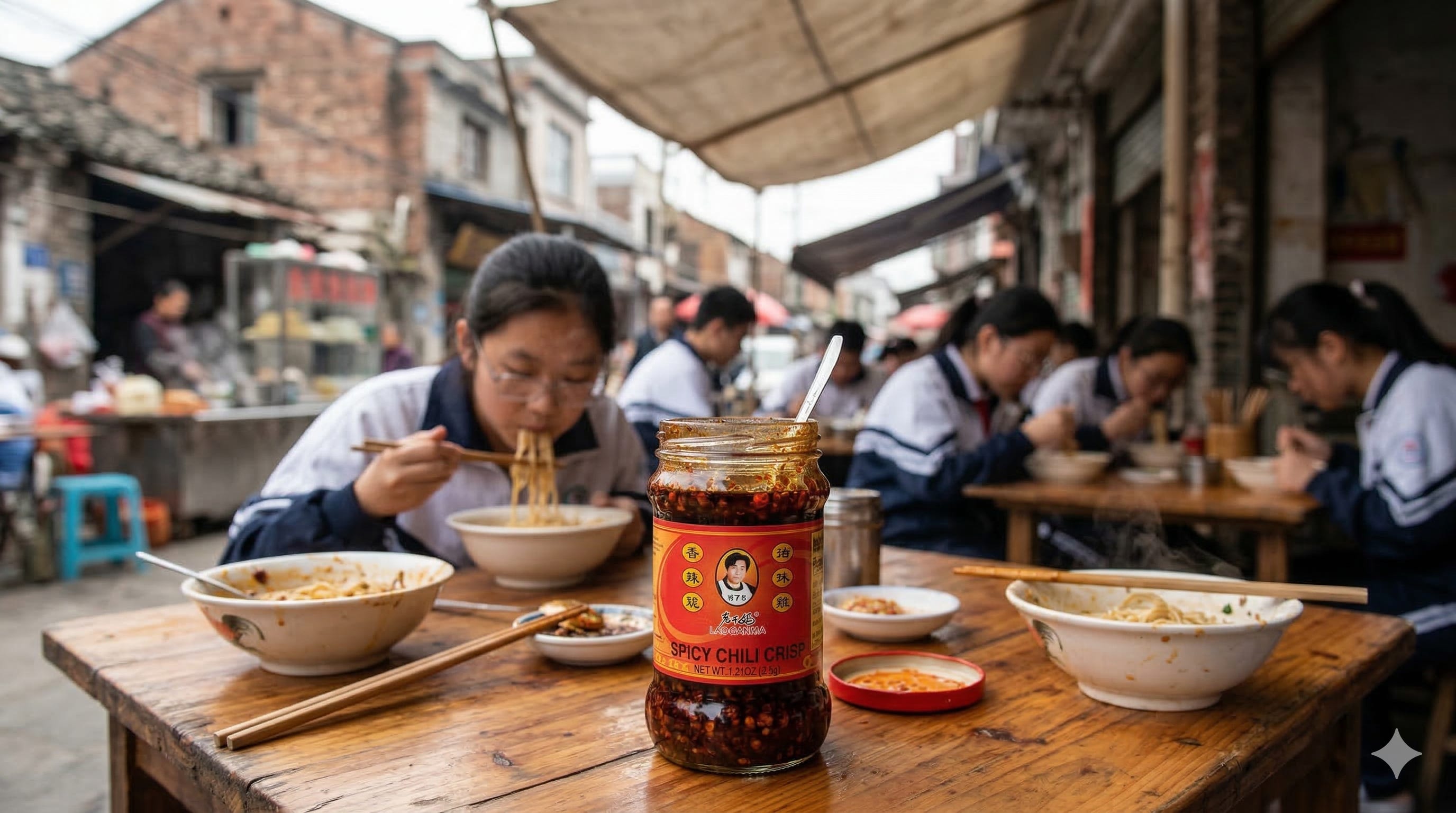
I was scrolling through Instagram the other night when an ad caught my attention. An artisan chilli oil. Slick, catchy, great packaging. And expensive, by chilli oil standard.
The ad copy goes something like this:
Established brand Lao Gan Ma (LGM) vs Small Local Business (Artisan)
The ad says LGM is mass-produced, while Artisan is hand-made by a passionate chef. What does “hand-made” really mean? Did you skip the food processor? It’s still produced, just in smaller batches.
LGM uses pre-fried ingredients that supposedly taste “old.” Does that mean they aren’t fresh? Artisan claims to use “fresh” ingredients, but you actually have to pre-fry fresh ingredients to keep them from spoiling. Besides shallots (and maybe garlic), which are sliced and then pre-fried, chilli flakes and spices are already dry, so are they “old” too? And honestly, it’s hard for small-batch producers to get good-quality dried chilli flakes outside China, which are key to good chilli oil.
LGM is fast and cheap. Artisan is slow-cooked and expensive.
LGM is famous because it is “accessible”. Artisan is not because it is “exclusive”.
LGM is at the bottom. Artisan is at the top.
If you’ve only ever had LGM, you can only go up the quality ladder.
The ad truly annoyed me.
I do not think that Artisan’s chilli oil is bad. In fact, I had wanted to try it since following their Instagram page. Having made my own chilli oil when I ran a restaurant, I have no doubt it probably tastes good. What annoyed me was the arrogance and presumption of it all.
It left a bad aftertaste.
So I’d like to share a bit of history about the “Godmother,” the woman behind Lao Gan Ma chilli oil.
The Godmother
Her name is Tao Huabi (陶华碧). Born in 1947, the eighth daughter in a poor family in Meitan County, Guizhou Province, one of the poorest regions in China. Tao never learned to read or write.
During the Great Chinese Famine, when she was just a teenager, she survived by digging up wild vegetables and learning to make flavours from roots and wild herbs. Years of poverty taught her that spice and fermentation could turn simple ingredients into delicious meals, a lesson that later became the foundation of her billion-dollar company.
She married young but soon became a widow, left to care for her two young sons.
She left her factory work in Guangzhou and opened a street stall in her hometown in Guizhou, selling liangfen (凉粉) and cold noodles (冷面). Then, in 1989, she opened a tiny shop in Guiyang called 实惠食堂 (meaning Affordable Canteen). It was a simple, working‑class eatery serving inexpensive home‑style Guizhou dishes and staple carbs (rice, noodles), with her signature chilli oil on the side.
It was the chilli oil that customers loved.
She gave discounts to students who couldn’t afford full meals. She gave extra food to those who looked like they needed more. Soon, they started calling her Lao Gan Ma (老干妈), which translates commonly as “Godmother.”
Note: In Chinese, Lao (老) doesn’t really mean “old” the way English uses it. It’s a word that carries respect, familiarity, and seniority. Your teacher is Lao Shi (老师). Your boss is Lao Ban (老板). When you call a close friend Lao plus their surname, like Lao Chen (老陈), it’s a term of warmth and familiarity.
And Gan Ma (干妈) actually means “honorary or adoptive mother”, someone who is like family but has no biological relations. This is unlike the Christian concept of godmother via baptism.
So Lao Gan Ma isn’t “Old Godmother.” It’s closer to something like “the adopted mother we all know and love.”
At that point, it wasn’t a brand yet. Lao Gan Ma was an affectionate nickname, earned through her generosity towards students and working-class customers.
Three Million Bottles a Day
By the mid-nineties, truck drivers passing through Guiyang were buying her sauce in bulk.
Long-haul truck drivers in China often cook their own meals while travelling. Usually, it’s just plain boiled noodles, maybe with some pickled vegetables—just enough to fill up. But a spoonful of Tao’s chilli oil could turn those simple roadside meals into something special.
That’s the power of a good condiment.
At her restaurant, customers wouldn’t eat the noodles if the chilli oil ran out.
So Tao stopped selling noodles and focused on selling her chilli oil instead.
In 1996, she rented a village committee house, hired forty workers, and started bottling her chilli oil in small batches.
Today, the company produces three million bottles a day and sells in over 160 countries. Tao never took the company public or borrowed money to expand. She built everything based on her instinct, a focus on quality, and a refusal to compromise on quality.
The Big Mistake
In 2014, Tao stepped back from running the company and let her sons take over. They followed typical business school advice.
They optimised.
They replaced the high-quality Guizhou chilli peppers, which are grown at high altitudes and have a special depth of flavour, with cheaper peppers from Henan province.
While margins improved, the taste changed.
And customers noticed.
Revenue fell from 4.5 billion yuan to 4.3 billion yuan. Online forums were full of complaints that it didn’t taste the same anymore. Tao’s sons treated a heritage product like any other business, thinking they could optimise it without considering its impact.
In 2019, at age seventy-two, Tao returned. She brought back the original Guizhou peppers and ordered 500 tons of chilli oil, worth over a million yuan, to be destroyed because it didn’t meet her standards.
By 2024, revenue had climbed back to 5.39 billion yuan.
Customers came back because the chilli oil was back to its original recipe.
The “Better” Product
Now, let’s return to the Artisan chilli oil.
LGM’s success opened the door for Western brands to enter the market. Brands like Fly By Jing, Momofuku, Bowlcut, and many “passionate chefs” have jumped in with their own “better versions” of LGM. You’ll find these names in the premium aisle of supermarkets, usually with higher prices.
Some of these can be quite good.
But here’s the thing: if you’re proud of what you’ve made, just say so. Tell me about your peppers, your process, your awards, even your grandmother’s secret recipe. That’s great. There’s room for more than one bottle on the table.
You don’t have to prove yours is good by putting down someone else’s.
But that’s how many brands market themselves. Look at the language: “Clean ingredients.” “No MSG.” “Artisan.” “Original.” “We use only fresh, hand-selected peppers.” “We never pre-fry our ingredients.” “Small batch, never mass-produced.” “We focus on quality, not quantity.”
Every single one is a comparison dressed up as a statement. They’re telling you what someone else doesn’t.
“I like MSG. I don’t react to it – nobody does. It’s a lie, man. You know what causes Chinese Restaurant Syndrome? Racism: ‘Ooh, I have a headache. It must’ve been the Chinese guy!’”
Anthony Bourdain: Season 3, Episode 3 of Parts Unknown (“Sichuan, China”)
The message is clear. LGM, the Chinese-made, mass-produced, five-dollar bottle, isn’t clean, isn’t fresh, isn’t careful. Western markets have a long history of framing Asian food in certain ways. They often suggest that traditional means unrefined, or that low cost means low quality.
Being the Better Product
This isn’t really about who can make the best chilli oil. Anyone can make a better chilli oil. The real question is what we mean by “better.”
You can use fancy ingredients (hand-cut Spanish organic shallots), design a beautiful label, write clever marketing copy that positions your product as the “better” choice, and charge more for it.
None of that is difficult.
What’s truly hard is what Tao Huabi did. She built something so connected to who she was that you couldn’t separate the product from the person. She couldn’t read her own contracts and tasted every batch herself because that was the only way she knew to ensure quality. She earned the name “Godmother” by feeding students who couldn’t pay, year after year.
It’s not hard to make a better product. It’s hard to be a better product.
I probably think about this more than I should. I’ve worked in marketing for most of my life, helping people tell better stories about their products. I know how the game works, and I know how easy it is to mix up style with substance, assuming that better packaging means better everything.
Then I am reminded of Tao Huabi, who built a billion-dollar company without being able to read or write. She didn’t have a content strategy or focus on optimisation. She just showed up every day and let her product speak for itself.
That’s something worth knowing and remembering.