

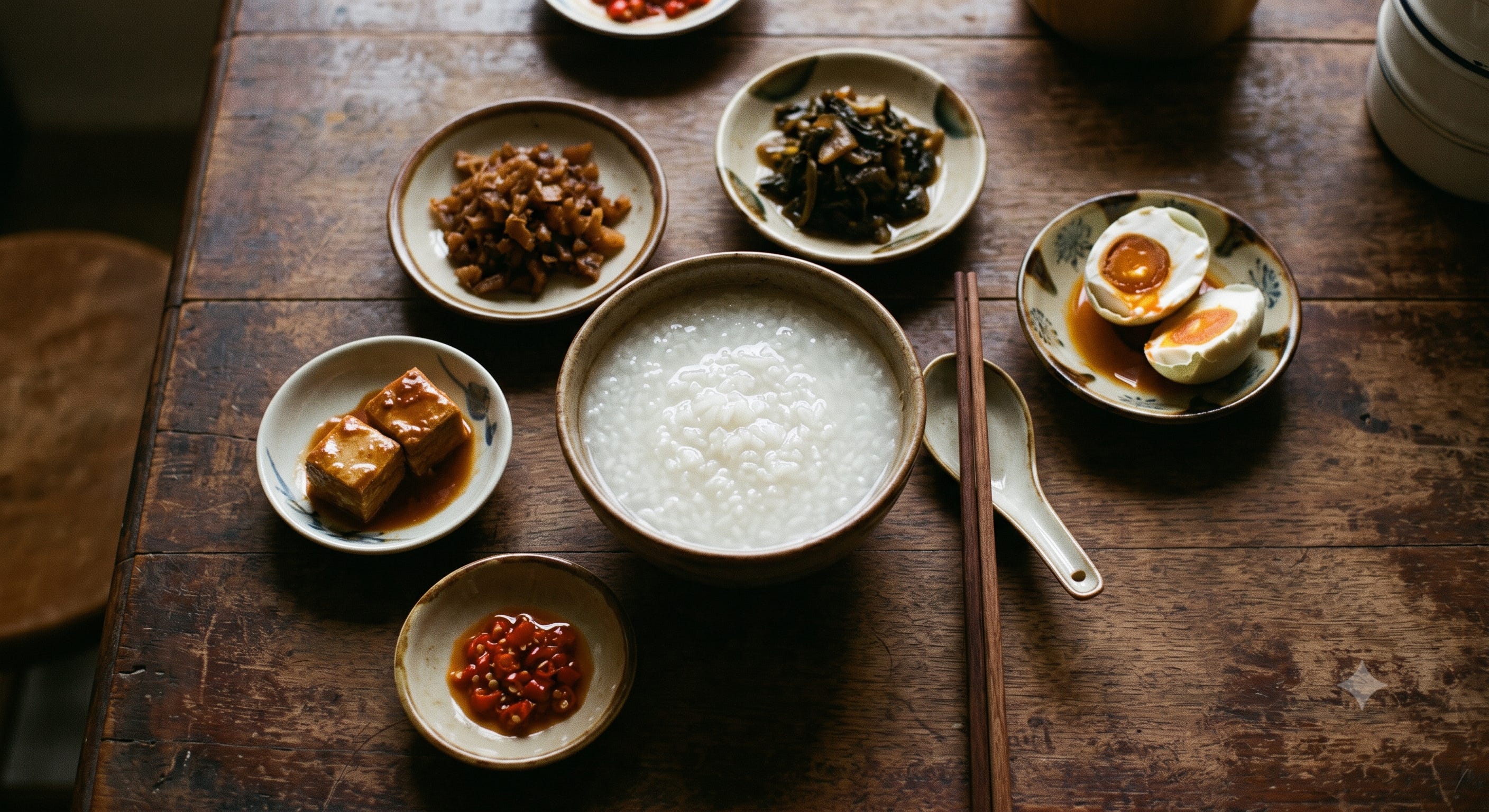
If you order Teochew muay (Porridge) in Singapore today, you will get a banquet. Braised duck. Cold steamed crab (fresh). Pork braised for hours, along with offals like the skin and intestine, tau kwa and lor neng (braised egg), served in a glossy stock. Steamed fish of many kinds. A spread of small dishes with a free flow of plain rice porridge. I love it. I order it whenever I am in Singapore.
But that is not what Teochew muay used to be.
When it arrived with the migrant workers in Singapore, muay was just plain rice porridge, nothing else. Watery and cheap. A way to make a little rice go a long way. It was barely a meal.
What made it a meal was a few small dishes, salted and dried and fermented and cured until they were strong enough to down a plain bowl of porridge or rice. You take a mouthful of porridge, then the tiniest bite of something almost unbearably pungent and salty, then more porridge. The Chinese word for this is 下饭, xià fàn: to send the rice down. A good 下饭 dish is one where a little “forces” a whole bowl of bland starch down. A less well-known phrase is 骗饭菜, or “dishes that tricked you into eating your rice.”
This is the logic of the entire Teochew porridge spread. How do you keep food from rotting in tropical heat with no refrigeration? And how do you make a little cheap flavour push down a lot of cheap rice? Teochew porridge was a solution to both at once.
The Teochew were immigrants and labourers with little. But what they developed was ingenious. A whole cuisine engineered out of salt, sun, and time. Let me walk you through what was on our table when I was growing up, the one before the present-day banquet.
The preserved seafood
The salted seafood was considered a luxury, and most of it has now disappeared.
Kiam lor, or salted baby clams. These are tiny shellfish cured raw in heavy brine, eaten straight from the jar. Briny, metallic, faintly sweet, with a slippery softness that stops most people before they start. You just need a few with a bowl of hot porridge, and you have a concentrated taste of the sea. My memory of this was more the salty sauce than the actual clam, which were incredibly small anyway. Perhaps my parents thought it wasn’t safe for a child to eat.
Gao ni, marinated squid. Small squid, marinated raw in garlic, chilli, ginger, and lime, then served chilled, is part of the Chaoshan tradition of 生腌, raw-marinated seafood, sometimes called Teochew poison for its addictive quality. The name is old: gao for the roe or paste, ni from 鯗, the classical character for cured seafood. My father loved it. A little, sharp and cold and briny, against a hot bowl of porridge. You still find it jarred in some Asian groceries, mostly from Vietnam now.
Kiam he, salted fish. This one had a whole range. At the daily level, hard, salty slabs are thinly sliced and fried until crisp, so strong that a small piece is enough to down a bowl of rice. At the top end, mui heong, the fermented-then-cured “plum fragrance” fish, soft-fleshed and pungent, the best of it from Kuantan, Malaysia. What was once poverty food is now a delicacy. Good mui heong runs to over a hundred ringgit a kilo in Malaysia today. It is no longer a poor man’s food.
Cincalok, one of my father’s favourites. Tiny whole shrimp fermented in a bottle, wet and pink, salty and sour at once. He would mix a spoonful with chopped chilli and shallot, maybe a squeeze of something sharp, and set it down. A tiny bit is more than enough. Cincalok isn’t Teochew, or even Chinese. It came from the Malay and Peranakan kitchens of Malacca and found its way onto our table, as so much did in Singapore, where the Chinese, Malay, and Peranakan larders sat side by side and borrowed from each other.
Buay kee, the salted baby crabs, which I have never tasted. Small tree-climbing crabs from the mangrove swamps, no bigger than the top of your thumb, are pickled whole in brine or soy with the roe left soft inside. You eat the whole thing, shell and all, the curing having softened it enough to chew. In the 1960s, they were food for the poor, sometimes the only dish besides a bowl of porridge. My father ate them for years, until one day he learned where they came from. In the fishing villages, these crabs gathered thickest around the drop toilets built out over the swamp. He never touched them again after that.
The preserved vegetables
Vegetables were salted, pickled, or sun-dried at harvest to keep for months, and they are the backbone of the table.
Kiam chye, salted mustard greens. The staple of staples. Crunchy, sour, salty, made by submerging mustard greens in a weak brine, often just leftover rice water, and leaving the lactic ferment to do the work. Sharp and sour on its own, it turns rich when slowly braised with a little pork belly or just lard, a few sour plums, and plenty of garlic.
It is also the backbone of chye buay, the great Teochew leftover dish. After a feast, the roast duck, the crispy pork, the roast chicken, whatever is left with meat still on the bone, all of it goes into a pot with a mountain of kiam chye and simmers for hours. The sourness cuts the richness of the fatty meats, the meats give the sour greens depth, and what began as scraps becomes a dish people look forward to more than the feast that made it. Nothing wasted.
Chye sim, the pickled stems of kai lan. If kiam chye is leafy sourness, this is the crunch: thick stems, pickled until they snap between the teeth. Tart and clean, more a texture than a flavour, all the better against soft porridge. These days, you can get them in a jar or a can in most Asian groceries.
Chai poh, sun-dried salted radish, chopped fine. Sharp, chewy, intensely savoury on its own. Fried into an omelette, chai poh neng, it becomes one of the great cheap pleasures of the Teochew kitchen, little bursts of salty crunch suspended in soft egg. I still cook this regularly for my family and me.
Ka na cai, olive vegetable. Mustard greens and black Chinese olives simmered in oil for hours until they collapse into a dark, glossy, jammy paste. Deeply umami, faintly bitter, meltingly soft. A teaspoon of ka na cai over porridge, and I am back home in 1972.
Ou lum, black olives. Not the Mediterranean kind, but the Chinese black olive (乌榄), a native fruit with pointed ends and a hard stone, eaten two ways on our table. Whole, they were scalded soft and packed in salt with minced galangal, then bitten straight off the pit, salty and earthy and rich, against a mouthful of plain porridge.
Nothing was wasted, not even the stones. The saved pits were cracked open with a hammer for the small white kernels inside. Those kernels, delicate and almond-like, went into mooncakes, the five-kernel kind. They are rare these days as fewer people go through the trouble.
The fermented beans and bean curd
Tau hu ru, fermented bean curd. Cubes of tofu aged in rice wine and brine until they turn creamy and sharp, closer to a strong cheese than to tofu. Salty, winey, faintly alcoholic. A small dark-yellow cube smeared across a mouthful of rice was my first introduction to these flavours. This is still a standard item in our pantry.
Tau cheo, fermented yellow soybeans, sometimes crushed to a salty paste, sometimes left whole. Usually cooked with steamed fish, pork, or tofu, though I have eaten it straight from the dish like peanuts. This is the plainest taste on the Teochew muay table, and the one that makes everything taste like home.
It is also one of the oldest. Salted, fermented soybean paste dates back more than 2,000 years in China, where it was called jiang. From that single ancient root, the whole family spread: doubanjiang in Sichuan, doenjang in Korea, miso in Japan. The miso in your soup and the tau cheo in my grandmother’s fish descended from the same Chinese paste that fed people long before any of these borders existed.
The dipping sauce, and a confession
There was also what we called Sek He (熟鱼), cooked fish, though its proper name is 鱼饭, fish rice. This is one of the most Teochew things on the Teochew Muay spread. There is no rice in fish rice. In old Chaoshan, rice was expensive, and fish was everywhere, so the fishermen ate fish in place of rice. They cooked the catch in seawater, packed it in bamboo baskets, and ate it cool. The salt was the sea’s, not added. Cooking it this way also kept the fish from spoiling before it reached the market, another solution to the same problem as everything else on this table. The Teochew have a word for the taste it produces: 咸鲜, salty-fresh.
We ate it with a dipping sauce my parents made from garlic and vinegar, sharp and pungent. The old Chaoshan way is fermented soybean sauce (Puning bean paste), but the garlic-vinegar combo works too.
I hated it. I had swallowed a fish bone (several times) as a small boy, and after that, I would avoid whole fish. To this day, I prefer fish balls, fish cakes, and sotong balls, the safe, boneless versions, and I leave whole fish to braver people, like my mother-in-law.
Eggs and the master stock
Kiam neng, salted duck eggs, cured until the yolk turns hard, orange, and oily, ringed by a firm, salty white. Traditionally, they were not soaked in brine but packed individually in a blackish paste of salt and charcoal or ash, left for weeks while the salt does its work. Here in Australia, you mostly find them already cooked and wrapped one by one, the messy black coating cleaned away. The yolk is the prize, dense and rich and almost sandy, the best thing with plain porridge.
As a child, I ate only the yolk and left the white. I didn’t like it. Too salty. My mother ate the white. I thought nothing of it then, but I now suspect that she would have loved the yolk too. She gave it to my siblings and me every single time. I know because now, I gave the yolk to my children and eat the white.
And the lor, the master stock. A 5-spiced soy braise kept bubbling on the charcoal stove through the day and night, so it would keep; the same liquid could be used for weeks, sometimes months. Some hawkers have lor that lasts for years. Lor tau kwa, firm tofu stained deep brown from hours in the pot. The cheaper cuts of things like pig skin, tripe or intestines, duck web, the cheap gelatinous parts that butchers sometimes give away, made soft and savoury by the endless stock.
The genius of it
I am still often amazed by how clever these dishes were made and preserved. Salt packed into earthenware jars drew moisture out of seafood and vegetables, creating a hostile environment for bacteria. Sun-drying on bamboo did the same by dehydration, and concentrated the flavour while it was at it. Mustard greens fermented in rice water, using lactic acid bacteria to sour the food and protect it. And the perpetual master stock, kept safe by constant simmering so it doesn’t spoil, and can be used almost indefinitely.
These were solutions to the tropical problem, worked out by people with no science and no electricity, observation passed down and refined over generations. And each designed to produce concentrated, salty intensity that pushes the rice down. How brilliant!
Most of these are gone now. Wealthy Singapore has regulated raw foods, such as brined clams and crabs, off the shelves for food safety, which, given the drop-toilet swamp crabs, is not unreasonable. What is left are factory-made, cleaner, milder and somehow less authentic versions. Only a few authentic Teochew porridge stalls remain, preserving the heritage. Consider this: the best salted fish now costs as much as Wagyu.
I still keep some of these in my pantry whenever I find them. There’s a bottle of cincalok, hu ju and ka na chye in my fridge always. I don’t always eat them, though. My boys have taken to some of these funky tastes without much persuading. They will never need to depend on these foods the way their grandfather did. But the taste, the memories, lived on, and I am glad to be the one sharing them.
A note for careful eaters
Some of these are raw, especially the seafood. If you do find them, they are risky unless thoroughly cooked. Raw marinated seafood can carry bacteria and parasites, which is exactly why the food-safety rules have taken most of these off the shelves. My father’s generation ate it straight from the jar. They had cast-iron stomachs. We don’t. If you are curious, the safe way in is to cook it: a spoonful of the fermented squid steamed into a pork patty, or stirred through a hot wok of kangkung, gives you the deep, funky savour with lesser risk.