

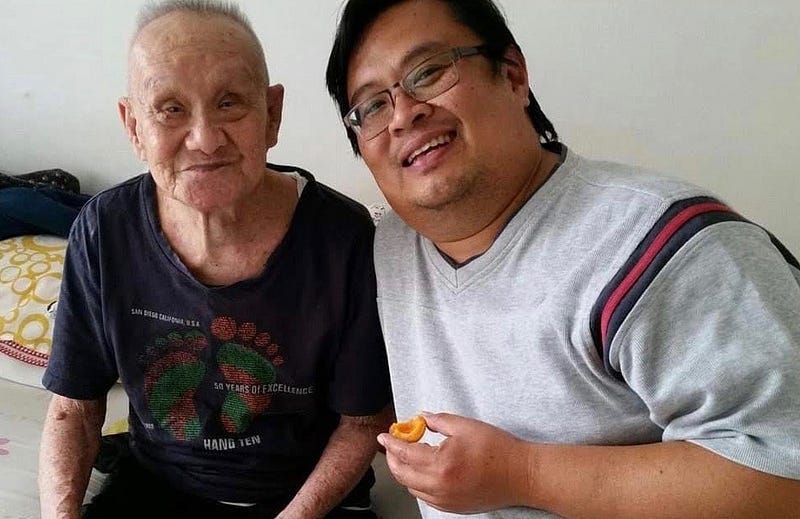
When we migrated to Australia in 2009, our boys were just little. Although we tried, we couldn’t afford to visit Singapore as often as we would like. And when we did, I could tell that they were mostly strangers to each other. Their grandfather spoke Teochew, and they spoke only English.
They grew up not really knowing who their grandparents were.
So I decided to spend some time telling them about him and the very hard life he led. And I wanted to do this before I forget.
Your Grandfather, John
John, your grandfather, was born in 1928, in the year of the Earth Dragon. Our family came from the Province of Guangdong (广东省), in the district of Jieyang Shi (揭阳市), in the village of Ma Shou Chun (马碩乡).
He did not know his date of birth. His parents told him they left China and arrived in Singapore by boat when he was about 2 years old. His mother said that on the way to Singapore, he had apparently crawled off the edge of the boat and was rescued by his mother, who grabbed his ankle just as he fell off.
We wouldn’t all be here if she had missed. He was very lucky.
Your grandfather’s name is Chen Lin Bao (陈林宝). In Singapore, the British had romanised it as “Tan Lim Poh” based on the Teochew dialect. He wasn’t “John” until 1965, when he was baptised into the catholic faith before he married your grandmother.
So we think he arrived in Singapore in 1930. You have no idea what Singapore was like in the 1930s. It was a very different place compared to Singapore today.
Your grandfather was the 5th child of your great-grandfather’s 3rd wife. He never spoke much about the family he left in China, except that there was a war and they had to leave. We do not know what happened to the rest. Someday, I hope to find them and reconnect.
Your great-grandfather died shortly after arriving in Singapore. We think it was in 1936. John mentioned that his father lost everything because of the war and died of a broken heart. John was 8 years old then.
He said that his mother died of breast cancer when he was about 12. He remembered waiting for treatment with his mother outside an overcrowded clinic, and the smell of rotting wounds on his mother’s breast. She died shortly after. That would have been around 1940.
WW2 had just started.
The Fall of Singapore
In February 1942, Singapore fell to the invading Japanese.
I often try to imagine what it would have been like for your grandfather, a 14-year-old boy, to lose both parents just as WW2 started, in a strange land with few relatives. I can’t imagine the grit one would need to survive in such circumstances.
Days after the fall of Singapore, the Japanese army started the Sook Ching Massacre (華僑粛清) that killed over 55,000 Chinese. Victims, mainly males between the ages of 18 and 50, were rounded up and taken to deserted spots and remote locations around Singapore and shot with machine guns.
This event could have changed the history of Singapore because Singapore’s Founding Father, Mr Lee Kuan Yew, almost became a victim. Here’s the interview with him about the event:
Like Mr Lee Kuan Yew, your grandfather was very lucky. Again.
He mentioned that during that time, he found work in the kitchen of a Japanese camp. If he was lucky, he would get some leftover vegetables (mostly kang kong) to bring home.
He once missed work for a day, and when he returned the following day, the soldier in charge slapped him so hard that it knocked him to the ground.
He did not return the following day.
We know very little about the family that came with your grandfather. He mentioned he had a 3rd brother (三哥). Years ago, I remember a lady came looking for pictures of her father (三哥). It seemed he died when she was very young, and she never met him. Your grandfather had a passport-sized photo (they looked alike), which he gave to her. We never kept in touch. We should have.
We have only ever met his eldest sister (大姑) and youngest sister (小姑).
His eldest sister got married when she was about 15. After his parents’ passing, he lived with his eldest sister now and then, but mostly with his father’s younger brother, an uncle.
He described this uncle (三叔) as an opium addict and womaniser. He once saw him being chased and beaten up for an affair with a neighbour’s wife. Sometimes his uncle would disappear for days, and he couldn’t go home. So your grandfather lived on the streets often and did whatever a teenager could to survive.
After the War
The British returned after the war, and it was business as usual.
Until 1957, your grandfather had no citizenship or national status. Most people in Singapore were considered British subjects.
From Wikipedia: When Singapore gained internal self-government in 1959, Singapore became an independent Commonwealth country for the purpose of British nationality law. [13] From then on, Singaporean passports had the unusual nationality status of “British subject: citizen of the State of Singapore” instead of the usual “British subject: citizen of the United Kingdom and Colonies”.[14] There are treaties signed by the United Kingdom during this period that specifically mention this unusual nationality status.
It wasn’t until 1963 that he became a citizen of Singapore under the new Constitution of the State of Singapore.
Your grandfather did all sorts of work to make a living. He told me about how he started as a coolie (苦力) carrying sacks of charcoal or rice from the bumboats to the go-down along Boat Quay. He received a short bamboo stick with red paint on one end from the supervisor for each sack he moved, and was paid based on the number of sticks he collected. He said you had to be quick, and the sacks were heavy, and it was backbreaking.
Eventually, after saving some money, he tried working as a fruit hawker. He collected them from the wholesaler and cycled some 5–6 miles each day to and from the town centre around Katong, where he lived. My late cousin said he and all his siblings would come, and that he would give them fruit as a treat. He thought maybe that’s why your grandfather never made any money.
He also sold homemade ice cream (which he taught me to make) and drinks at the Katong area, mostly targeting cinema-goers and people out and about in the evenings. He used to live in this house on Tanjong Katong Road in the 50s.
In the 60s, he started working in construction, as there were more opportunities in Singapore. There were developments in housing, factories, and schools. He worked as a subcontractor with friends mostly, and specialised in installing sewage pipes.
He had a few business partners over the years. I understood that, because of his lack of literacy, he would handle the actual work, including hiring and supervising workers from Malaysia, while his partner would seek contracts and entertain clients (main contractors). Your grandfather was very dependent on his partners.
This is what it was like for your grandfather back then.
Years later, I would learn that his job was actually very dangerous. His colleagues and workers got injured or killed frequently. There were no safety standards or proper tools when lifting sewage pipes that weigh a couple of tons. It was all makeshift scaffolds and pulleys, with workers pulling in tandem, and one person at the bottom of the ditch guiding the massive pipe into place. And accidents were frequent.
Over the years, there were accidents that could have gone badly, but your grandfather lived through them with unbelievable luck. He always thanked his guardian angel for looking after him. And he spoke with much pride of the hardship he endured those days.
But after several near-misses, he retired from construction in 1984. He was 56.
There were other reasons, I think.
The partnership fell through, and he became rather disillusioned. I remember his partner coming to our house to settle payments. I remember hearing my father saying,
“What about the company car? Are you sure it is worth so little?”
“Is this all that is left?”
“Whatever, whatever.”
By 1984, construction contracts were more regulated and very competitive. Large Japanese MNC contractors now compete with locals for projects. The cost of “entertaining” these “main cons” was also rising as margins got thinner.
Your grandfather was also seriously myopic by then. He used to buy his (used) spectacles from roadside vendors at night markets (Pasar Malam). Whatever he thought gave him a clear vision, he just bought it. No prescriptions. He mistook overpowered lenses for better lenses. Eventually, opticians said his near-sightedness was -20. There were no lenses then that were -20.
He was legally blind.
It was years later, when he had a cataract operation, that he discovered it was not myopia but serious astigmatism. By then, it was too late.
Over the years, his hearing got worse, too. Working without protection, the loud noises at these construction sites took their toll. And those barbers who “cleaned” his ears after a haircut did irreparable damage. He was getting deaf as well.
It must have been very difficult during those times. Your grandfather was the sole breadwinner, and with so many of us to feed (your grandmother, 5 children and my great-grandmother), the pressure must have been tremendous. Although he never told us about it, I can imagine how hard it must have been just putting food on the table.
With some persuasion from your grandmother, they set up a stall in a school canteen to sell food. They would walk 2km from our home to the school at 6 a.m. each day, carrying some of the food we helped prepare the night before. It was a small primary school for girls, so they made very little. Maybe enough for groceries and our school fees. We were living off your grandfather’s savings most of the time.
Around 1990, your grandmother inherited some money from her father, and as some of us started working, life got a little better and easier.
Your grandfather retired shortly after and lived a quiet life. He spent many hours saying the rosary each day and watched endless WWF reruns in his room with his eyes inches away from the television. By then, he was basically blind and deaf.
On 6 May 2013, your grandmother Teresa, his sole companion, passed away.
On 17 November 2022, your grandfather, John, passed away.