

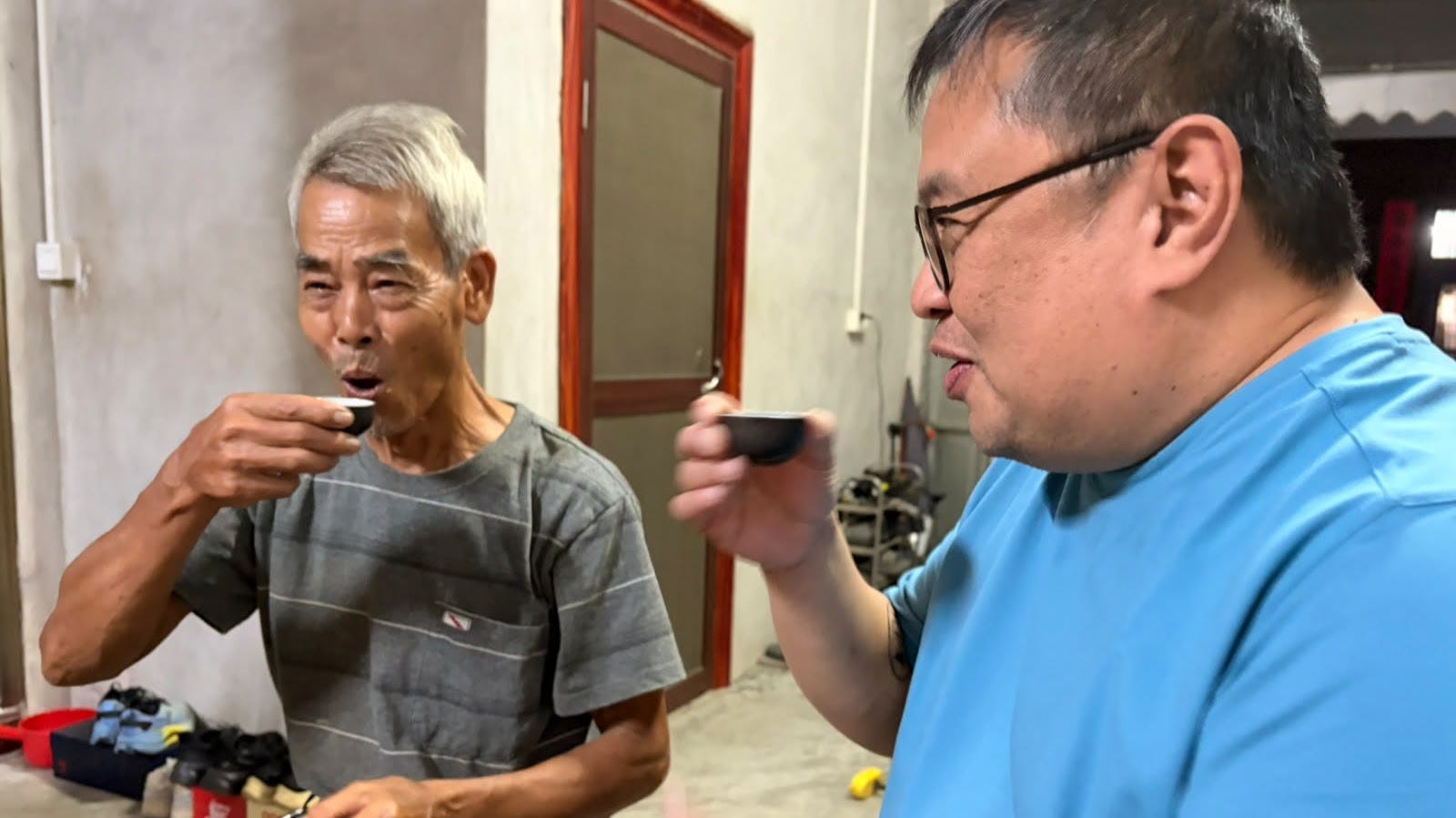
The First Day in Mashuo
My cousin, Chen Luo Fang, took my hand as we walked into Zhen Yong’s house. She held my hand until we sat down, and kept holding it as she spoke, like she was meeting her younger brother for the first time. She’s in her mid-70s. Over the next two days, I learnt that this family holds hands a lot.
At least twenty people greeted us at the door and walked us inside. I sat between my cousins as they served Chinese tea and began the introductions.
Then, my cousin mentioned the name “Ah Kee...” In that moment, I knew I had found my long-lost family in China.
“Ah Kee” is what the family called (Tan) Lim Kee, my father’s elder sister (大姑). I hadn’t heard anyone say her name aloud since I was little. In fact, I had largely forgotten her name and never mentioned it when I asked the village secretary. When it came up in the conversation, I recognised it right away. My aunty had been sending them parcels of used clothes and money from Singapore in the 60s and 70s.
The Night Before
The plan was simple. We would meet Teacher Chen at the school where he taught, and he would bring me to the clan hall to meet my relatives.
We arrived a day early. That evening, the phone rang. It was Teacher Chen and my nephew. Would we move to a hotel closer to Mashuo village?
I said there was no need. We would take a Didi, China’s Uber, out to the village.
They insisted. I cancelled our booking and asked about the new one. “Don’t worry,” they said. We’ll meet you there. I was a little worried because Trip.com said there were no rooms left due to the Mid-Autumn Festival and National Day. Apparently, my nephew had booked and paid for the rooms even before we arrived.
My wife’s young uncle, the same age as she is, drove two hours to meet us in Zhangzhou, Fujian. He drove us on to Mashuo, then drove another hour home. He said it was no trouble. I suspect he wanted to see us delivered into the right hands, not into an elaborate scam using a long-lost family as bait.
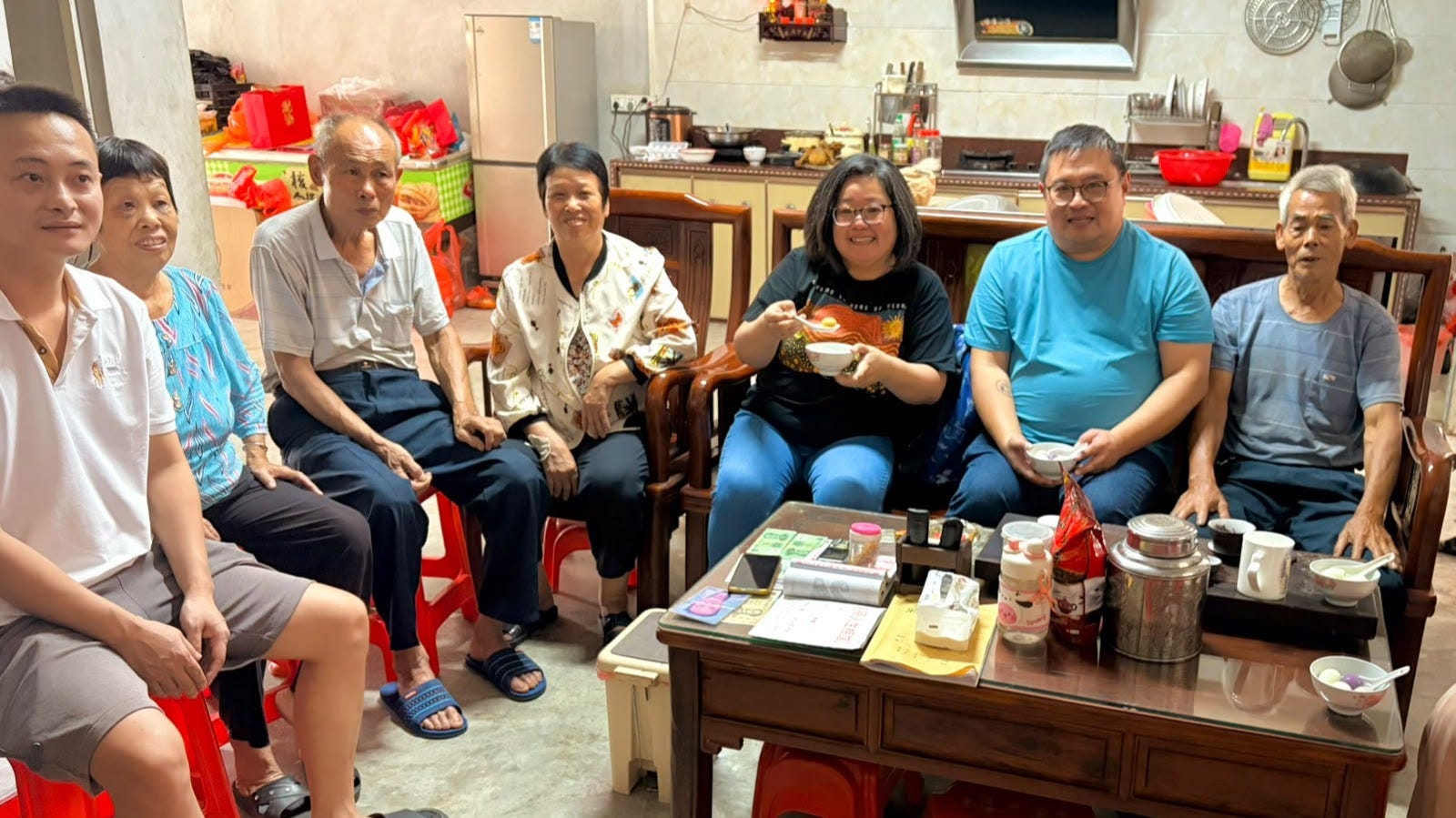
Many people
We arrived at noon. My two nephews took us to lunch, ordered too much, then drove us to my cousin’s house for tea.
I had played this scene over in my head for weeks: who would be there, what I would say, which language I would say it in. None of that rehearsal helped when we walked in.
About twenty people were gathered outside the house when we arrived. They were immediately familiar, holding my hands (and my wife’s and my mother-in-law’s) as they led us into the house. They sat me down next to my cousin 真勇.
This is the closest family I have in China. This was my father’s elder brother. Same father, same mother. My grandfather had three wives and five sons. The first wife passed away without giving birth to any children. The second wife had two sons. The third wife, my grandmother, had three sons. My father was the youngest of 5 sons. When my grandparents left for Singapore around 1929, they took him with them. He was two.
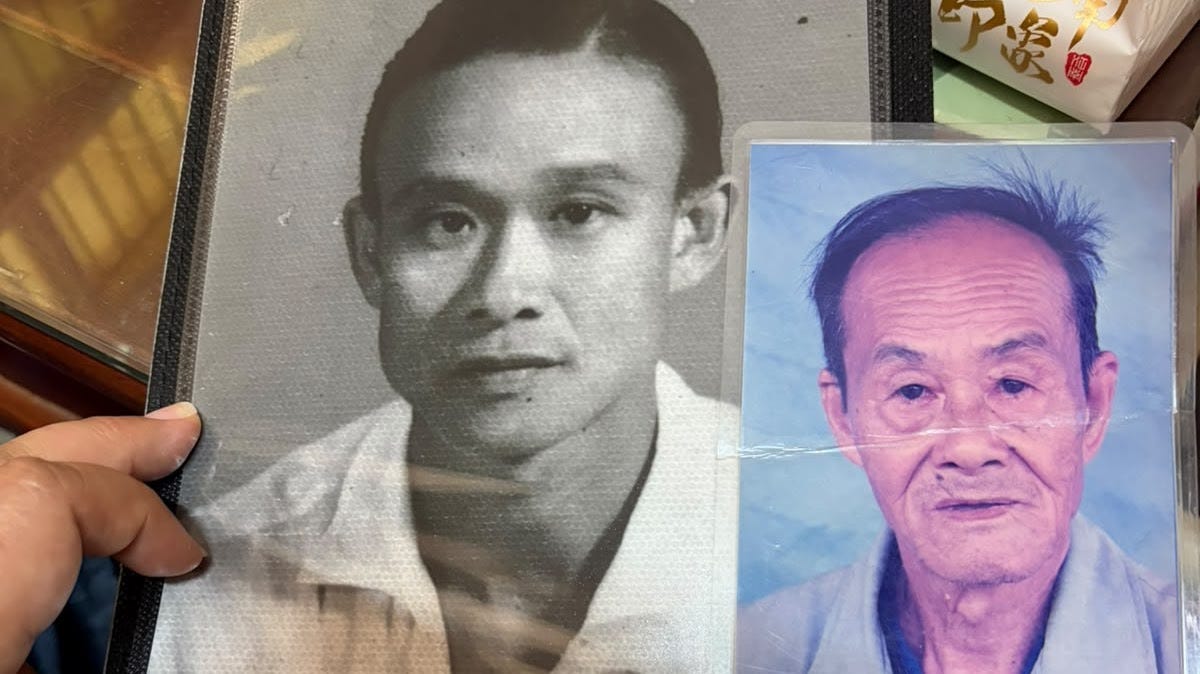
He looks very much like my father. So does my cousin, especially when he talks and laughs. I inevitably thought of my dad as I sat next to my cousin. My wife was too busy to take photos or video until much later.
Teochew
We spoke mostly in Teochew. I would throw in some Chinese now and then when I got stuck. I was surprised, as were my hosts, that I could speak their version of Teochew (there are 9 different accents) so fluently.
The truth is that my Teochew improved a lot over those few days. Words I didn’t know I knew came out of my mouth, from deep within my memory. It was as if the linguistic floodgates opened.
Teochew (潮州话) is the language of Chaoshan, my grandfather’s corner of eastern Guangdong. It belongs to the Min family of Chinese languages, and a Mandarin speaker won’t understand a word of it.
Teochew is an old language. It retains features of an earlier stage that other dialects have lost. Linguists count Teochew among the most conservative Chinese languages.
You can hear it in everyday words. A Teochew speaker says 食 for eat, where Mandarin says 吃; 食 is the word Confucius used. Eyes are 目, where Mandarin says 眼睛. Chopsticks are 箸, Mandarin 筷子. A wok is 鼎, a word the rest of China now keeps for ancient bronze tripods.
About 14 million people speak Teochew in Chaoshan, and millions more overseas. Teochews are the largest Chinese group in Thailand and Cambodia, and the second largest in Singapore after the Hokkiens.
In Singapore, Teochew has mostly faded. In 1979, the government launched the Speak Mandarin Campaign, and dialect programmes were phased out of television and radio. Today, many, including my children, hardly speak the language.
The parcels
They talked about the older ones who had died, and what each had left behind in people’s memories. My grandfather came up less in the conversations than I expected. Most people haven’t heard of him, which was why it was so hard to find the records. He left the village about a hundred years ago and died long ago, and only the very elderly in Mashuo vaguely remember him. My aunts came up again and again: Lim Kee, my 大姑, and Lim Ngoh, my 小姑.
Lim Kee had kept in touch. For years she posted parcels of old clothes from Singapore to Mashuo. My cousins said they remember going to the other family to collect some of these clothes and money.
After she died, the parcels stopped arriving. Her children didn’t continue. The same happened to the families of 文龙 and 文远, my grandfather’s grandsons through his second wife, who also went to Singapore.
I had always told this story as a break in 1929. A man left for Nanyang, war broke out, and the family lost touch. In that room, I learnt that day that one woman kept the thread for decades after my grandfather died, posting second-hand clothes. It ended when she died in Singapore, because nobody on our side continued. The younger generation was not interested. In fact, even those in Singapore stopped contacting each other, especially after COVID.
Many of the older folks in that room had been wondering about us all these years.
Six o’clock
As I told them how I had found them, more nephews and nieces drifted in, then grand-nephews and grand-nieces. I told them about the letter to the village secretary, Teacher Chen’s late-night video call, and my father’s name in the zupu (ancestry register).
Around 4 p.m., my nephew said he would take us back to the hotel to rest and pick us up at six to bring us back here for a reunion dinner.
I was told more people would be coming.
(Part 3)

What a warm welcome you received. I’m happy for you Francis. Family is everything.
Dear Francis, I am so happy for you that you have connected with family!! Congratulations and well done!! Enjoy the love and warmth. Can't wait to hear more!