

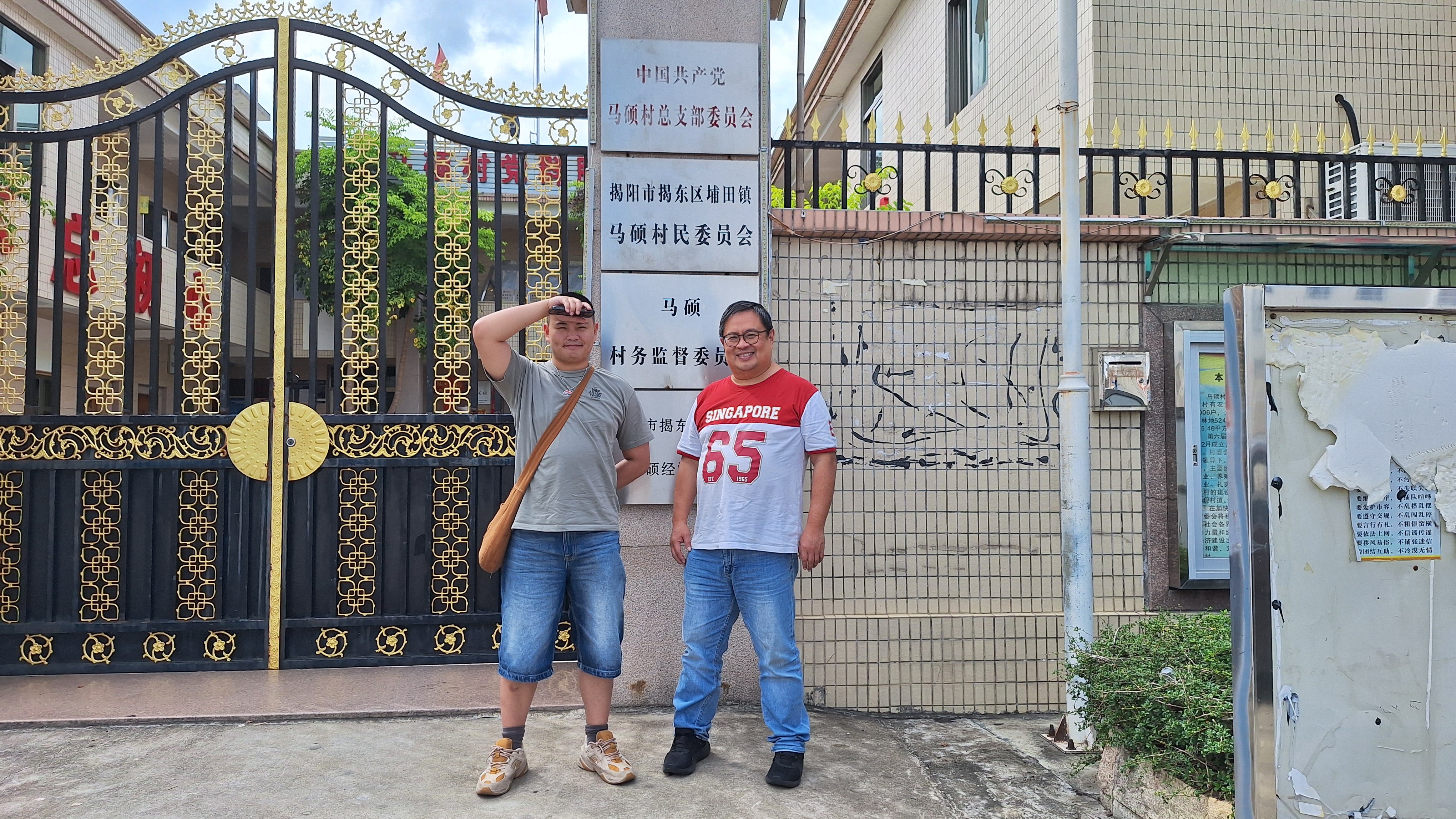
Several weeks ago, late on a Saturday night, my phone rang with a video call from 马硕村 (Mashuo Village) in China.
“Mr Chen, we found it.”
The man at the other end was also Mr Chen. A retired schoolteacher in Mashuo, a village of four and a half thousand people where nearly everyone carries the same surname. He sent me a photograph of a page from a lineage register and told me my father was on it.
Fifth child. Correct. Named 林宝. Correct. Second volume of the ancestral records, under a branch ancestor called 义庭公. Twenty-fourth generation in that line. He asked what trade the family was engaged in. Traditional Chinese Medicine. Correct.
I had been looking for two years.
That is mostly why this newsletter has been quiet recently. I was busy investigating. The rest of it is a gig with the Maggie Beer Foundation, consulting on culturally diverse food in aged care since June this year. The project isn’t public yet. When it is, I’ll give you the story.
What I had
In May last year, I wrote here about taking my son to China to see the ancestral village. I said then that all I had was the name of a place, and that I wasn’t expecting a dramatic family reunion any time soon.
马硕村 (Mashuo Village) sits in 埔田镇 (Putian Town), in the Jiedong district of Jieyang. Hills on three sides, water on two, a mountain called 马头岽 at its back. About a thousand households work 1,300 mu of farmland and 5,000 mu of hill forest. The hills are planted with 麻竹笋 (bamboo shoots), and the province has designated 马硕 as one of its specialist producers.
It had not occurred to me that the place my grandfather was born grows bamboo shoots for a living.
Most people in Mashuo Village share the same surname. Chen (陈) in China, Chan in Hong Kong, Trần in Vietnam, and Tan in Singapore and Malaysia, where the British wrote down what they heard the Teochew or Hokkien man say. The surname narrows the search in a village of four and a half thousand people down to a village of…four and a half thousand people.
陈 is the fifth most common surname in China, behind 李, 王, 张 and 刘, with somewhere between 54 and 63 million people depending on whether you take the 2010 census or the 2019 household registration figures. 王, which means king, runs to about a hundred million people.
But Chen is less common across the north, ranks around seventh, and increases along the southeast coast. Guangdong alone has 8.48 million. Chen is also the most common surname in Fujian, Zhejiang, Hainan, Hong Kong, Macau, Taiwan, Singapore, and Malaysia. In Vietnam, Trần is second only to Nguyễn at around eleven per cent of the population, and the Trần dynasty ruled the country from 1225 to 1400. There’s a Mǐnnán (闽南) saying: 陈林半天下, Chen and Lin are half the world. Along that coast, it is no exaggeration.
How did all this happen?
In 669 CE, a Tang officer named 陈政 was sent south with garrison troops to hold the Fujian-Guangdong border, and his son 陈元光 stayed and founded 漳州 (Zhangzhou) prefecture. Almost every Chaoshan Chen family traces its origins back to that migration. Many of those genealogies are documented to this day.
I am the least distinguishable Chinese person in southern China. A strange position from which to go looking for one particular household.
The code to unlock
When I first visited the village in 2024, the village secretary told me to find the person who holds the 族谱 (zúpǔ), the written lineage register. That was the first step and the critical one.
The format of the register still in use was developed in the 1050s and 1060s, when 欧阳修 and 苏洵 each compiled a genealogy for their own family, establishing the two systems that everyone copied afterwards. That was during the Northern Song Dynasty, about 970 years ago.
The Chaoshan Chens came out of Fujian in waves. Song officials took postings here and stayed. Soldiers and civilians scattered south with the last Song court in the 1270s. The largest movement came later, from the end of the Yuan Dynasty into the early Ming Dynasty, roughly 1350 to 1450, and that is when most Chaoshan village-founding ancestors are dated. The place they name is usually 莆田 (Pútián), on the Fujian coast.
Then, in 1536, having just rebuilt his own imperial ancestral temples, the Jiajing Emperor of Ming accepted a proposal from his Board of Rites and allowed ordinary subjects to make offerings to a founding ancestor and build a hall for the purpose. Guangdong and Fujian ran with it. Halls went up, registers were compiled, neighbouring lineages stitched themselves into federations, and most of what a Chaoshan village holds today traces its records to that century.
The range, then, is five hundred to seven hundred years of actual people in actual houses. Above that, the pages bear a conventional stem connecting any Chen to the ancient clan, running back to 陈胡公, granted the territory of Chen by the Zhou king around 1046 BCE, give or take a few decades.
Then there is 昭穆 (Zhāo mù), the generation system in the form of a poem. A lineage fixes a series of characters in advance, one for each generation in order, and every male born into that generation carries it in his given name. My father’s generation character, matched against a village register, would place him.
If I can place him, the path opens.
Two years of nothing
Genealogy forums. Clan associations in Singapore. Paid researchers who mostly sell canned stories and slide presentations. The problem was never the records. Chaoshan has plenty of them. The problem was that I sat eight thousand kilometres away with a village name, two given names, and an estimated year of departure. I needed a way in.
The way in, it turned out, was via the young village secretary, also Mr Chen.
I wrote to him a second time early this year about my grandfather, my father, and whoever might still be left of that household. I might have gotten the address wrong the first time. If you want the story, I wrote about it a few years ago (here).
To my genuine surprise, he took it up. He passed the letter to Mr Chen, the retired teacher, who knows the local lineage history, who then assembled six or seven village elders to work through the records and ask around about a family whose son left for Nanyang in 1929-30. According to Mr Chen, the retired teacher, the village secretary gave him the assignment, and he is anxious to report his success.
A hundred-year absence
My grandfather left for Singapore (supposedly temporarily) and never made it back. The family he left behind went through the Japanese occupation of Guangdong, as did Singapore. Then the civil war, land reform (where he lost everything), the famine years, the Cultural Revolution, and the emptying of the villages as the young left for Shenzhen and Guangzhou. Any of those could have ended the line or the record of it.
I had accepted that as the likely outcome. Then the phone rang.
Twenty-four generations put the founder of that branch somewhere in the late Yuan or early Ming, which is exactly where the whole Chaoshan migration pattern says he should be. The 族谱 had it all written down. Through every decade of turbulence, those pages preserved his record. I stared at the characters on my glowing screen late one Saturday in Adelaide. It was strangely comforting to see my father’s name in a lineage register from the village where he was born.
What surprised me was how much the searching happened on its own. My wife says that it is because my ancestors wanted me to take on this role and return the family to its roots. As Mr Chen, the retired teacher, said, “你们能来认祖归宗,我们全体族人都为你高兴...”
“We, the entire clan, are overjoyed that you have come to acknowledge your ancestry.”
So I’m going. I’ll meet Mr Chen, the retired teacher, at the village during Golden Week, when the country shuts down for a few days, and everyone who left for the cities comes home for a reunion. Some of the people in that room may be related to me.
I’ll write about it when I’m back.
Francis - I look forward to reading the next instalment! All the best.