

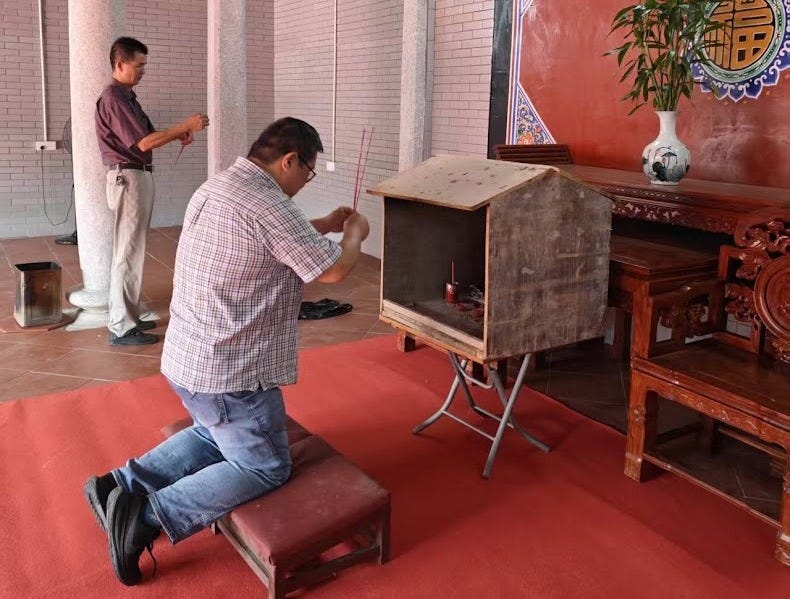
Teacher Chen met us at the entrance of the clan hall the next morning.
We shook hands, and he walked us into the new clan hall. First, he asked me to pray and offer joss sticks to our ancestors. Then my wife did the same.
This simple ritual is called 认祖归宗.
认祖归宗 (rèn zǔ guī zōng) means to acknowledge your ancestors and return to your lineage: 认, acknowledge; 祖, ancestors; 归, return; 宗, the lineage, with its hall and its register.
I claim my ancestors, and the clan takes me back. That’s why Teacher Chen told me the whole clan was overjoyed I was coming. To them, a lost branch had rejoined the trunk, and I had come home as a son of the village.
What it traditionally involves
Paying respects at the ancestral hall. Bowing and offering incense to the ancestral tablets in front of the elders. This is the visible act of return.
Entry in the register (入谱). My line will be written into the next edition of the zúpǔ (族谱). My father’s entry is marked 往洋 (gone overseas). Now the generations after him will be recorded too.
Standing obligations. Returning for 清明 (Qingming, the tomb-sweeping festival) or major rites when possible, and contributing to the clan hall or the register. The new hall opening is exactly the kind of occasion where attendance is expected.
As my cousin said, “Now that you know the way back, you must come home often.”
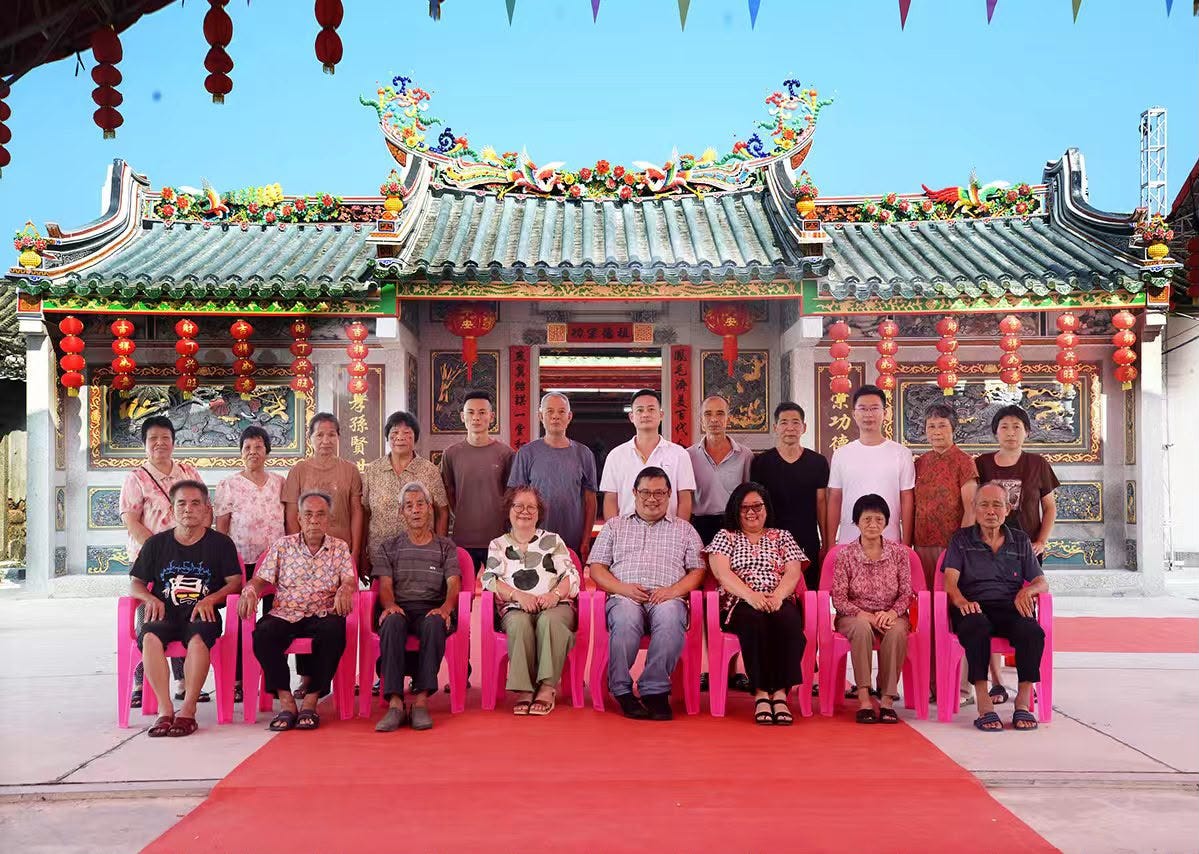
A great-great-grand-uncle at 60
Some of my nephews and nieces are in their 80s, and several are great-grandparents. By the end of the second day in Mashuo, I had worked out that, to the youngest children in the clan, I am a great-great-grand-uncle.
When my father was 2, his eldest brother was already in his mid-30s. Most people in the village married before 20, so a gap like that widens fast. My father married at 40, and I had my first son at 38. By then some of my cousins were already great-grandparents. Things do move faster in China.
The Clan Hall
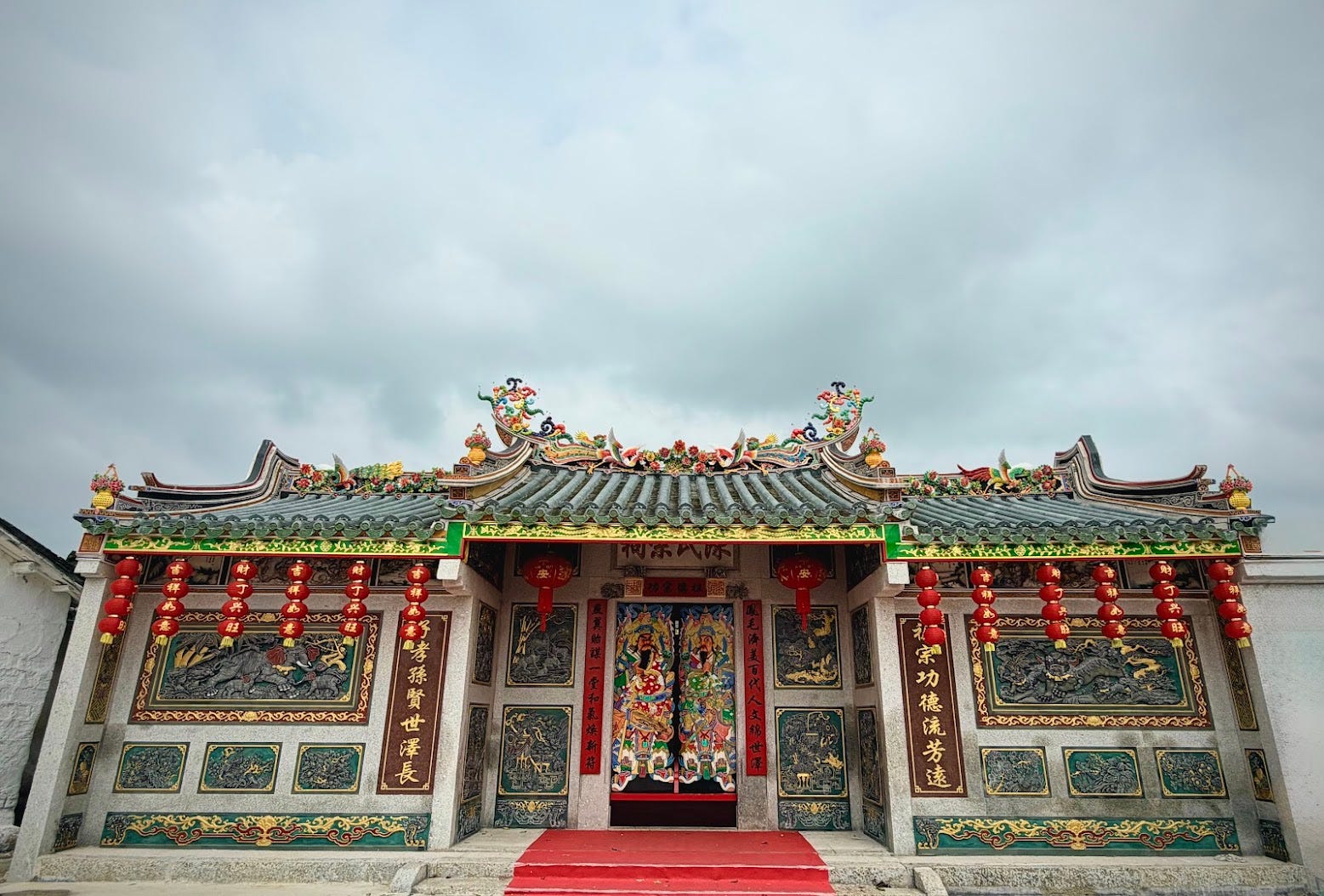
The second day was the main event. Most of my relatives in Mashuo gathered at the clan hall, two days before its official opening. The old hall next door was built in 1727, 299 years ago, so the opening was a big event for the village.
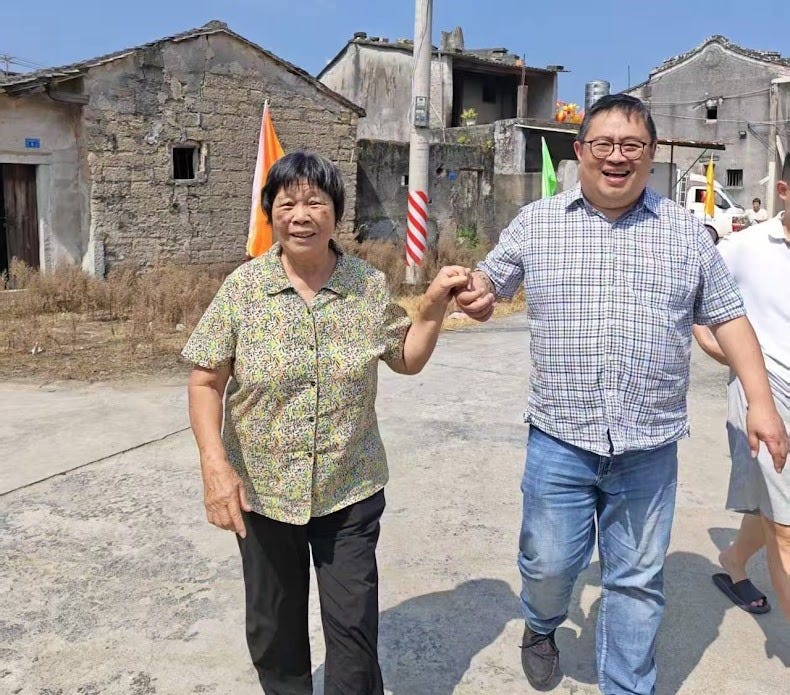
My niece, the mother of one of my nephews, took my hand and held it as we walked towards the old house that my grandfather built in the 1920s.
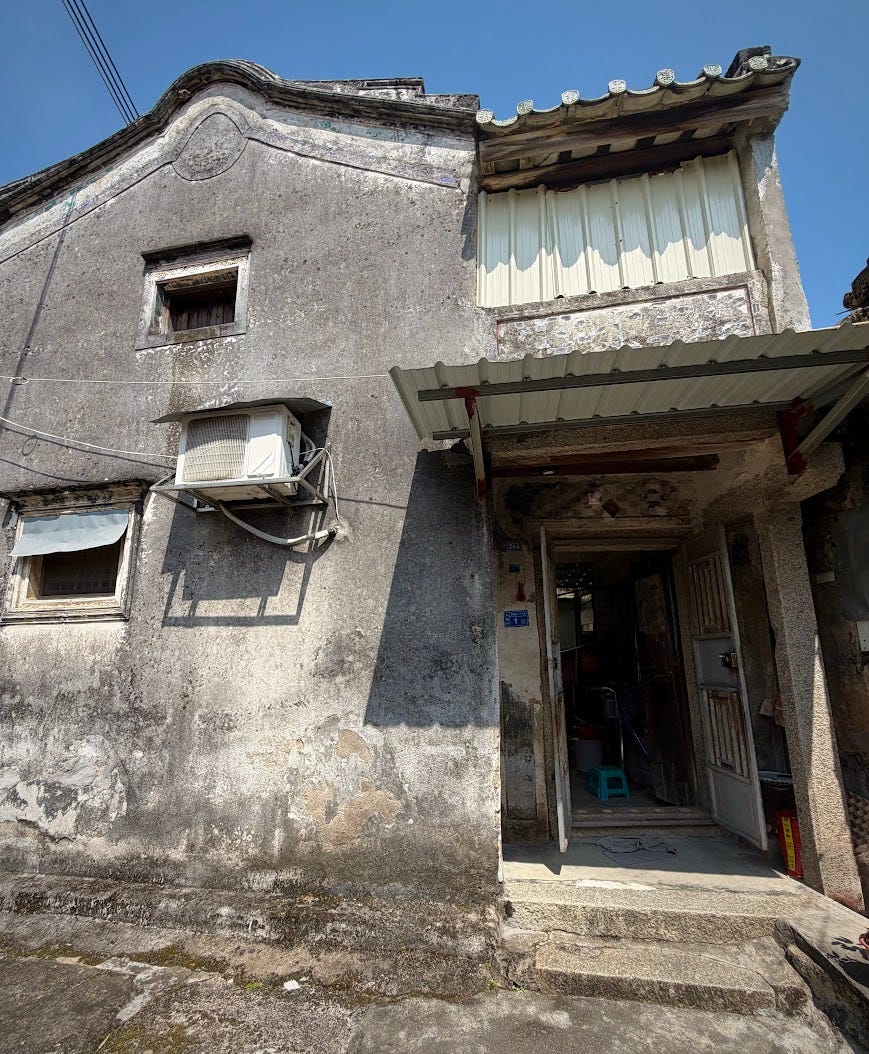
A quick count that day put our family at more than 200 people. Most no longer live in the village. They work in Shenzhen and Guangzhou, in Fuzhou and Xiamen across the border in Fujian, and further afield.
How Teacher Chen found my father
When my letter reached the village secretary, he passed it to Teacher Chen, a retired schoolteacher who knows the lineage history better than almost anyone in Mashuo. Teacher Chen gathered a committee of village elders. Together, they pored over the 族谱, surveyed the graveyards, and questioned the village’s oldest people.
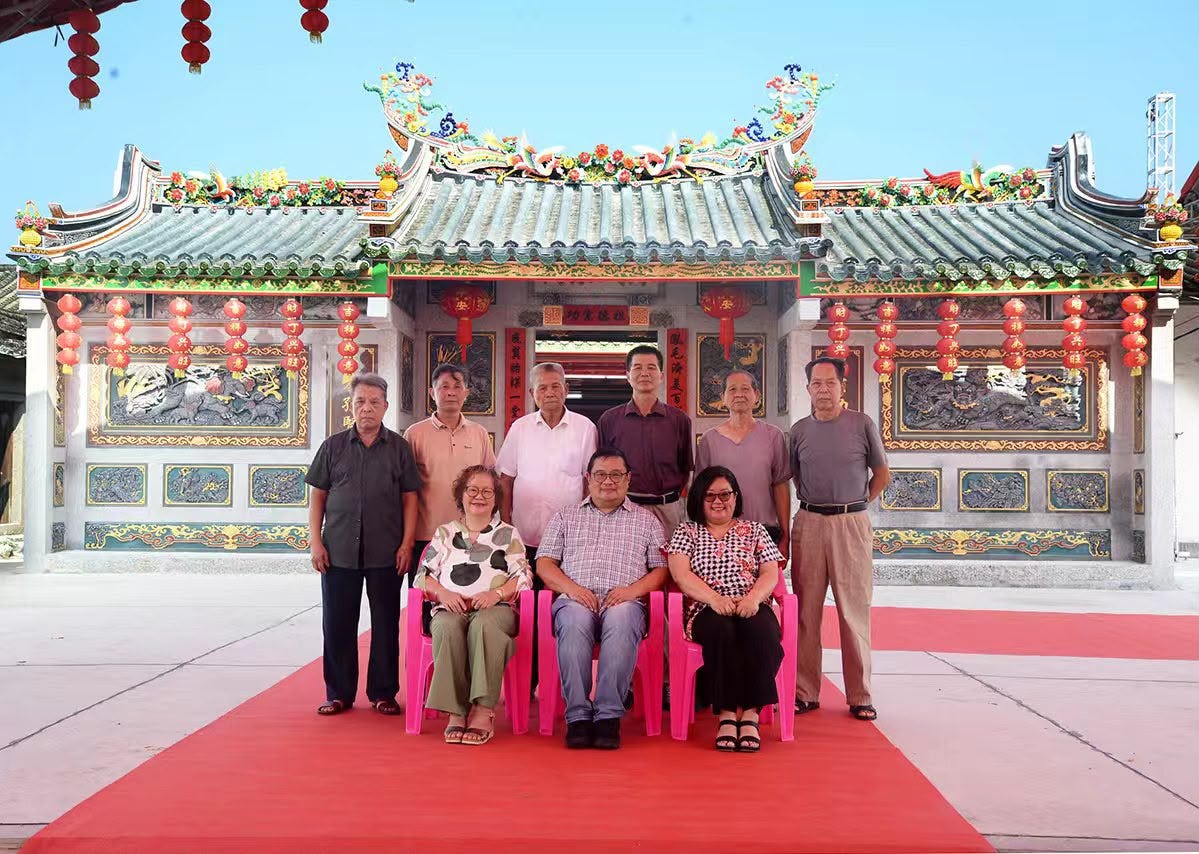
My father was born in Mashuo, so he should have been in the register. At first they couldn’t find him.
The problem was Chinese names. At home my father was 林宝, and in Singapore he was Lim Poh. The register lists him as 泽宝, his 谱名 (register name), which carries the character of his generation. My grandfather had even more names. In Singapore’s records, he was Tan Kee Lye. His real name was 陈启来, but I gave the secretary 陈奇来, a different character that also comes out as “Tan Kee Lye” in Teochew.
He practised medicine under the name 陈碧波. In the register, he is 陈惠勤.
That’s why Teacher Chen’s initial response was “None of the names you provided could be found in the family records…”
But Teacher Chen was persistent.
My visits to Mashuo in 2024 and 2025, before I knew anyone there, helped convince him I was genuine. “There’s no reason someone would visit our village from Australia twice,” he said, “unless he is genuinely looking for his family.”
Then there was a line in my letter. I mentioned that my grandfather sent money home to build a house, and Teacher Chen remembered. In the 1920s and 1930s, not many families in Mashuo built stone houses with money sent from Nanyang. He pulled out the name of every household that had.
He didn’t share the details I gave to the secretary. He went to those families one by one and asked:
Do you have any relatives overseas? Where? Most were from Siam (Thailand), it seems.
Do you know their names?
What was their trade/business back in those days? The majority were farmers.
My cousin answered:
Yes. I have an uncle in Singapore.
His name is 林宝 (Lim Poh)
They (my grandfather) made medicinal plasters.
Teacher Chen went back to that family’s pages in the register, and my father’s name was recorded as the fifth son. Everything else in my letter matched.
He called me at 10.33 pm on Saturday, 15 August, 2026. “Mr Chen! We found it!”
(Teacher Chen’s last resort, after discussing with the village secretary, was to have me do a DNA test in China.)
We go way, way back
According to the register, our line begins with 陈泰初 (Chen Taichu), who founded the old walled village of Yuhu (渔湖旧寨, once called 古家洋) in 1098. That was during the Northern Song dynasty, about four decades after 欧阳修 and 苏洵 set down the genealogy formats I wrote about last month.
That’s more than 900 years ago.
From there, the family moved slowly across Chaoshan. In the second generation, a third son, 陈承凤 (Chen Chengfeng), founded a branch at Fengtang (凤塘) in Chaozhou. In the fifteenth generation, a branch was founded at Guxiang (古巷). In the sixteenth generation, 陈奕鼎 (Chen Yiding) moved again and founded a branch in Mashuo.
Counting from 陈泰初, my grandfather is the 24th generation, my father the 25th, and I am the 26th in the clan. In Mashuo, I am the 11th.
A correction. Last month I put my father in the 24th generation and dated the founder to the late Yuan or early Ming. I was a generation out, and about 250 years late.
For most of my life, our family history began in Singapore around 1929. Now it runs back 26 generations to 1098. Mind-boggling.
My father was a shy, honest man. An introvert. The hard life he had made him fatalistic about many things. He was not the most confident or optimistic person I know.
I often wonder what this knowledge would have done for him. He grew up believing his family was small: his parents died in his teens, and he had two sisters. Would he have been more sure of himself, knowing he had another brother in Mashuo who spoke often of him? An extended family of many generations? A clan whose first ancestor reaches back to 1098? Would he have been proud of where he came from?
I think about my sons too. They grew up in Australia. The only other family they know is in Singapore, and the distance grows with each passing year. Now I want them to know they belong to a family of more than 200 people, and a clan with nine centuries of recorded history.
There is a couplet attributed to Mao Zedong:
掌上千秋史,胸中百万兵
Hold a thousand autumns of history in your palm, and you carry a million soldiers in your heart.
A thousand autumns in the palm of my hand is what the register gave me: a place in a line of people that runs back to 1098. The confidence it brings is a quiet assurance. It’s knowing where I stand in time. My father never had that. My sons can now.