

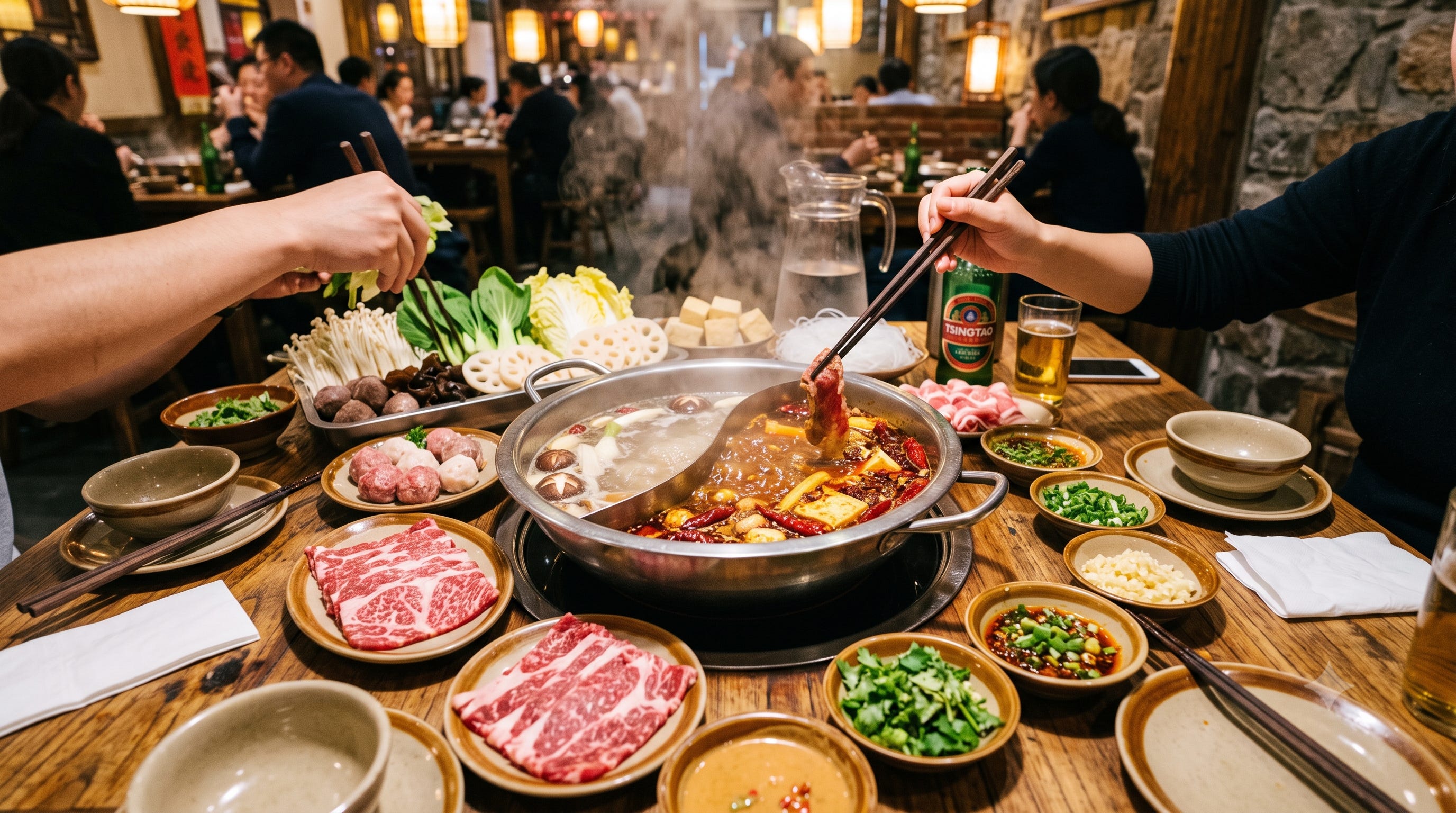
Growing up in Singapore in the 1970s, hotpot meant the Teochew version of a mild, clear chicken/pork broth. You put in your ingredients, cook them immediately, and eat them with a mild soy sauce and a bit of sesame oil. The whole point was to taste the quality of the ingredient that went into it. Fresh fish, slices of pork and chicken, and handmade fishballs. If the broth was clean and non-intrusive, everything tasted of itself. Clarity was the dish’s philosophy.
About a decade ago, something from Chongqing arrived and upended everything for those of us used to a milder approach.
Mala hotpot originated in Sichuan, spread across China, and then went global. In Adelaide, restaurants opened for homesick Chinese students. In Singapore, many said mala spots crowded out local Chinese food. I watched, suspicious as someone who identifies as Chinese but finds this cuisine genuinely uncomfortable.
I don’t really like mala hotpot. The heat is relentless. The numbing is disorienting. It overwhelms rather than reveals. You can’t taste the freshness (鲜) of the ingredients. Everything I loved about childhood hotpot seems to contradict everything I love about mala.
And yet, every now and then, I find myself craving it despite my reservations.
Part of this shift may come from my family. My elder son, who grew up here in Australia and has no memory of Singapore hotpot, loves mala completely. He will order it every time, and eat through the heat with the contentment of someone who knows exactly what he’s doing.
So, over time, I’ve tried to understand what this dish is actually doing to us, especially from a cook’s perspective.
The Mystery of the Sichuan Peppercorn
The Sichuan peppercorn is not really a pepper. It shares a botanical family with the orange and the lemon, and nothing at all with chilli or with the black pepper in your grinder. The kinship is close enough that, for nearly 40 years, America banned the import of Sichuan peppercorns, afraid they’d carry a disease that attacks citrus groves.
The numbing compound in Sichuan peppercorns works differently from chilli. Chilli tricks your mouth into feeling on fire. Sichuan pepper tells your mouth it’s vibrating, a gentle electric current across lips and tongue, like a 9V battery we all put on our tongue as children. That’s ma. The numbness is its own sensation.
The la, the chilli heat, comes behind it. And because your mouth has already been altered, the heat feels different from just using chillis. The two sensations don’t cancel each other. They kinda collaborate, like a dance. Hence mala.
What mala produces is “complementary contrast”. The numbing sets up the heat. The heat builds until you stop eating, put down your chopsticks, and breathe. Take a sip of cold beer. In that moment of relief, something happens. The absence of sensation feels strangely extraordinary. Better, somehow, than if you’d never felt anything at all.
There’s a concept in Chinese painting called liubai, of “leaving the white”. The deliberate blank space in a composition makes everything around it more vivid. The unpainted sky makes the mountain more real. In Chinese aesthetics, emptiness is active. What you leave out intensifies what you put in.
Mala is like liubai applied to eating. The numbing is the white space. The flavour within it is enhanced.
The Tao of Hotpot and Horror Movies
Laozi said something about this. Chapter 22 of the Tao Te Ching opens with a paradox: yield and be preserved whole. Bend and become straight. The thread running through Daoist thought is that going through difficulty, rather than around it, is the only way to arrive somewhere real. You don’t fight the heat of mala. You surrender to it. What’s on the other side is only reachable because you went through it.
Maybe this is why we love horror movies. The comparison is less strange than it sounds. When you watch a horror movie, your body responds as if what you see is real. Your heart rate accelerates, your palms sweat, something in your nervous system treats the threat as genuine even as another part of you knows you’re sitting safely in a cinema. The pleasure isn’t just being afraid. It’s knowing that the fear will eventually end. The completion of the cycle.
Eating mala, perhaps, works the same way. Your body treats the heat and numbing as a kind of genuine assault. You stop, breathe, and relief arrives. Then, almost immediately, you reach for more.
Psychologists call this benign masochism. The deliberate seeking of controlled discomfort for the pleasure that follows. Humans appear to be the only species that does this. We ride rollercoasters. We watch horror movies. We eat mala hotpot.
Most intense flavours have to be learned. Fermented fish, bitter melon, the funk of aged cheese, durian, the stink of smelly tofu: You need familiarity before it turns from repellent to delicious. Mala is a bit like that, too.
But Mala carries something the others don’t. Underneath the acquired flavour sits a strange kind of reward. A pleasure, even. The chilli burn triggers an endorphin rush, the body’s own relief flooding in behind the heat. This fires in everyone, from the first bowl to the thousandth, from Chongqing to Adelaide. Durian gives you only the pleasure you learned to expect. Mala gives you that, and a chemical payoff underneath it that you can’t refuse. That is what carried an obscure regional dish around the world in a decade.
Sichuan sits in a deep, humid basin. In traditional Chinese medicine, damp climates call for hot, pungent foods: dishes that generate warmth and expel cold, moist energy accumulated in the body. Mala was a local answer to a local problem. The physiology, however, is universal.
Which brings me back to winter in Adelaide, and a craving I can’t get rid of.
My childhood hotpot experience was about cultural identity. The taste memory and clarity of the broth are what I crave. Mala is about something else entirely: discomfort, contrast, the relief that only the pain makes possible. We didn’t inherit this dish. It found us by a strange route. And despite my resistance, I’ll order it again, and again, and again.
The Basement: Building Your Own Mala Base
If you’ve read my hotpot piece, you know I’m lazy about stock. Packet-based, butane stove, dish-washer finish. For mala hotpot, there’s a whole range of pre-packs that will do the job: Haidilao, Xiaolongkan, Dezhuang. Most are good. Some are very good. If you just want mala on a Tuesday night in July, buy a packet and skip the rest of this.
But a pre-pack is almost always a suspicion. Build your own base once, and you’ll understand what mala actually is. After that, you read the back of the packet to see if that’s what you want to serve up.
What follows is a working framework, not a rigid recipe. Chinese cooking is forgiving, and mala especially so. Cook by smell and taste as you go along.
The two things that make it mala
Everything else is supplementary, if you like.
Dried chillies. Dried chillies. We use two kinds to do two jobs. Er jing tiao for fragrance, colour, and a moderate heat. “Facing Heaven” chillies (chao tian jiao) for a sharper bite. A good handful of each. Snip them, soak them in just-boiled water for fifteen minutes to soften and smooth the heat, then drain. Shake out some seeds if you want it gentler. The seeds carry harshness, not flavour.
Substitutions. The two-chilli logic works like this. For the er jing tiao, the fragrant red one, reach for coarse Korean gochugaru or whole dried Kashmiri chillies. Both give that deep red and gentle warmth without the heat running away from you. For the facing-heaven, any small hot dried chilli will do: Thai bird’s eye or dried árbol. Soak whole dried chillies to reconstitute them, but if you’re using flakes like gochugaru, add them to the oil with the heat off so they do not burn. Avoid generic Indian chilli powder. It’s usually too fine and too hot, which makes the base bitter and cloudy.
Complete recipe and instructions for paid subscribers…
